Do You Want Coronavirus to Go Away?

Do You Want Coronavirus to Go Away?

Adapted from a sermon by Fr Mark Basily


John 5:1-18

Take a moment to think about this question – do you want coronavirus to go away? You may be thinking, “what a silly question, of course we want it to go away. Isn’t it obvious?”

We witness a scene of devastation in the gospel reading of the paralytic man; similar to what we see in the world today. St John describes it as, “a great multitude of sick people, blind, lame, paralyzed” (Jonh 5:3). They’re all lying there by a pool which is situated next to the gate.

The gate was the sheep gate where the sheep would enter on the way to be slaughtered for the Passover. By the gate was a pool so that they could be washed before they were taken to the Temple for slaughter. Because there was a direct link between the pool and the Temple, it was considered to be holy water.

The people thought they would be healed when it was stirred and given power.

We have a scene set around a multitude of sick people but then the story hones in on one person, a man paralysed for 38 years. He was probably in the worst state, all the more reason for Christ to focus on him.

Christ approaches him, a man that had been paralysed for 38 years, and asks him a question; “do you want to be made well?”

What a silly question, of course he wants to be made well. Why ask a question like that?

The gospels are not just historical stories or events, the gospel is for our lives. Our own personal encounters with Christ. The gospel takes these stories and puts them in the midst of our lives. So the question we can take from this is – do you want coronavirus to go away? This is the question that Christ asks the paralytic man.

We know that Christ would not ask a silly question. Everything He did had a profound purpose. Why did Christ ask this question?

When I was ordained a priest, I had to go to Egypt for my ordination. When I arrived in Egypt, I met Anba Bakhomious just before the liturgy began for the ordination and he looked me in eyes and asked, “are you prepared to be a priest?”

I replied, “Yes, Your Grace, by your prayers.”

He raised his voice and asked again, “are you prepared to be a priest?”

Again I said, “umm yes, by your prayers.”

Then he became visibly angry and he shouted, “Are you prepared to be a priest? Yes or no?”

So I said, “yes.”

And he replied, “good.”

It seemed like an obvious question. I’ve resigned, I’m here, I travelled from Australia to Egypt, so I was prepared. But he was asking in the sense of – Do you realise the consequence of what you are entering?

Do you realise what will be required of you?

Do you realise the sacrifices necessary?

Do you realise that you will lay down your life to others?

Do you realise what you are embarking on?

Are you ready?

It is for that reason that Christ asks the question, “do you want to be made well?”

Are you ready to be made well? No longer will you lie here. No longer will you rely on others to feed you. Are you ready to stand, to walk to carry your bed, to work? Are you ready for the consequences and responsibilities of healing?

The climax is when Christ finds him again and says, “See, you have been made well. Sin no more, lest a worse thing come upon you.”

We see the link that Christ puts between disease and sin. It’s not clear whether this man’s sin led to his disease or if it were the other way around. What is clear is that there was a link between disease and sin and part of his physical healing was to sin no more, and restore his spiritual health.

“For since for the most part when the soul is diseased we feel no pain, if the body receive though but a little hurt, we use every exertion to free it from infirmity, because we are sensible of the infirmity, therefore God oftentimes punishes the body for the transgressions of the soul, so that by means of the scourging of the inferior part, the better part also may receive some healing.”

St John Chrysostom

Christ after healing the paralytic finds him again so that he can complete the healing, the spiritual healing. In the NKJV, we read, “see you have been made well.” In the other translations, it reads, “see you have been made whole.”

You are now complete, physically and spiritually whole. We see the ultimate responsibility of healing – repentance.

Do you want coronavirus to go away? There are many ways that the world is responding to coronavirus; social distancing, closures, lockdowns, self-isolation, closing borders. They’re all good measures.

Other measures include prayer. Even the prime minister said his prayer knees were getting a good workout. There is another measure beyond this that some people are putting in place. I believe this is the most effective measure. The measure of repentance. Do you want to be made well? Do you want coronavirus to go away? Let us repent. Let us sin no more. If God sees us all repenting what would He do?

“If my people, which are called by my name, shall humble themselves, and pray, and seek my face, and turn from their wicked ways; then will I hear from heaven, and will forgive their sin, and will heal their land.”

2 Chronicles 7:14

We implore God’s mercy to heal our land, to heal our world by giving Him our repentance.

The scariest thing about corona is that our actions affect everybody else. If we are infected and we don’t self-isolate, it effects everyone around us through the ripple effect. Our actions affect others. If a virus can do that, repentance can do the same, more even. My repentance has a ripple effect on the world and on God’s heart.

What did I do?

What did I do?

by Marcus Mikhail


What did I do, Lord to deserve Your grace?

To earn Your favour and know that You are preparing a resting place

What did I do, Lord? I’m so undeserving

But thanks to Your Son, You have made me worthy and given me Your word unswerving


What did I do, Lord to deserve Your love;

That You would shower me with gifts from above?

I love You, Lord because You loved me first I cannot contain it,

I feel like I will burst!


What did I do, Lord to deserve Your salvation?

To be in an everlasting relationship with You because of Your incarnation

As the deer pants for the water, so my soul longs after You

You love me so much dear Lord, nothing can undo


What did I do Lord to deserve your heavenly gifts?

Even though I’m prone to wander and my love for You drifts

My cup runs over; it’s truly amazing

To see my life unfold with Your special blessing


What did I do, Lord to deserve Your protection?

You are our shield, our defender because of Your affection

You care about us so much indeed this is true

No wonder You asked us to cast our cares upon You


Your word is so powerful sharper than any double-edged sword

We understand Your mind through it; it draws us closer to thee, sweet Lord

It has the power to change us, to mould us into the image of Your Son

It lifts us up when we feel like we are overrun


In prayer, we praise and thank You and put before You our hearts desire

It brings us closer to You and sets our hearts on fire

We can come to You at any place and at any time

You are always listening to us and Your presence makes us shine


You are so faithful, Lord; Your promises have never failed

Even when I was the one who bailed

Time and time again you have proven your faithfulness

You’ve helped me throughout my whole life in failure and success


Help me to hold onto You, You are worthy of all glory and praise

Draw us closer to you so we are in tune with you always

I truly don’t deserve You, Lord

I’ve failed You time and again

But with You I have nothing to lose and all to gain 

The Poor in Spirit

The Beatitudes Series: Part 1

Blessed are the poor in Spirit for theirs is the Kingdom of Heaven

by Karin Zaki


The beatitudes. We read them in Matthew 5 and pray them in the 6th hour of the Agpeya, but what do they actually mean to me? How do I become poor in spirit?

Let’s start off by defining the term ‘Beatitude.’ It comes from a Greek word ‘makariotita’ meaning blessedness. St Gregory of Nyssa teaches that,

“beatitude is a possession of all things held to be good, from which nothing is absent that a good desire may want.”

Now let’s explain the setting. In Matthew 5, Jesus is giving a sermon on the mountain presenting the life principles necessary to achieve a perfect Christian life. Rather than starting with a list of ‘do’s and don’ts,’ He begins to attract the people to the righteous way of living by revealing their eternal rewards. St Augustine says,

“As long as we love to see the rewards, we have to continue the struggle to attain them. Let us be kindled in our eager work to obtain them.”

So what does ‘poor in spirit’ actually mean?

Usually the poor have nothing of their own and constantly ask for assistance/aid. They are not ashamed to admit that they receive their simple sources of sustenance as gifts from others. Similarly, the poor in spirit have nothing of their own, God gifts all their talents, family, friends, community and spiritual/earthly wealth. It is when one comes to the realisation that without God, they are nothing. Simply put, it is to be, ‘humble and contrite in heart’ (St John Chrysostom).

We all know that the beginning of all sin is pride, acting according to our own personal will with complete disregard to God’s will, as Timothy says, “lest being puffed up with pride he fall into the same condemnation as the devil.” (1 Tim 3:6)

Logically, the opposite of pride is humility, so why then use the term ‘poor in spirit’ and not ‘humble in spirit?’

St John Chrysostom in his Homily, beautifully explains that the term ‘poor’ means “awestruck, and tremble at the commandments of God,” as Isaiah states in chapter 66 verse 2, “But on this one will I look: On him who is poor and of a contrite spirit, And who trembles at My word.” St John then goes to explain two types of humility; humility according to one’s own measure and humility with all “excess of lowliness.” The perfect example of this is the story of the Pharisee and the tax collector in Luke 18:10-14. Here St Luke pictures a man (the Pharisee) who is pleased with himself for complying by what he thinks are the ‘requirements’ of religion. He is proud of himself and humble in his own eyes only. Sadly, he has falsified what it means to be religious. He has reduced the understanding of a spiritual relationship with God to a mere checklist of external ‘religious’ actions, such as the amount of riches he gives to the temple, as a measure of his piety. On the other hand, the tax collector displays genuine humility and it is this act of “excess of lowliness” that justifies him before God. This second type is that which develops into spiritual poverty.

Unfortunately, the world we live in assumes that everyone can achieve anything by themselves and even portrays God as a gift bearer for one’s good deeds. Contrarily, display of humility be it in individual, communal or corporate situations is seen as a sign of weakness and a hindrance to reaching your maximum potential. In that way, we live in a society that constantly instils self-glorification and a sense of pride in us. It is therefore essential to always give thanks to God “on every occasion, in every condition and for all things,” for thanksgiving is the first step to humility since it is the realisation that all I do/don’t have is from God.

From an engineering perspective, the spirit is like a high-rise building. To reach the heavens, this building will need to be quite high and so would require a very deep and heavy foundation set in stable rock. This foundation is modesty and submission. If this modesty was taken away, despite how high the spiritual building has been built, it will collapse with quite deplorable consequences. This is captured in Proverbs 24:27 where it says, “Prepare your outside work, make it fit for yourself in the field; and afterward build your house.” That is, first you need to prepare your ‘field’ by admitting your sense of pride and with prayer, earnestly working to thank God in all things submitting to His will. It is only when thanksgiving and humility in submission become an instinct to every situation, that your poverty in spirit continues to rise till it attains the kingdom of Heaven.

Glory be to God. Amen

The Absolute Truth

The Absolute Truth

by Daniel Rafla


One of the most sought-after objects in the world, the most desirable form of knowledge. Truth. Humanity itself revolves around what is true – in friendship, love, success, happiness, strength, etc. You could literally qualify the highest level of attaining any one concept or virtue by referring to it as true. Pontius Pilate himself upon questioning the Lord Christ

“Pilate therefore said to Him, “Are You a king then?” Jesus answered, “You say rightly that I am a king. For this cause I was born, and for this cause I have come into the world, that I should bear witness to the truth. Everyone who is of the truth hears My voice.” Pilate said to Him, “What is truth?” ” John 18:37-38

Winston Churchill comments, “The truth is incontrovertible. Malice may attack it, ignorance may deride it, but in the end, there it is.” (Churchill, 1916) Yet no one has ever quite been capable of summing up the mere impact of the truth better than the words of Christ,

“ ‘Then you will know the truth, and the truth will set you free.’ ” (John 8:32)

This appears to be a fairly universally known quote, and it can be commonly found in film, music and books. We ourselves, in order to teach the importance of the truth to children, refer to this one verse constantly, that we can create a definitive link between the truth and peace. The irony is that the true impact of truth is itself difficult to measure, and difficult to quantify. That said, I wonder – if the impact of the true means of something is to an individual seeking it can be immeasurable, then what if we were to consider the absolute truth.

The word absolute is rooted from the Latin word Absolutus meaning freed and unrestricted, however the modern understanding of the word is that it is all encompassing, that something being absolute becomes the measure of the thing it contains. Consider for a moment the mathematical symbol of absolute     |X|

I want you to now begin to visualise the way in which these two bars actually not only surround that “X” but they are the literal boundary that contains and transforms whatever is inside of it to a positive number.

Now into the rabbit hole we go, as I now begin to delve into an absolute truth that I’ve meditated over during the period of the Great Lent and even into the Holy week of Pascha, rather He who is the absolute truth, Jesus. There can be found no better summary, nor better wording than what He did speak on when He said, “I am the Way, the Truth and the Life.” When Pilate asked his question, he did not know that He was speaking to the answer, though I feel that there is many complications around why He said that, especially as He was responding to Thomas asking Him about the things to come, I will however choose to focus on why He referred to Himself as the truth. As I have said above, truth is something we all seek in various aspects of life – things which we can know that Christ has perfected in His life on Earth. Furthermore, we know that in Christ we have life, and that anyone who places themselves in Christ, and allows God to surround them, transformation to their positive form is attained. No matter the value within the absolute bars, it is transformed. Likewise, when Christ envelops any one person, you can be assured that this person, no matter how great or small, will certainly find themselves in the light, no matter how dark they previously were.

Brothers and sisters, the impact of absolute truth is that it is transformative, for the absolute truth is Christ Himself.

The Gift of Failure

The Gift of Failure

 By Monica

Original post by Becoming Fully Alive blogsite


Six years.

“You’ve worked so hard.”

“You deserve it, God will bless you.”

“Do your best and God will do the rest.”

I have been here, untangling the knots. Untangling the idea that God’s love means He will carry you to every success. Shaking off every ‘I can do all things through Christ who strengthens me.’

I write to you today in the knowledge that, God loved me so much that He let me fail. The struggle from bitter to better, from self-deprecation to self-compassion, that is leading me through a journey of acceptance, so that the image, or who I ought to be, can greet who I really am.

To acquire the mind of Christ means to learn to see myself as He sees me. Sometimes, we think that if we beat our chests hard enough, if we beat ourselves hard enough, it will make us humble. But the truth is the opposite. The truth is, real humility is recognising who we really are. It is the courage to hear a greater Voice call us His beloved, His successful sons and daughters.

Failure has been a gift; a very revealing gift. Acquiring the mind of Christ means recognising in the mirror the person who met their suffering with bitterness and despair. I had read many spiritual books about suffering, that I expected to wake up joyful the next morning. But this is no synaxarium story.

I found that, I was not all who I thought I was, “Then we will no longer be infants tossed back and forth by the waves, and blown here and there by every wind” Ephesians 41:4, and that I was literally tossed by this wind.

So, failure has been a door, a door of repentance, so that He can recreate me from the ashes of this fire.

“we must lay before Him what is in us, not what we ought to be in us”- C.S Lewis

 Failure helps us shake off the veil of perfection, that we may stand honestly before Him. Failure allows us to grow in compassion for ourselves and for others who are struggling; because we remember how hard things have been for us.

“Joseph was with God and he was successful” has never rang so true, because often we focus on the gift not the gift-Giver. In the story of the wedding of Canaan we rejoice at the new wine, but we completely miss that in providing the wine, Christ was declaring Himself the Bridegroom, fulfilling the messianic prophesies in Hosea, Songs of Solomon and Isaiah.

If I have the courage to see myself, I will learn to recognise Him in me. If I have the courage to relentlessly stay with Him, to not run from Him, that makes me successful.


Original blog found at – http://becomingfullyalive.com/the-gift-of-failure/


Does God Care?

Does God Care?

By Demiana Salib


Does God really care about me – what coronavirus will do to my life? If coronavirus has put my education or career on hold? One answer to this would be no, salvation is what matters and for as long as I get there, it doesn’t matter how I got there. God only cares about my salvation, true? No, and this is the most insulting line of thought we, as humans, have ever conjured.

I have never really understood the parable of the unjust steward (Matthew 6:26-34) but the final message is nice – “He who is faithful in what is least is faithful also in much,” so I’m generally happy to overlook the parable, but nothing our Lord said can be ignorantly overlooked.

Imagine a servant that devoted so much time and effort into the church. Anything that needed to be done, they could do, and in record time, too. But they would go home completely exhausted to the extent that they didn’t have time to pray. They did good, their actions were good, their intentions were good, but they didn’t have a personal relationship with God.

In unusual circumstances, their services began to be taken away from them. They had nothing left. In their distress, they consulted their father of confession;

“Why isn’t He letting me serve, and I know I need to pray, but I was doing good!”

Their father of confession replied, “He’s not letting you serve until you pray. He loves you very much and you need to see that first, spend this time in prayer.”

Could this servant be our modern day unjust steward? If I continually serve but do not pray, am I wasting my Master’s goods? When God asks me to give an account for my stewardship, how will I answer Him? Will it be, “God I spoke to you daily, you were a part of every aspect of my life.” Or will I struggle to even recognise Him?

Jesus spoke this parable to the Pharisees that judged Him for His love for sinners. For they knew the law, they knew how to appear before the people. They thought they could steal the Kingdom in the same way they fooled the people into believing that they were the most righteous of all men. With the recent closure of many churches worldwide, we are faced with a similar reality check. Is my relationship with God based on a fulfillment of commandments and services of the church, or is there more?

Our relationship with God runs so much deeper than set church services and just doing good. Our modern servant did good, but I can’t even guarantee that my outward display comes close to this. I read this parable and get lost at the unjust steward that went to his master’s debtors and told the one that owed 100 measures of oil to give back 50 and to the one that owed 100 measures of wheat to give back 80. This is not good, it’s deceitful and he’s not getting back what his master was owed. Why does the master commend his shrewdness? I feel like he was just digging his own hole deeper out of desperation.

Instead of reading this as an outsider, I need to read it as if I were the unjust steward. My church has been taken away and I need God, so I need to find another way to love and serve Him. For the unjust steward, the thought of his stewardship being taken away from him was the wake-up call he needed to work and act differently because he could not the face the loss. I will do whatever it takes to give back to my God what He is owed. If I can’t spend time with Him in church, I will try to make up for it at home, even if I think it will not measure up.

It is no longer a matter of, “Does God care?” but “God, I need You to care,” and He does; “Look at the birds of the air, for they neither sow nor reap nor gather into barns; yet your heavenly Father feeds them. Are you not of more value than they?” (Matthew 6:26)

If I think that God does not care about me, that is not a reflection of Him, but a reflection of me. While I am caught up in life, He is still caught up in me, if there is any consolation to coronavirus, it is the time it has forced me to spend with my Beloved. The ones that love you are the ones that gets excited by what makes you excited, the ones that are sad when you are sad, the ones that are happy when you are happy. How could you ever question that your loved ones cared about you? God is greater than these! If I go to work, come home – a standard day, but it is all I can offer in conversation, God wants to hear it, He wants to know how my day went, He cares about  all the little things.

Whenever I have thought that God doesn’t care, I can’t recall ever asking Him honestly for His opinion. If my prayers are surrounded on one external factor, He will respond kindly; “My grace is sufficient for you, do not worry.” If it causes sadness, grief, anguish, distress, then He will shift my focus to the eternal. If I want Him just as Saviour from this world that causes me pain, then I won’t see His concern for the little things.

But God starts small, He is faithful in the little, if you want Him as Father, Friend, Biggest Fan, He will be all those things, too. He loves you with an everlasting love and will do anything to have a meaningful relationship with you.

Once we have daily and meaningful conversation with Him, everything is in His Hands without question. And then we can truly say when faced with this larger scale pandemic, “He who is faithful in what is least is faithful also in much.” There may be so many things that are taken away from us, but we will do whatever it takes to keep building our relationship with God and serving those in need. We can’t have big answers to big questions if we don’t start small, start now, even if you feel there is no relationship and you’re starting out of the desperation. He does care and He will continue to work overtime until we see it. To any doubt that God cares about what is happening to our world, He responds,

“Can a woman forget her nursing child,

And not have compassion on the son of her womb?

Surely they may forget,

Yet I will not forget you.

See, I have inscribed you on the palms of My hands

– Isaiah 49:15-16.

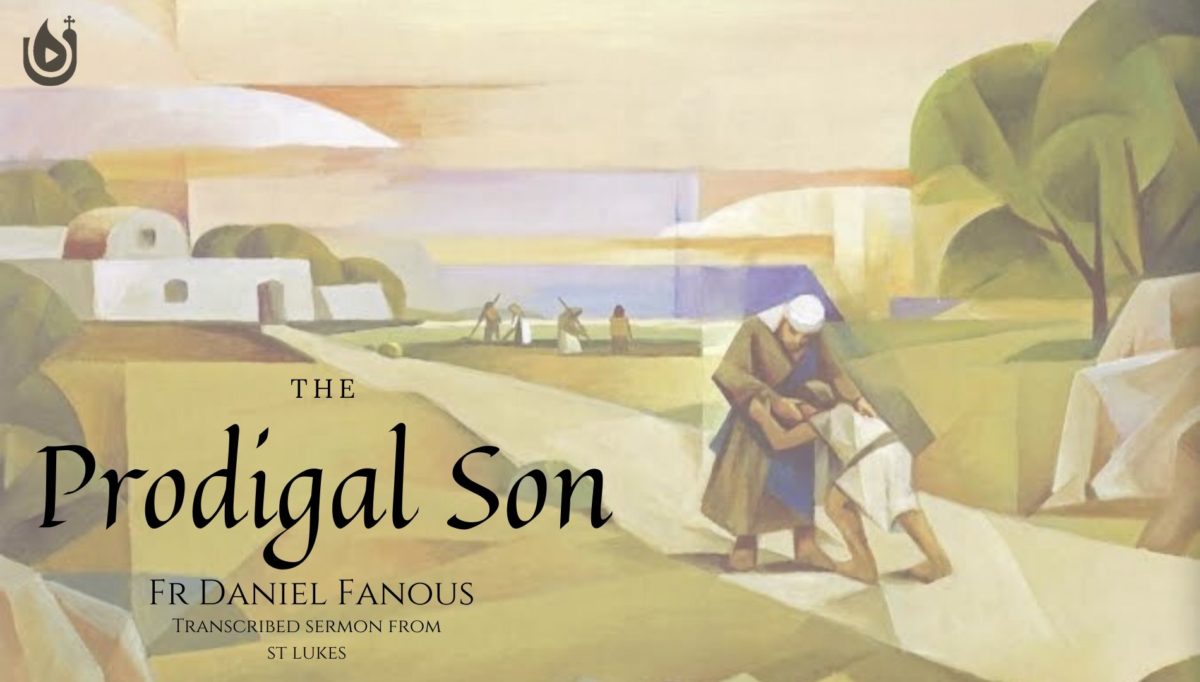
The Prodigal Son

The Prodigal Son

Adapted from a sermon by Fr Daniel Fanous


Luke 15

The prodigal son- the most beautiful of the parables. This parable came at a time when sinners were gathering around Christ. The Pharisees and Scribes were seeing this and thought to themselves, “this Man gathers sinners together and eats and drinks with them.”

Every word that follows is in response to their judgement. The son comes to the father and asks for his inheritance. The father does not say no, nor does he try to challenge him. He respects his freedom entirely. He not only gave away the inheritance that his son asked for but he allowed him to sell his inheritance.

In the Jewish Michener – one of the writings of the Rabbis on the interpretation of the law – it was permissible to give a child their inheritance before the father passed away, but never could you sell it before the father passed away. The son goes in haste, within days, and sells his entire inheritance. What shame this would have brought upon his father in the eyes of the entire community.

At the time that this happened, the prodigal son’s actions were the equivalent of him saying to his father, “I wish you were dead.” The son did the unthinkable, but we observe how the father reacted in complete respect for his freedom. Christ also demonstrates in this parable a completely different take on sin and sinners. The sin was not the mark of somebody that had made a mistake. It’s not a cross that was put against someone’s name. It was not a catalogue of sins that the sinner would have to account for, one by one. On the contrary, it was a broken relationship – moving away from the unity with God. The son humiliated the father, left him and went as far away as possible.

An old Jewish tradition was called the Kezazah shaming. When a Jewish person lost their inheritance to the Gentiles, they would be greeted with the Kezazah shaming upon their return to their village. The people would get pots and fill them with burnt corn and nuts and break these pots as the person returned to their village. While they did this, they would shout repeatedly, “you are cut off.” It was intended to be a deterrent so that a person would be extra careful with their family’s land.

The prodigal son knew the shame that would befall him if he returned because his immediate action was to tend to the pigs. Pigs were not a kosher food and would not be kept by Jews. The prodigal son must have been working for Gentiles as far away from his father’s home as possible.

And yet, the father never forgot the son; he remained watchful. Christ portrays the image of the father standing in the middle of the village square with his eyes fixated on the entrance. The prodigal son was the last of three parables Christ taught about the lost in response to the judgement of His dining with sinners. He starts with the good shepherd that lost one of his 100 sheep, the good woman that lost a coin and ends with the good father that lost his son. All three are symbols of Christ. The heroes of the parables are those that find the lost and rejoice.

The hero of the parable of the prodigal son is the father. Christ is telling us that He is the father, He is always watching and waiting for the son that has wasted his inheritance. We look at the son who became a herder of pigs whose only food was the food of the pigs. We read that he realises the state he is in and says,” I will arise and go to my father, and will say to him, “Father, I have sinned against heaven and before you, and I am no longer worthy to be called your son. Make me like one of your hired servants” (Luke 15:18-19). He doesn’t say, “I will go and be a slave,” but a, “paid servant.” He wants to go back and earn what he lost. He knows that the Kezazah shaming is what awaits him and he knows he has a lot to make up for. The son was not searching for mercy and repentance, his mind was not on the broken relationship but on the lost money. Christ was teaching us that no father truly care more about the money that was lost over the broken relationship with his son. Christ is saying to us, “When you sin, you haven’t lost My money, you haven’t discarded something of Mine but you have broken your relationship with Me.” This is what sin is.

The son returns to the father that has been waiting all along. The father who is Christ, the One who eats with sinners, who yearns to repair every broken relationship. The actions of the father depict Christ’s love for the sinner. The father runs to his son after waiting day after day for the son that has shamed him. We read, “But when he was still a great way off, his father saw him and had compassion, and ran and fell on his neck and kissed him” (Luke 15:20). He was inwardly moved with compassion. Christ is inwardly moved with compassion for every sinner that returns.

The father ran to his son, possibly to stop the Kezazah ceremony from even commencing. Running for a wealthy middle eastern man was shameful, they would never run in public. Yet, he ran, he humiliated himself for the sake of the son. He embraces and kisses the son before he could even open his mouth. This is Christ speaking to his children. This is Christ’s feeling for the sinner that returns in repentance. He embraces him even before he repents. The son could only manage the beginning of his speech – ‘Father, I have sinned against heaven and in your sight, and am no longer worthy to be called your son.’ Before he can say, “make me like one of your hired workers,” he stops. He doesn’t need to say those words, he doesn’t need to earn back his inheritance for his father that has accepted him back. The relationship is healed. The father embraces him and overlooks his weakness. This is Christ self-emptying for us – a son that has rejected Him and wasted his inheritance and come only because he was hungry, but Christ overwhelms us with His love.

Peter Chrysologus, Bishop of Ravenna in the 5th century says, “The father fell on his neck and kissed him. This is how the father judges and corrects his wayward son and gives him not beatings but kisses. The power of love overlooked the transgression. The father redeemed the sins of his son by his kiss and covered them by his embrace in order not to expose the crimes or humiliate the son. The father so healed the son’s wounds as not to leave a scar or a blemish upon him. Blessed are they whose iniquities are forgiven and his sins are covered.”

Not only does the father return the son to his original state, but he elevates him for joy for his son who was dead was now alive. This is the nature of who Christ is. He created us out of the super abundance of his love so that we could be with him and we could be united with Him.

Finally, we see how the older son complains after a hard day of labouring in the field to return back to the festivities for his brother. He says to the father, “these many years I have been serving you; I never transgressed your commandment at any time; and yet you never gave me a young goat, that I might make merry with my friends. But as soon as this son of yours came, who has devoured your livelihood with harlots, you killed the fatted calf for him’” (Luke 15:29-30).

Again, we see the nature of Christ when dealing with the older son. He pleads with him to return, gently encouraging him to share his compassion. He doesn’t condemn him for being judgmental nor scold him. He gently pleads that he becomes more like him, and share in his joy to have his son back. Christ calls us to love the way He loves. To seek the healing of our brothers and sisters and nothing else. All Christ wants is to shower us with His mercy. We were never just statistics of sin, but temples for His dwelling out of the super abundance of His love.

When they accused Christ of eating with His sinners, this is how He responded to show Himself as the father, sinners as the younger son and those that condemned Him as the older son. St Isaac the Syrian says, “among all of God’s actions, there is none which is not entirely a matter of mercy love and compassion.”

God is not waiting to pass or fail us depending on our actions. He waits to hear from us and to bring us to perfection. How then can we not turn him? How then can we not confess? How then can we not run team recognising that we have broken our relationship to him? Knowing that He is ready to forgive and heal us of all sin. May we all know who Christ is in the deepest recesses of our hearts.

You Crown the Year with Your Goodness

You Crown the Year with Your Goodness

by Marc Eskander


Lent is upon us! A time for being alone, purifying ourselves, detaching from the world, burning away all that is unnecessary, and striving toward victory over death. For every time, you have fasted half-heartedly, this is not the year for it, and it has nothing to do with your own spiritual life. In fact, it has nothing to do with being a Christian. For this year, a molecular particle is upon us. Coronavirus has flipped the world as we know it, upside down.

For those that strive for asceticism, coronavirus has half the world locked in their own homes under quarantine. For those that wanted to eat out less often, coronavirus has made eating out next to impossible. For those that do not want to live so apathetically anymore, coronavirus provides the cure. We are constantly ensuring we remain safe, and not just for our own sakes, but for those we may harm.

Whether we like it or not, whether we are fasting or not, we are abstaining from things we love, and not by choice. Lent is the time of year that I should want to slow down, increase asceticism and prepare for the Passion of our Lord. Christ taught us how to detach from the world when He entered the Judean desert to fast and pray for 40 days and nights before His upcoming mission. Christ neither ate nor drank but fought for us, His children, in the wilderness. He starved the body so that He could feed the soul.

Every year, I promise myself that this Lent is going to be different. That I am going to benefit more this year. I’m going to repent of that sinful habit, repair that broken relationship, pray harder, eat less, read more – be more like Christ! Yet this year, I am forced to do all the things I have struggled to in the past. This is the year to capitalise on virtue and embrace the restrictions that befall me.

In years past, occasionally yes, I have tried and benefited from this period, other years it feels like all l did was change my diet, albeit I wasn’t even being that strict. Do I forget what the point of it all was? Fasting is a struggle – and I speak for myself first and foremost – so there needs to be a point. Christ taught us to fast so that we may, “walk in the Spirit, and you shall not fulfil the lusts of the flesh”(Galatians 5:16).

With the latest outbreak of coronavirus and the mass hysteria that surrounds it, I can’t help but look upon lent differently this year. I’m not suggesting that God sent coronavirus to teach us a lesson by any means, but I can’t help but reflect upon the timing. One verse in particular has me thinking…

“Blessed is the man who endures temptation; for when he has been approved, he will receive the crown of life which the Lord has promised to those who love Him.” – James 1:12

The link I see so clearly between Lent and coronavirus lies in this verse. While Lent is a time of fasting, prayer, and slowing down, these are the means not the goal.

It is the Resurrection…victory over death and sin; an everlasting Crown. The aim of Lent is repentance. It is victory. Not regret, guilt, shame, self-control, or a mere change of diet. But repentance. Metanoia. A change of heart. Before victory, comes death.

Lent, is the spiritual game changer if you let it be. Similarly, the coronavirus pandemic, is a game changer … but can we make it a spiritual game changer too? In this time, we can gain victory over sin – eternal life by putting to death our desires that chain us to this world. This is what coronavirus brings. We can’t be ignorant to the effects this pandemic will have on many of us – the reality of loneliness, isolation, greed, selfishness, fear of death, and an immense focus on hygiene and cleanliness.

If we shift our mindset to our inner selves, we soon see that we are asleep at the wheel and God is trying to wake us up. Lent is a time of exposing ourselves… Figuring out where we’re missing the mark. It’s a time to realign ourselves with the path of the Cross.

The loneliness and isolation we turn into a dwelling place for the Lord.

The greed and selfishness we turn into an acceptable fast of the Lord where we “share our bread with the hungry” and “bring to our house the poor who are cast out.”

The fear of death we turn into fear of God, strength in tribulation and opening our arms wide open to accept the Cross just as Christ did.

At a time when hygiene and cleanliness are paramount, are our hands clean of sin? Have we rushed to dirty our tongue with the words we speak? Have we clouded the eye of our body? Do we clean the outside while our soul lies among the “swine” as the prodigal son did?

During this time, we must remember Christ’s rebuke the the Pharisees; “Now you Pharisees make the outside of the cup and dish clean, but your inward part is full of greed and wickedness”(Luke 11:39. So it can’t be a mere coincidence. Use this as an opportunity to reflect and assess. Grab the broom and clean out the inner room of your heart.

Have our social gatherings become an opportunity for gossiping and bad mouthing others? Have we lost ourselves to the “practices” of our faith instead of the real essence of orthodoxy?  Have we lost the importance of fellowship and unity in service? Do we just assume because our youth “are in church” they’re okay? With so many churches in lockdown, we cannot allow our spiritual lives to be put on hold but we must strive to fill our inner lives in the secret place, for our Father who sees in secret will reward us openly (Matthew 6:4), especially in this time of uncertainty.

This period could be God’s way of saying,”Behold, the Bridegroom is coming; go out to meet Him” (Matthew 25:6). We must stop hoarding toilet paper and start filling our lamps with oil. Repentance is change, and change we must. The Bridegroom is coming to that guy that comes to church and leaves because He feels no love… He is coming to your friend stuck in that sin that is destroying them… He is coming to that girl in your class that is depressed and feels no one understands her. What are we doing to prepare them?

This is a wake up call! If we use it wisely, this Lent can become for us an opportunity to share in the immense Glory of the Resurrection. We too can experience the purification and change that Christ demonstrated for us in the wilderness. Through this isolation, doom, and darkness of our selfish human behaviour, our “healing shall spring forth speedily”, we “shall call, and the Lord will answer”, our “Light will break forth like the morning” (Isaiah 58:8).

The Pride of Life

The Pride of Life

Adapted from a sermon by Fr Samuel Fanous


Matthew 4:1-11

Today we have a perfect reading for us as we’re in Lent. Jesus was baptised in the Jordan and as soon as He came up out of the Jordan, the Holy Spirit came unto Him and this is immediately when He was led by the Spirit into the temple. If you think about Adam and Eve as the first humans who were tempted by sin in the Garden of Eden, they failed. These temptations are the lust of the flesh, the lust of the eyes, and the pride of life.

From the book of Genesis when Eve was tempted by sin, it says, “When the woman saw that the tree was good for food..” – this is the lust of the flesh, her hunger, “… and that it was pleasant to the eyes” – this is the lust of the eyes, “…and a tree desirable to make one wise” – this is the pride of life “…she took of its fruit and ate. She also gave to her husband with her, and he ate.” (Genesis 3:6)

Eve lusted out of hunger for the fruit. She looked at the fruit that was pleasant to the eye, and this was where the devil said I will make you ruler over everything, I will make you wise and she believed the devil. This was the pride of life. Adam and Eve represent all of humanity. Like us they sinned.

The first temptation is the lust of the flesh. It says the devil came to Jesus and gave him a stone after fasting for 40 days. Can you imagine not eating for 40 days? Eve looked at the stone that the devil gave to her and she saw that the stone was good as fruit. She was hungry and she desired it.

Oregon says the devil tries to convince us that this stone is bread and will nourish us. He tries to convince us that if you are well fed, if you have comfort, if you have sexual fulfilment, if you have everything you want in this world to satisfy your flesh, you will be satisfied. However, to you and to everyone it is just as good as a stone. It cannot satisfy us any more than a stone could satisfy anyone’s hunger.

The “bread” will provide a minute of enjoyment, a minute of satisfaction, but there is no lasting satisfaction with any of the lusts of the flesh. Christ teaches us how to overcome these lusts. He denied His body as soon as He was baptised. The second He was baptised, the battle began, and this is why, for most people, Christianity is too hard. It is too hard to fast, too hard to go to Church, too hard to pray and too hard to love unconditionally. So, most people take the easy way out. They don’t pray, they don’t fast, they don’t love unconditionally, they don’t come to church because it’s easy.

Jesus says that the easy way out will never satisfy you. What’s His response to the devil? He says “man shall not live by bread alone.” Our satisfaction will not come from bread but by every word that proceeds from the mouth of God.

The second temptation is the pride of life. That pride where in your heart you want to be like God, you want to have His authority. You think “I am my own God.” Satan convinced Eve that God didn’t want her to eat the fruit because if she did, she will have His power. Eve thought that was a pretty good deal. I eat this fruit and I become like God.

This is the pride where she wanted to become better than what she was created to be. Most of us want this in our lives. We want to live, ruling our own life and making our own decisions. How many of us live as if we are God, at least to ourselves and probably to those around us?

Everything in this world, everyone in this world exists for me. For what I want, for my comfort, my satisfaction and my achievement in life. It is very difficult to realise that you are proud until you have been humiliated.

When I’m humbled, when I’m embarrassed, when I’m disrespected, what happens? People will say that they’re not proud but watch when someone disrespects them publicly. What happens when someone is more successful than me or when someone is smarter than me. Do I feel anger and bitterness on the inside? Why is this person better looking than me? Why does everything good happen to this person and not to me? It’s my right. I should have it. We don’t realise it until we’re humbled and humiliated, we have no idea that we are filled with pride.

Everyone suffers from this to some extent – it is the basic human condition. Jesus, once again teaches us how to overcome. His death and His essence is so beyond our comprehension that we can’t even begin to fathom it, yet this same very God emptied Himself of all His glory and every right that He had, yet He had all the rights.

He was crucified, He was poor, He had nothing. If God emptied himself of His glory and humbled Himself, then we must. There is no disrespect, no humiliation, no embarrassment that could ever compare to what Christ has gone through.

When we hold a grudge, respond in hatred, act petty, with envy, with jealousy and cannot forgive, we are not acting to be God, we are making ourselves out to be far above God. When we are humbled, we apologise when we feel like we shouldn’t, we accept disrespect the same as you would respect. That is when you are behaving like God.

The last temptation is the lust of the eyes. The fruit was pleasant to the eyes and this is the human desire. I look at everyone around me and I want what they have. I’m never satisfied with what I have. This is the curse of Western civilisation. Jesus once again teaches us how to overcome this. He was baptised and immediately He fled to the desert to the wilderness. Saint Arsenius says, there’s one way to overcome this world. Flee, be silent, and be still.

Wealth, investments, and status are only attractive because we have nothing to compare it to. If we go to the wilderness, away from the noise and distractions and find God, we realise all of these things are counted as nothing. They’re relatively meaningless. It doesn’t mean we don’t work and try to achieve in all the things we do, but they have no hold over me.  If I have them, thanks be to God if I lose them. We have to recognise that there is nothing external that can satisfy me, only what is within.

Christ says “Behold, the kingdom of Heaven is within you.” It’s only what’s within me that can satisfy me. We are made in the image of God, in His likeness. If you want to find Christ, retreat to yourself. There you will find him.

Let’s focus on retreating into my inner deserts. Let’ take the opportunity to utilise that quiet. Retreat into your bedroom and find Christ there. If you go into your bedroom and open your heart before God, you will find the pearl of great price that Christ talks about. When you find the pearl of great price Christ says, you will sell everything you have to get that pearl.

Let’s overcome the temptations like Christ showed us by hungering from physical comfort. We are nourished by the word of God, which is Jesus Christ, by emptying ourselves of our pride, sacrificing ourselves and living for others and finally retreating into the wilderness, into the silence and stillness, to encounter God who is within me.


Where are You, Lord?

Where are You, Lord?

by Marcus Mikhail


Where are You, Lord, can’t You see I need You?

Where are You, Lord, I need You to be true.

True to your promises, true to your love,

True to Your blessings and grace from above.


Where is the strength that You promised to give,

Or the peace that surpasses all understanding to let me live?

Why can’t I stand up?

Why don’t I have strength to live?


Did I forget that with You all things are possible;

Did I forget that all things will work for good for those called to Your purpose?

I feel like my problems are not salvageable,

But really, they are only on the surface.


I live a life that is external,

When all the joy in the world resides internal.

In the secret place, You reward me openly

In the secret place, I fall in love with You totally;

So much that I can’t remember the force of the external.


Help me, dear Lord, to get up and not forfeit.

This life is tough but I know You will not leave me orphan.

I love you, Lord, I want to trust You with all my being

I need to trust You, but sometimes I can’t believe what I am seeing.


I’ll climb every mountain cross every ocean

Until I find You and cease the commotion.

Lord, help my unbelief help me to stay true

Help me to stop questioning, “where are You?”


You are always there regardless of the distractions.

You are my Lord, You are my comfort.

Your ways are higher than any worldly attraction,

Help me to trust Your promises so that my life reveals You triumphant.


Let me never let you go and always pray,

That you will be my hope and help me through the grey.

You are my shield, my counsellor and guide

You’ve helped me so much, how could I deny?


Let me live according to Your will

And help me to remember to be still.

Be still and know that you are God

Be still and know You are my rod

As I feel a sense of relief You have helped me overcome my unbelief.