Put Off Doubt, Put on Faith

Put Off Doubt, Put on Faith

By Louise Makarious


Having faith sounds simple. It’s something we’re taught to do early on and as Christians we pledge in every liturgy to have faith in the Christian paradigm – that is, Christ’s resurrection and our salvation, with eternal life. If I believe in Christ, then I gain eternity, simple.

“But as many as received Him, to them He gave the right to become children of God, to those who believe in His name” – John 1:12

Personally, I have spent a lot of time trying to make logical sense of Christianity. How can Jesus’ crucifixion and resurrection actually save us or how does the bread and wine become the Body and Blood of Christ during each liturgy, and so on? These were typical questions of doubt, from a faith not yet fully grown. “We walk by faith, not by sight” – St Paul teaches us this in 2 Corinthians 5:7. It is not unusual to presume that faith is blind based on this verse. On the contrary, faith is to walk with spiritual eyes, and not our earthly vision. Doubt is warranted, and should be explored. If God did not want His children to question, He wouldn’t have given us free will.

Hebrews 11:1 describes faith as “confidence in what we hope for and assurance about what we do not see.” Faith is complete belief and trust without a seemingly logical explanation. Daniel was a great prophet that many could see God dwelling in his humble being. After presenting him with a series of visions that were interpreted by Gabriel, the messenger of the Lord, he was left with a final sentence – “Go your way, Daniel, for the words are closed up and sealed till the time of the end.” – Daniel 12:9. Our doubts are not ignored by the Lord, He listens and He answers, but there will always be a limit to how much we can handle. Not even in the greatness of faith of Moses could He witness the glory of God. Ultimately, our God is incomprehensible, eternal and comparable to none and this is where our faith comes in.

God speaks to our hearts in our every day lives, pushing us along the path of salvation, but He is not the mighty wind, nor the earthquake, nor the fire, but the still small voice (1 Kings 19:13). He will guide each of us along the path for as long as we are open to hearing His voice amid a world of tumult and tribulation. Through it all, we know that He is in control in ways we may not fully know, but we trust based on His providence to this date that He will leave us nor forsake us.

Slowly, I’ve learnt that having complete faith in God isn’t something of the head but of the heart. It does not require the struggle to try and comprehend Him, a power too divine for us to understand, but to trust in Him despite the unknown.

How can we practice faith in our everyday lives? Whenever we’re struggling with a dilemma, unsure of the future or going through a rough time, the most common advice we hear is to “have faith” or “God’s got a plan”. At the time, it usually seems like pretty useless advice, but what does it really mean to “have faith”? How can we trust in “God’s plan” for us, if we can’t see any plan that would relieve us from our problems or stressors? Again, doubt. Doubt often makes us feel alone in our problems and responsible to find our own solution, contributing anxiety and worry. Faith, on the other hand, means we are never alone and there is always a solution, even if we can’t see it.

One way for faith to practically change our lives everyday is by prayer. Psalm 138:3 says, “In the day when I cried out, You answered me, and made me bold with strength in my soul”. Making our worries and concerns known to God gives us inner strength that we will never experience turmoil alone. Like David, who had faith in God to help him defeat Goliath and deliver his people, we too can practice faith in situations that may seem unlikely or impossible to us. Faith allows us to act on what we have not yet experienced and trust in God’s plan when our situations seem hopeless.

With practice, faith becomes less of a vague, unreachable religious concept to a more practical, tangible and incredible experience everyday.

Two Processions

Two Processions

Guest post by Becoming fully alive blog site


Well, He’s dead.

In the end, they took Him and nailed him to a cross, watched Him suffocate under the weight of His own body, and then stabbed Him to make sure He was dead. Then everything seemed to go mad; the Veil of the Temple split down the middle, blasphemously revealing the Holy of Holies. The earth started shaking and the ancient dead burst from their tombs, as though strolling around Jerusalem was the most natural thing in the world after a thousand years of bodily decay. They say that if you put your ear to the ground, you can hear the whole netherworld beginning to creak and shudder; the dead are waking up, and the Devil is screaming.

It all seems a lot of fuss for one dead man. You can see Him there, moving down the path toward His tomb. He’s the bleeding bundle of cloth at the front of the group. The man holding His feet is Nicodemus; one of the wealthiest men in Jerusalem. The man holding His shoulders is Joseph of Arimathea. That woman behind them, the one who can’t seem to stop crying, is called Mary. She comes from Magdala, and unlike Joseph and Nicodemus, she is not the religious type. We don’t know much about her, but we do know that when she first met her Teacher, her body was home to no less than seven spiritual parasites.

They were old, terrible creatures who fed off her misery and desperation. Back then, she had  plentiful stores of both, though we don’t know precisely why. Perhaps she had done terrible things or terrible things had been done to her. At any rate, she was not what anyone would call a “pillar of respectability,” and it hadn’t helped her Teacher’s reputation to have her hanging around. But He was the one who freed her. All seven of her demonic tormentors had screamed and fled when He came along, and they never came back. Since then, she has followed Him; and she follows even now, when all that’s left to follow is a bleeding corpse.

There are others walking with them, following the blood-soaked bundle that was their Teacher.

Surprisingly, you are present too.

You’re part of your own procession, a larger one, invisibly leading Joseph, Nicodemus and their bloody bundle of linen towards the tomb. Your procession is headed by golden crosses on poles and at the very back, just in front of Joseph and Nicodemus, men are carrying icons of Jesus’ burial and crucifixion, being censed by bearded priests wearing golden cloaks. Although there are more people in your procession than in the ancient one behind you, yours is a good deal less serious. Where Joseph and the Mary’s are burying a brutally murdered Friend, you are attending a religious festival. The atmosphere is solemn enough, with the icons and the incense and gold crosses on poles, but in your procession people are distracted, occasionally chatting to one another, making quick remarks about Uncle So-and-So’s chanting voice and what they’re going to eat once the service is over. They’re tired because they’ve been in Church for nine hours. Mary, Joseph and Nicodemus are tired because they’ve just spent nine hours watching their Friend asphyxiate and bleed to death.

And so, the two processions make their way slowly to a new tomb in a garden; one decked in white and gold, the other wet with tears and blood. You seem to be in two places at once. On the one hand, you’re walking around your local Coptic Church holding a candle, singing “Lord have mercy” in a tune which seems deeply sad and deeply joyful at the same time. On the other hand, in some mysterious way, you are also walking towards a garden in Jerusalem to put a blood-soaked corpse into a new tomb. Some would say you’re not really in the same place as Joseph and Mary and the bloody bundle; you are in a Coptic Church on Good Friday. You might imagine that you’re following a group of first-century Jews to a new tomb outside Jerusalem, but imagining doesn’t make it true. That’s what some people would say. Perhaps they’re right. But those people have probably never been to a Coptic Church on Good Friday, and so we might wonder how they can be so sure.

As you walk around the Church in procession, you notice some of the tired faces around you. A few places ahead of you in the procession is the man who taught you to be a Sunday School teacher. Like Joseph and Nicodemus, he’s the religious type. He’s attended every Holy Week service so far, morning and night, and he knows more about the Church and its history than anyone you’ve ever met. He loves this kind of service. His eyes are always closed during the long hymns, not because he’s sleeping but because he’s contemplating the deep nuances of the ancient hymns. He’s also one of the kindest and most self-sacrificing people you’ve ever known. You can only see his back from where you are, but you’re sure that his eyes are closed now too.

The procession takes you up the back of the church, where a woman called Selena is leaning against a pillar. Selena still comes to Church for the big occasions, but she’s not really the religious type. She has a complicated history, which she doesn’t like to talk about. A combination of things she’s done and things that have been done to her have convinced her that she isn’t pious or holy enough to be a good, church-going Coptic girl. So Selena only comes on Good Friday and Easter Sunday, because the services are crowded and she can slip in the back without really being noticed. She doesn’t understand the long hymns, but she likes the processions. In the processions, Christ comes to her at the back of the Church, meaning she doesn’t need to wade through an ocean of harsh eyes and perfect people to get to Him. The priests and deacons carry Him around the whole Church, and she can even reach out and touch Him, like the bleeding woman in the Gospels. You meet her gaze as you pass her, but she looks away.

Over there in the corner is the kid you kicked out of your Sunday School class last week. You probably shouldn’t have lost your temper, but in your defence, he was being an arrogant little punk. He hit another kid hard across the back of the head, and when you yelled at him, he acted like he couldn’t even hear you. But you remember now that he’s Selena’s younger brother, and you don’t really know what his family is like. The one time you visited his house you noticed that his mother was limping. The father was in the house but he didn’t come out to say hello. In the car on the way back, your mentor said, “Pray for them. Especially for the father.” You didn’t ask for details. You hadn’t been thinking of that when you kicked him out. You should probably talk to him later.

As the procession takes you through the church pews, you see the faces of your friends, your teachers, your relatives, even one of your old crushes. Mostly you don’t acknowledge them; sometimes, you exchange a quick smile or nod. You have seen these faces nearly every week for years; at liturgies and fundraisers and functions, at fantastically failed church plays, at homeless drives and hospital visits, soccer competitions and youth camps. But it strikes you all of sudden, how strange it is to be here with all these people. I mean, in one sense, it’s no surprise that the usual people would turn up to Church on Good Friday, as they have done for years. But in another sense, it all seems like a strange coincidence that these people, with whom you’ve spent so much time doing such boring, normal things, should be present with you at something so important. This is no parish camp or trivia night; you’ve all come here to bury God. That bloody bundle of linen behind you contains the Firstborn over All Creation, the Word of God, the Father’s Wisdom and Power. Now that He is dead, the whole Kingdom of Death is being overthrown; angels are pouring down into Hades to join the coup. You’d expect burying God and the overthrow of Hades to be a unique and monumental occasion; something that removes the mundane existence you carry out day by day. And yet, there is your old mentor, your punk Sunday School kid, your old crush, your friends, the woman who leads the Sunday School service, the man who runs the bookshop, the lady who makes sandwiches on Sunday mornings.

You reach the end. Joseph and Nicodemus lay down their load and let the women pour a last libation of myrrh and spices on Him. Your parish priest is with them, sprinkling rose petals as red as the blood seeping through the linen. You remember that those hands, sprinkling rose petals, are the hands with which he played volleyball at your last camp. Now, he is using them to anoint the body of God for its burial. You look around at the tired, familiar faces, watching Abouna wrapping the tiny icon in white cloth. No-one is joking now. They are either singing, “Holy God, Holy Mighty, Holy Immortal” or saying nothing. And again, you are surprised that you should all be together here, at this place where the whole world turned upside down.

When all is done, Joseph and Nicodemus seal up the tomb, locking their Teacher in Hades to do battle with its dark prince. Abouna kisses the door of the tomb and begins to read Psalms while the ancient mourners go home to weep and ponder the spectacular disaster that had become of all their hopes and dreams. Selena slips quietly out the back. Your old Sunday School mentor stands in the sanctuary, eyes closed and arms folded. When the chanting stops, your class punk is unusually quiet in his corner seat; he is praying that God will teach his parents how to love each other. You realise that you’re glad they were all here with you, to see God die and come to rest in the earth.

It’s only as you leave that you realise who had been walking next to you in the procession. He never said a word, but He had directed your attention as you walked; He had pointed wordlessly to Selena, to your old mentor, to your Sunday School child. And He had looked back at you from inside each of them; from the peace that hung around your old mentor, from Selena’s downcast eyes, especially from your little punk Sunday School kid. When you reached the end of the procession, you watched Him wrapped in linen and sealed behind the black curtains of the sanctuary. But even then, somehow, He hadn’t left your side. He was walking beside you while He was borne behind you in burial clothes; just as He was still in the bosom of His Father, even when He went to the depths of Hades. You realise now that it is no coincidence that you were all here together. You have things to do.

And He’s not dead.

“Bear one another’s burdens, and so fulfill the law of Christ.” (Gal 3:2)

Original blog post found at- https://becomingfullyalive.com/two-processions/

The Battle in Eden

The Battle in Eden

By Sarah Beshay


How long would you have lasted in the garden of Eden?

‘For no one is clean from the stain of sin even if his life on earth has been but for one day’ (Letter 133.2 – Saint Jerome).

As Saint Jerome wisely spoke, I have come to realise that my strive to live a sinless life, for even a day, is impossible. Not just impossible, but a never-ending battle. It’s a spiritual war. One where I’m ‘wrestling against powers and principalities’ (Ephesians 6:12). For I am warned, that the Devil, the ‘highest of angels’ who by his pride fell, is the ‘father of lies’ (John 8:44). The cunning deadly beast. He slithers around observing his prey before he attacks them at their most vulnerable, lowest moment. I wonder what Eve was doing at that moment? As for myself, I imagine I would have been pondering and drifting into my own thoughts whilst strolling for the first time down through the Garden.  So just as Eve was deceived into the Serpent’s craftiness at that solitary moment, I, without a doubt, wouldn’t have been any stronger nor wiser than the Mother of All the Living to surpass his temptation. The matter as to how long I would have lasted in Eden, well for me, that answer is, at most, not even a day following my creation. But before my Creator, the answer is irrelevant, ’for a thousand years in His sight, are like yesterday when it is past’ (Psalm 90:4).

‘For what I will to do, [abide by the Law], I do not practice, but what I hate, [that which is evil], that I do’ (Romans 7:15-20).

For in the end, I am only human, like Eve, limited in the flesh. For ‘my spirit is willing, but my flesh is weak’ (Mathew 26:41). Not that my flesh is evil, but that my roaring flesh is not as great as my soaring spirit. For my flesh has less of reason and discretion. If it is not led by the spirit it will eventually indulge in what it pleases and become carnally minded. I whose body obtained mortality, because it became an easy prey to sin (St John Chrysostom). For once Eve was tempted, ‘she saw that the tree was good for food, pleasant to the eyes and a tree desirable to make one wise, and ate of its fruit’ (Genesis 3:6). So, it is true, that for ‘all that is in the world are the desires of the flesh, desires of the eyes and the pride of life’ (1 John 2:16). I know not where the Garden of Eden was located, but it truly was a slice of paradise on earth. One that I lost at first sight. Therefore, I was prone to sin at any instant, by one of these ways or another, being born in the flesh on earth. I too am ‘bound to have fallen by the guile of the enemy and by my own free will disobeyed God’s holy commandments, [separating myself from my Creator] and bringing upon myself the sentence of death’ (The Liturgy of Saint Gregory the Theologian).
 

‘When your enemy presses in hard do not fear. The battle belongs to the Lord! Take courage my friend, your redemption is near. The battle belongs to the Lord’!

The Battle Belongs to the Lord by Petra (Hymn)

What this means for me is that this is not a war that I can conquer alone. So, what can I do? I can only lean on God, for it is God’s war, for He is my divine spiritual source. I will firstly ‘come to the holy font, wash in saving baptism and be renewed in the bath of rebirth’ (Sermons 213.8 – Saint Augustine). In Eden I ate what was hanging from the tree and thereby died, in the Holy Liturgy I eat what was hanging from the tree and thereby live. For by both Baptism and the Holy Eucharist I will come into union with God again. Now He has given me the Holy Spirit to work within me. And as long as I am feeding the flame of the Holy Spirit by living in the spirit, ‘He shall convict me of sin’ (John 16:8) and encourage me to do what is right. I shall ‘put on the full armour of God’ (Ephesians 6:10). to defend myself in this battle. That is by dwelling in Faith, the Word of God and by Prayer in the Spirit. I shall rise, repent and return to my Creator.   


So at an end, in my daily reality and challenges of life, I will confirm to these things, and I will unworthily cry to you my Master: ‘to forgive those sins I have committed this day, whether by action, by word, by thought or any of my senses’ (The Absolution of the Twelfth Hour – Agpia). And ‘to absolve, forgive, and remit my transgressions; those committed willingly and those committed unwillingly, those committed knowingly and those committed unknowingly, the hidden and manifest’ (Holy, Holy, Holy – Agpia). I plead to You oh Lord, ‘for ten thousand times ten thousand sins are too few for Your mercy to forgive in one hour’ (Saint Athanasius of Alexandria).

Unity

Challenge

Try to deny yourself in one instance this week, for the sake of unity. For example, if there is a decision to be made and your opinion differs to someone else’s, try to neglect your own preference to further establish unity with that person/group.

Unity

Prayer

Lord, please grant me to understand the importance of unity in all aspects of my life. Teach me to seek after unity, even if that means having to give up my own desires and plans. Grant me a taste of the sweetness of unity, that I may strive for it always.

Open my eyes to see the importance of this virtue in my life and in my service. Never let me think that grand ideas and plans are worthwhile, if they come at the expense of unity. Grant that my family and I would live in unity all the days of our lives – so that this would be where you would command the blessing.

Protect our church from divisions. Shield us from fruitless and divisive debates. Amen.

Unity

Focus Quote

The One, indivisible Trinity ever remains the Trinity. The Father always remains the Father, the Son remains the Son, the Holy Spirit remains the Holy Spirit. Besides their personal properties, they all share all in common and in unity. That is why the Holy Trinity is One God.

– St. John Maximovich

Unity Readings

Psalm

Psalm 133

Behold, how good and how pleasant it is For brethren to dwell together in unity! It is like the precious oil upon the head, Running down on the beard, The beard of Aaron, Running down on the edge of his garments. It is like the dew of Hermon, Descending upon the mountains of Zion; For there the LORD commanded the blessing: Life forevermore.

Discussion Questions

  1. The psalmist refers to unity as something that is particularly ‘good’ and ‘pleasant’ – what are some of the ways that unity achieves this?
  2. What is this oil that is referred to in the psalm, and why is it mentioned in the context of unity?
  3. What are some of the ways that we can practice living in unity, in our homes and in our service?

Old Testament Passage

2 Samuel 11: 6-11

Then David sent to Joab, saying, “Send me Uriah the Hittite.” And Joab sent Uriah to David. 7 When Uriah had come to him, David asked how Joab was doing, and how the people were doing, and how the war prospered. 8 And David said to Uriah, “Go down to your house and wash your feet.” So Uriah departed from the king’s house, and a gift of food from the king followed him. 9 But Uriah slept at the door of the king’s house with all the servants of his lord, and did not go down to his house. 10 So when they told David, saying, “Uriah did not go down to his house,” David said to Uriah, “Did you not come from a journey? Why did you not go down to your house?”

11 And Uriah said to David, “The ark and Israel and Judah are dwelling in tents, and my lord Joab and the servants of my lord are encamped in the open fields. Shall I then go to my house to eat and drink, and to lie with my wife? As you live, and as your soul lives, I will not do this thing.”

Discussion Questions

  1. In this passage, we see how great Uriah’s unity was with his fellow soldiers. He was very conscious of the danger and discomfort that they were in, to the point that he refused to accept his own comfort and pleasures whilst they were in distress. How can we grow this same spirit of unity within us?
  2. Shortly after this encounter, Uriah is killed in battle under the orders of King David. We had previously read in Psalm 133 that unity brings from blessing. How can we then reconcile this with the way that Uriah’s life ended?

Hidden Warfare

Hidden Warfare

Adapted from a sermon by Fr Jonathan Ishak


Passage Matthew 12:22-37

“Or how can one enter a strong man’s house and plunder his goods, unless he first binds the strong man? – Matthew 12:29

This verse on its own is a parable that the Lord eloquently presents to us. If a person wanted to enter the home of a strong man, they would first need to consider binding the strong man so that they would be successful.

We have something good concealed within our hearts. Satan would like to take this from us. In order to defeat us, he first finds ways to bind us so that we are restrained from fighting back. If we are strong, we are untouchable to Satan, but if we are weak, he can steal and destroy as he pleases.

The most valuable thing we own is our faith and the devil wishes to plunder our faith and void our hope. He cunningly seeks out our destruction through a variety of methods. We would be foolish to think that the devil would leave our faith to flourish undisturbed. His aim is to make us believe that we do not have a place in heaven. For every step of faith, the devil fight to pull us back to where we started.

The question remains, if the devil wishes to plunder our houses and our goods, how can we be strong? A certain youth once answered this question with three main attempts;

  1. I can work on my physical strength
  2. I can grow in knowledge and respond in wisdom
  3. I can use weapons

Spiritually, we can do the same. We can be physically strong as Christians so that we fight against the attacks of Satan. Mother Teresa was once asked, “why do you serve in the poorest and sickest of areas?” To which she responded, “Because I love Jesus.” She didn’t give a nice, worldly answer, that is she kind, or altruistic, or it’s a service to Christ, but a simple answer that shows her spiritual strength. Her motivation and goal is to love the Lord our God. Her motivation never faltered, if you love the Lord, you will have strong faith that will compel you to walk on the path of Christ.

When speaking of his book, The Imitation of Christ, Thomas Kempis says, “the most beautiful thing I found in this book is the title because it contains the name of Christ.” When we go to heaven, our Lord will give a summary of our lives on earth as an example of how much we love Him and how much effort we made to grow closer to Him. This is how to be a strong Christian. Satan cannot plunder a heart that loves God.

When the Lord came to Peter after His Resurrection, He only had one question for him; “Do you love Me?” (John 21:15). He didn’t ask him why he betrayed Him or why he denied Him. Only after he said that he did love Him could he be a shepherd of Christ. In everything you do in the church, love the Lord. Measure your Christianity by the amount of love concealed within your heart. If you grow in loving the Lord Jesus Christ, your house is built on a firm foundation.

Next, we must have a strong mind. I can fight back if I can think and mentally prepare for the battle. This preparation comes from the Bible and applying the teaching of the Lord. Read the Bible, know the teaching of the Lord and apply this to the battle that befalls you. When Potiphar’s wife tried to seduce Joseph, he applied the wisdom of the Lord. Even if it meant defying her authority, he knew the words of God and remained pure. The word of the Lord was clear before his eyes.

In life, we too, must have the word of God at the forefront of our minds in all our actions and deeds. Those around us have their own thought processes but we remain strong in the Lord. We do not follow the teaching of the world, but the commandments of the Lord. Pope Kyrillos VI during the liturgy was sitting inside and fell asleep. A person was brought to him who was demon possessed. Even while asleep, the demon immediately fled from the man in the presence of Pope Kyrillos. This reveals the power of the Word of Christ within him.

The Lord said, “in vain they worship me, teaching the doctrine of men” (Matthew 15:9). If you would like to be strong, apply this teaching. Never follow the teaching of the people for they lean on their own understanding.

The final thing is to arm ourselves with weaponry. Our weapons are the sacraments of the church. Pope Shenouda III once said that you cannot stand strong against the attacks of Satan without the sacraments. These are Holy Communion, confession and a spiritual canon that you follow without fail. Ask your father of confession to give you a spiritual canon that you can stick with. These are our weapons in the Body and Blood of Christ, in our repentance and confession. Together, these make us strong against the adversity of the devil. This will make the devil flea from you.

When we look at the secret place of our hearts, is it open to attack, or have we armed ourselves with the strength of our faith, the knowledge of the Bible and partaking of the sacraments? At any point when we sway towards things of the world, we let our guard down in the face of adversity. Continual nourishment of these three elements helps us withstand the wiles of the devil. Let us make our homes full of prayer, full of almsgiving, full of blessing, full of love for the Lord and a welcome space for Christ to dwell. Be strong in the Lord so that the devil cannot snatch your faith and claim your eternity.

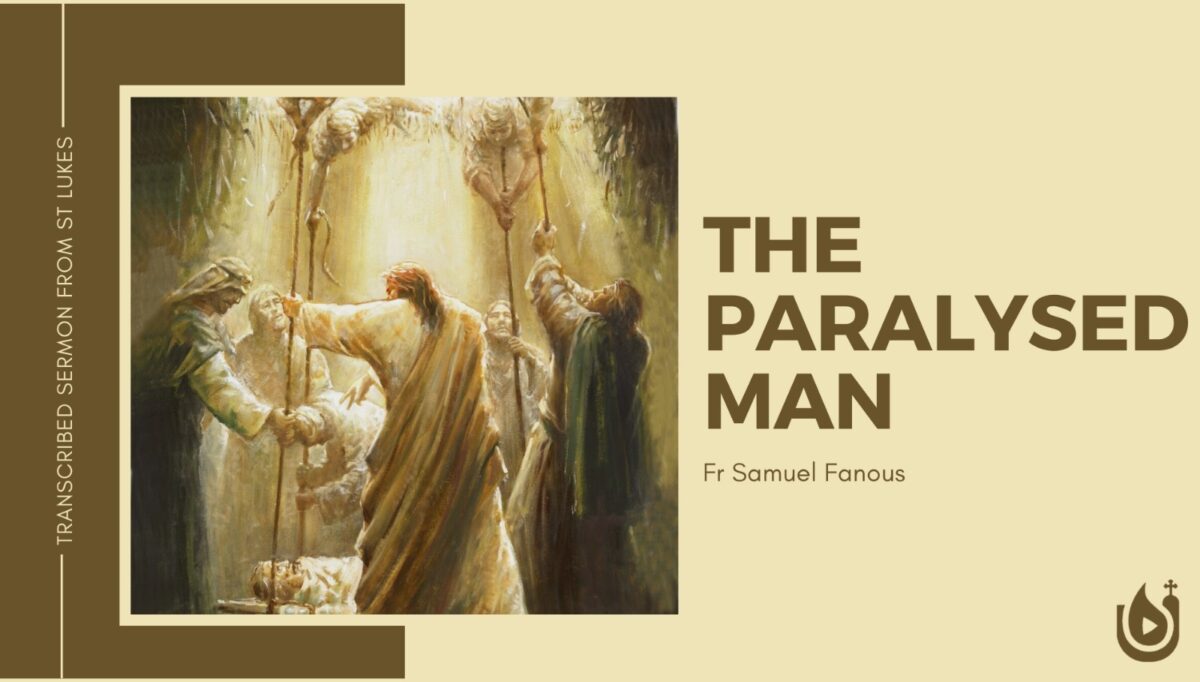
The Paralytic Man

St Luke’s transcribed sermons- Fr Samuel Fanous

There are some beautiful readings today, and if you look through them there is a common theme that runs through all of them. That theme is healing.

If you look at the Pauline it says;

“eye has not seen, nor ear heard, nor has entered into the heart of man the things which God has prepared for those who love Him.”

So, you can’t even begin to imagine what God has prepared for you. Then if we go to the Catholicon;

“by which have been given to us exceedingly great and precious promises, that through these you may be partakers of the divine nature having escaped corruption that is in the world through lust.”

This is one of the most famous passages in the whole Bible because St peter teaches us something very profound in this passage; the true incarnation of Jesus Christ through Him coming as fully God and touching humanity in the way He did and uniting it to Himself, He has touched all flesh so that we become like God. God became man, so man could become God. So, this is what Christ offers us through healing our flesh, through touching it and making it holy and divine. Hence why this is one of the most famous passages in the Bible.

If we go to the acts, we hear of St Paul healing a cripple from Lystra. They thought that he was a God because of this healing. As we also hear of St Moses the Strong in the Synaxarion, which is one of the most beautiful stories of repentance we have in the whole church. A man who was so far gone and yet he became one of the greatest saints that we have in the church.

Finally, in the Gospel we have Christ healing the paralytic man, and if you have a look at the order, He doesn’t heal him then forgives his sins. He forgives his sins then He heals him. And the question is, what is the greatest miracle in the Gospels?

He raises Lazarus from the dead after 4 days and He made eyes for a blind man. But is this really what He came to do?

Lazarus rose and then died later on in life. The blind man saw but became blind again when he died and saw nothing. So, is this really what He came to do?

All of these miracles don’t achieve any lasting service in and of themselves, because the healing that he achieves is temporary.

Matthew Henry, one of the great biblical commentators says;

“The only reason Christ did miracles, was to show what He could really do.”

The miracles were just a little taste tester to show what he could really do. The miracles don’t mean anything in and of themselves because of how many people saw his miracles and walked away and kept going on about their lives.

What Christ is teaching us today is the real miracle, which is the forgiveness of sins. The real miracle is the healing of the soul, not the body. The healing of the soul has eternal ramifications, and it is so much harder to do than the healing of the body. That’s why Christ questions, “what’s easier to say?”

It is much easier to heal someone than to forgive their sins. Now in modern medicine, you come, and we have miracle drugs because they cure many diseases and fix problems that we never had before. That’s what medicine can achieve, but what medicine can never achieve is the change of heart, the change of person, helping someone to overcome a particular sin. So, when Christ came, He did not come for miracles, He came to say, “look, you have a physical disease and I will heal it for you. Just to show you. Imagine what I could do with your spiritual disease. For us its standard, I repent, and the sin is gone. This is what we have been taught in Church, but if you look, it wasn’t always the case. In the old testament, if you sinned; let’s say you killed someone, there’s no forgiveness. The punishment is death. It is only through Christ that that changes. Now everything is forgivable, everything is healable. This is why the Pharisees were shocked, they said; “who can forgive sins but God alone?” And God doesn’t refute them, because He forgives the sins to show that “I am God.”

So, all of these readings today show us the process from sickness to health is an incredibly joyful process, not something sad. We often think that repentance is something sad, we should cry and lament, which might be the first part of it. But the reality of repentance is exceeding joy, to that that ‘I was sick and now I am healed’.

From now on in your life, you have to remember that there is nothing that can separate you from God except yourself. The only person standing between you and God is yourself. Many people sin and then they think that is the end of the line for them; ‘Now I am a sinful person; how can God accept me …’

And that is what you call despair, which is the worst thing that you can do in life. Many people think that despair is humility, but it is the opposite. It is pride. When you think of yourself as so good, that you can’t imagine how you have fallen so much, you think that you are better than that, but none of us are better than that. At our best states, we are still the biggest sinners before God, comparatively speaking. But when I think, ‘wow look at what I’ve done, how could I have done this?’ You think your better than what you are, but if you saw realistically you realise that when you sin it is what you are without God’s grace. So, we must remember that nothing can separate us from God’s grace. St Paul says;

“For I am persuaded that neither death nor life, neither angels nor principalities, nor power, nor things present, nor things to come, not height, nor depth, nor any other created thing should be able to separate us from the love of God, which is in Christ Jesus our Lord.”

But there is a catch; and that catch is ourselves. If you do not repent and not feel as though you have sin in your life, or you feel as though you are not worthy before God and you feel that you are ok, you can never have this relationship, it’s impossible. It is you putting yourself a big barrier between you and God, and not allowing God to enter. For us, repentance starts with an acknowledgment of the sin and is completed in the act of confession and achieving healing. Many people feel as though the church made confession up, but if you look at the old testament people would take 2 goats and bring them to the altar and cast lots for them. One of them is God’s lot. And the goat which the Lord’s lot is cast, that goat is slaughtered. The Lord’s one is slaughtered, and the goat that didn’t get killed is set free into the wilderness. Before they set it free, the priest lays his hand on the goat and he confesses the sins of himself and of the whole Jewish people, and that goat goes free while the Lord’s goat is slain. And so, when you come to have confession it is the exact same process; when the priest lays his hand on your head and you’ve confessed your sins you go free as the scapegoat, you’re the one who escaped. But the Lord, the Lamb himself, Jesus Christ, is sacrificed for your sake. Confession is a sacrament in which there is a hidden mystery, in which something happens that you don’t see with your eyes. This is a very beautiful thing that we have to remember, this is the miracle that God gives us in healing. The physical miracles in your life are nothing compared to this healing that can happen to us.

The worst cases as a doctor to see is when somebody comes in with mental health problems. The first thing you ask is a question that tells you what their insight it, do they have insight into their disease, and if they have good insight it is excellent. We can fix it as they will comply with treatment and do what needs to be done because they know that they need it. If you have no insight it becomes infinitely more difficult to treat, if the person has no insight of their mental health problems they won’t comply and thus we can’t treat them. And so, the number 1 marker of whether a person can be healed is whether they have insight into their disease. Sometimes, we walked around like this, with zero insight into what we are. Zero insight into how sinful we are and how much we need God; ‘I’m fine, I’m a good person. I don’t fight, I don’t kill, I don’t do anything, what do I need God for?’ And that is the hardest thing to cure. St Moses the strong, big sinner, no problem, he knows he’s a big sinner. But most of us going about life ordinarily thinking everything is ok, that is a big problem because we don’t recognise what we need and don’t have. This is the hardest job for any priest and even Jesus Christ Himself who came and could not convince the Pharisees that they needed Him.

So, I think for us, God is offering healing for us and if you seek Him as a Physician, He will be given to you. But you must never feel or think that you don’t need it, or that you are too good for God. The moment you do that you are making yourself out to be God.

Glory be to God forever.
How Great is your Faith?

How Great is your Faith

Adapted from a sermon by Fr David Shehata


Passage Luke 5:17-26

The Paralytic Man is read in the gospel of Luke 5, but also in Matthew 9 and Mark 2. It is very commonly confused with the miracle recorded in the gospel of John which recounts a paralytic man that was 38 years old and sat by the pool of Bathsaida. This is usually because Jesus says to both, “rise, take up your bed and walk.”

There are key differences between the two. They are definitely not the same person and when we look at the differences, there are a multitude of benefits that reveal how Christ treated them according to the depth of their faith.

Jesus was in a house in the gospel of Luke and the man was brought to Him, while in John, Jesus sought out the paralytic man. The man in Luke had friends around him while the man by the pool of Bethsaida had no one.

It can come across as insensitive that the Lord – who is all-loving, all-powerful, all compassionate – would allow this man and his friends to go through so much trouble to reach Him. St Mark recounts the extent of the difficulty they had when he writes, “many gathered together, so that there was no longer room to receive them, not even near the door” (Mark 2:2).

He emphasises a house that would have had so many people that they were flooded out the door. There was no room, so the four men looked upon this situation and decided to enter through the roof; “And when they could not come near Him because of the crowd, they uncovered the roof where He was” – Luke 2:4.

If we pause at this verse and put ourselves in this situation. If I was one of the four men in this situation or the paralytic man himself who had come to see Jesus in faith because I have heard of what He has done for others, how do I react to the obstacles in my path?

This applies to every time we want to spend time with God, but find an obstacle along the way. I am making my way to church, I have planned ahead and booked a spot because of the current Covid restrictions. I find rain, storm, cold… what next? Do I wait for the next mass?

Or I come to pray at night at my designated prayer spot but just before I get there, I find the room is cold and I remember the warmth of my bed… what next? This is a question we ask ourselves. What would I do in this situation; when Christ is so close but there is an obstacle in my way?

Do I presume that it’s just not God’s will for me to go to church on that day? There is nothing wrong with waiting, Jesus will still be around when I eventually pray the next day, or the day after that. There are so many ways to justify turning back at the first obstacle we see.

But in Mark, the four friends saw that they could not enter through the door so they created their own entry point through the roof. It seems irrational and beyond the logic of society to enter through a closed roof instead of an open door.

It is not the faith of one alone in this situation but the combined faith of the five men. They had to carry the man to the roof, they had to uncover some of the tiles so that they could lower him into the house. The greatness and difficulty of this task was exemplary of the greatness and unwavering faith of these five men.

The understanding of Jews at the time was that in major disease or illness was the result of sin. Either their own sin or that of their parents, just like in the gospel of John when the disciples asked Christ in front of the man without any fear of whether he would hear them or not, “Who sinned, this man or his parents?” This is an insight into the culture at the time. The paralytic man was seen as a sinner, deserving of his punishment of paralysis.

The life of a paralytic would have been extremely difficult, they had no social security, were unable to work and moreover, they were blamed for the state they were in. No one had compassion on them and they were likely to grow irritable and resent society. This man showed willingness to become a public spectacle, to be judged and condemned as a sinner, for a chance to reach Christ and be healed. This was all irrelevant to him compared to what he was about to gain. His gain in this process was far greater than any criticism and social stigma. This is a lesson in faith we can all learn from.

How many times do I sacrifice time with God for momentary praise or pleasure? How many times do I, in my own life, say that I will speak to God later?

When the Lord sees the faith of the paralytic man and his friends, He says, “your sins are forgiven.” This is so powerful and gives us insight into the nature of Christ. The Lord prioritises the man’s sins over his paralysis. This was the more important of the two in the eyes of the Lord. Heavenly healing lasts for eternity, while healing of the flesh is irrelevant to the hereafter.

Perhaps we can learn to prioritise similarly; to work harder on the forgiveness of my sins, to work harder in speaking to my father of confession, to work harder in partaking of the sacraments and finding time alone with God.

God wants to approach Him similarly as Fr Yacoub Magdy points out – “the trust of the beggar, compels the giver.” We learn to approach the Lord in unworthiness, in helplessness and that compels God to come to our rescue, for He is our only hope.

We cannot say we have finished breathing for the day, so we can not say that we have finished praying for the day. Prayer is a continual and ongoing relationship with the Lord. The four men approached the Lord and encountered an obstacle but they kept striving to reach Christ by any means possible. They persevered with greater effort so that they would see the Lord and have the life changing encounter that they hoped for.

One reason why the Lord ensured on that day that He would be so far out of reach was to highlight the extent of their faith on that day to benefit those that witnessed the miracle and even to us, 2000 years later.

The question we then ask ourselves is how much effort do I make to meet the Lord? Is it beneficial to me? I need to keep asking, I need to keep seeking, I need to keep knocking, until I encounter the Lord, whatever it takes.

“Do not be foolish in the requests you make to God, otherwise you will insult God through your ignorance. Act wisely in prayer, so that you may become worthy of glorious things. Ask for things that are honorable from Him Who will not hold back, so that you may receive honor from Him as a result of the wise choice your free will had made. Solomon asked for wisdom (3 Kg 3:8-14) – and along with it he also received the earthly kingdom, for he knew how to ask wisely of the heavenly King, that is, for things that are important.”

St Isaac the Syrian

We have the King of Heaven and Earth before us and He is willing to give us all that we ask for. Ask, and ask for big things. Don’t ask for meaningless things that you would never put before a king. Even if you don’t receive immediately, keep praying for your begging will compel the Hand of God to give.