A Common Enemy

By Annalisa Boyd

Original post found at Phoebe Farag Mikhail’s blog Being in Community (June 5, 2020)


We have a common enemy and it is not a race or a religion or class.

The enemy is a chameleon. Where it can destroy because of race it does. Where it can destroy because of class, it does. Where it can destroy because of religion or region or accent, it does. But it is the same enemy. If we stop long enough we can turn and stand together and fight together against the common enemy, Satan. 

“The Great Reconciliation,” an imaginative icon of St. Stephen and St. Paul by Annie Africa Claudius

Where God brings love, he brings hatred. Where God brings unity, he brings division. Where God brings hope, Satan brings hopelessness and despondency. God call us sons and daughters…co heirs, Satan calls us illegitimate. 

Where God focuses on oneness in Him, Satan encourages us to focus on our differences and to categorize the value of a man or woman or child in any way that breaks us away from the truth and isolates us from love. 

We can NOT remain silent but we must make sure we are fighting the right enemy. If we fight each other we will not have the strength to stand in the end.

May God give us courage like those who have left the world behind to follow Him in hope and love.

May God make us like the saints amd martyrs who had hope in the resurrection and the world to come.

May God remove the scales from our eyes like he did for Saint Paul who held the coats of those who murdered Saint Stephen and then united Jew and Greek into one faith.

May God have mercy on us all!


(c) Phoebe Farag Mikhail (2020). Being in Community. A Common Enemy by Annalisa Boyd. Original post- https://beingincommunity.com/a-common-enemy/

Raising Lazarus

Raising Lazarus

Adapted from a sermon by Fr Elijah Iskander


There are so many characters with varied roles in the story of the raising of Lazarus that we can learn from.

Two of the characters we meet are Mary and Martha, the sisters of Lazarus. Martha runs to the Lord and says, “Lord, if You had been here, my brother would not have died” (John 11:21). She had some understanding of who Christ was, but she didn’t have a complete understanding. She knew Jesus was powerful and had authority over death but she also had a misunderstanding that His power was limited by distance. IF You were here, perhaps she didn’t know the number of miracles He did when He healed from a distance. The centurion’s daughter for example.

When Jesus tells her that he will rise, she responds with theological insight when she says, “I know that he will rise again in the resurrection at the last day” (John 11:24). Jesus clarifies that He meant beyond this.

Her sister, Mary, comes to the Lord with the exact same sentence, word for word. Jesus doesn’t seem to engage with Mary theologically as He did with Martha but simply completes the miracles.

Regardless of if I am Mary, coming to the Lord broken-hearted with no understanding or if I come to Him with questions, concerns and debates, He still comforts me in the language I understand best and is for my benefit.

Another character that is easily missed in this story is Thomas. The one known as, “doubting Thomas,” has a powerful role in this story. When Jesus informs the disciples that Lazarus had died and they must go to him, Thomas replies, “Let us also go, that we may die with Him” (John 11:16).

Earlier in the Gospel, Jesus makes a bold claim of divinity, saying that He is the Son of God. The Jews hearing this want to kill Him for making Himself equal to God. And now the disciples see that Lazarus has died, that the Jews are surrounded in the area after they had just escaped from them. It would natural for the disciples to think that if they went to the Jews, they would kill Jesus. Thomas concludes the same but sees this is an opportunity to follow the Lord even unto death.

Are we like Thomas, ready to follow the Lord regardless of the cost and consequences? For Thomas, this became an accidental prophecy of his own martyrdom. Doubting Thomas, in this instance, proved to be brave and courageous. What can we learn from Thomas’ example today? Even if I must sacrifice for you, Lord, I am ready. Let us also go that we may die with Him. Let us aspire to have the courage of Thomas.

The compassions of our Lord are magnified in the shortest verse of the Bible which reads, “Jesus wept” (John 11:35). When He saw His beloved weeping, He also wept. How can we perceive the depth of this verse? He groaned in the Spirit and was troubled. The Comforter, the Counsellor, weeps and is troubled. This gives us an insight into the compassion of the Lord and how much He loves us. We call Him, “Abba, Father” which is to say, “Dad.” This is a real mystery, a compassionate father or mother carry the burden of their children’s needs, even if it is nonsense, even if it is not a big deal. Jesus does not take humour in our requests but He shares with us every feeling that distresses us.

Can I bear the burdens of others? Can I share in the joy and sorrow of others? The Creator wept, groaned and was troubled.

We see a final group that responds saying, “Could not this Man, who opened the eyes of the blind, also have kept this man from dying?” (John 11:37). Does this not sound like those who mocked Christ on the Cross saying, “He saved others; Himself He cannot save. If He is the King of Israel, let Him now come down from the cross, and we will believe Him” (Matthew 27:42). Do I see myself in this group? Lord, if You are so powerful then why did I fail my exam, why did I endure such hardship, where were You in my struggles?

This brings about the second groaning within the Spirit of our Lord, perhaps this was not sharing in grief but in the hardness of their hearts, their utter lack of faith.

Which of these characters am I like?

  • Mary, who approaches the Lord in broken-heartedness
  • Martha, who approaches the Lord with a question and incomplete understanding
  • Thomas, who was ready to die for the sake of the Lord
  • The Jews, who questioned why Jesus would not save Lazarus from dying
  • Jesus, who we are called to like. Full of compassion and sharing the burdens of others. Groaning and weeping for those that are pained
  • Lazarus, the one raised from the dead

St Augustine describes the difference between the raising of Christ and the raising of Lazarus. When Jesus rose, the woman found the linen folded and left behind. Lazarus rose while still bound in linen. Simply because Lazarus will need those again, but Jesus will not. In whatever earthly things we receive from the Lord, we will eventually lose. If I am healed, I will be sick again. If I have a job, a time will come when I don’t have a job. Whatever earthly things we have, will be taken.

When I come to the Lord, let me ask for the imperishable. For any worldly concern, I bring forth before the Lord, He cries with me, He shares my suffering with me. Let me ask of something that is fitted for the Giver. Lord, teach me to pray.

Pope Kyrillos would wake up at 2am for his formal prayers would end at 10am and he has a constant dialogue with God. When people asked how he had such great insight, his response was simple, if you spend time speaking with God more than anyone else, He will speak to you. Lord teach me to imitate Pope Kyrillos.

For any wrongdoing, help me to let is go. Teach me to sacrifice, to love, to be humble. We pray for things worthy of the Giver.

Sensitivity For Others

Adapted from a sermon by Fr Samuel Fanous


Passage: Luke 9:10-17

The words of the Gospel today from Luke 9 begin with a realisation about something that’s happened. The disciples had been travelling with Jesus and multitudes had been following to hear him speak. And then it says, “when the day began to wear away” – when the people were exhausted and the day had come to its close, the disciples said to Christ, “Send the multitude away, that they may go into the surrounding towns and country, and lodge and get provisions; for we are in a deserted place here.”

You hear those words – “send them away” – and they can sound arrogant. It almost sounds as if the disciples are annoyed – that they’ve had it with these people that they’ve been with for an entire day, even days perhaps, following them, serving them, caring for them. So in annoyance, they say: “send them away”.

But one of the most remarkable this is that this is not how the early church read these words. St Cyril of Alexandria in the fourth century spent almost an entire homily talking about these words, “send them away”. He said

“[the disciples] seized with love toward the multitudes, and beginning to have a concern for the people…”

They were beginning to have concern for them.

When they say, “send them away”, they aren’t doing it out of annoyance or frustration or arrogance – they’re doing it because they’re starting to feel people. They’re starting to become sensitive to the needs of people. So they ask the Lord to send them away to the surrounding towns before it gets dark so that they can go and eat and sleep – because this is a deserted place. It’s likely the multitude themselves hadn’t realised it – it had just started to get dark, and perhaps they were distracted, unaware of their needs that would come in just a few hours. So the disciples start to become very sensitive – St Cyril is very specific that they “seized with love… beginning to have a concern for the people”.

St Cyril goes on to say,

“for to draw near, and make supplication on the people’s behalf, is an act becoming to the saints”.

To be sensitive to people and their needs is the beginning and act of becoming to the saints. So from here, Christ commands the disciples: “You give them something to eat”. Christ could feed the multitude, but he wanted the disciples to share in that. They told Him that they had no more than five loaves and two fish, so He takes those, blesses them and gives them out to people in groups of 50, to feed perhaps 50,000 people – an event which we call the Blessing of Multiplication or the Blessing of the Little – a remarkable miracle which would’ve reminded people of the days of Moses when Manna would come from heaven and the people would eat from it.

All of this comes first in the beginning of sensitivity. Sensitivity to others, and not myself. It creates the space in which God can work, can heal and can love through us. But that sensitivity requires me first to move out of myself. It means I have to move out for my own lusts, desires, ambitions – I have to see others.

If we do not see others, we cannot be sensitive to them. We can’t feel them or their needs. If we see ourselves, we only care for ourselves. This is actually where the word “narcissism” comes from – it’s a word that we painfully throw around at others who are quite self-absorbed – but actually, the word “narcissism” comes from one of the Greek gods in mythology, Narcissus, a handsome young Greek man who was being chased by a woman, the nymph Echo, and rejected her.

He didn’t want to be loved or to love somebody else. She wasn’t beautiful enough for him. One day after hunting he came before a pool of water, and he sat down in front of the pool, as he went down to drink, he saw himself. He looked at that image, and couldn’t stop looking at it because it was so beautiful. Eventually, after hours of staring at his own image in the water, he realised he couldn’t consummate his love. He couldn’t embrace the person. And so after gazing, enraptured in his own image, he killed himself – because he couldn’t attain the object of his desire. And that’s where we get the word narcissism – somebody that was so self-absorbed, all they could see was themselves.

Yet Christ is the exact opposite. Something that always strikes me in the gospels is that if you pay attention to the words carefully you see how many times Christ sees people. How many times, the evangelists stop to make a point that He looks and sees somebody.

“And Jesus, walking by the Sea of Galilee, saw two brothers” (Matt. 4:18). He saw Nathaniel, and said, “Before Philip called you, when you were under the fig tree, I saw you.” (John 1:48). With the paralytic man, it says, “When Jesus saw him lying there, and knew that he already had been in that condition a long time, He said to him, “Do you want to be made well?”” (John 5:6). In Matthew, Jesus “saw the multitudes, He was moved with compassion for them, because they were weary and scattered, like sheep having no shepherd” (Matthew 9:36). When Christ sees the rich young man and is asked how he can be saved, it says, “Jesus, looking at him, loved him” (Mark 10:21). When Jesus looks up at Zacchaeus, it’s up in the sycamore tree, and he is hiding because he is so embarrassed as a tax collector to be seen by people. It says, “when Jesus came to the place, He looked up and saw him, and said to him, “Zacchaeus, make haste and come down, for today I must stay at your house.” (Luke 19:5).

These are just a few examples – the gospels are littered with them. Christ sees us. He is sensitive to our needs. He feels our needs. He looks beyond himself, He sees others, and so He is sensitive to our needs. Sensitivity to others is the beginning of saintliness. It is the beginning of drawing near to Christ and becoming like Him.

Many years ago, perhaps when I was in my first year of university, I didn’t attend university very much. I was a very poor student – I was probably attending about half an hour a week – so I had nothing to do and took up many hobbies that no 18-year-olds do.

One priest had asked me to help him – so I used to pray one liturgy every Thursday morning from 5-7 a.m., and afterwards I would drive around this elderly priest to help him give people communion, sometimes for four or five hours, sometimes until 2 p.m.

And every time after we’d finished the liturgy, I would watch this priest take the Eucharist and put on his head, and I’ve never seen anyone do what he does. He would refuse to drive – he let me drive – and he would sit in the car with the Eucharist on top of his head for five hours, going from place to place with incredible reverence. Often I would drive in silence for hours because I didn’t want to disturb him, until we’d visit the very last person receiving communion, after which, I would try to go to the drivers seat but he would refuse to give me the keys and let me drive, and say the exact same words: “before you drove because you were driving Christ. But now it is Yohanna, and I cannot allow you to drive Yohanna.” He would refuse to let me drive him, ever – but I could drive when Christ was on top of his head. This went on for a year, every Thursday, until one Thursday we came to the last communion. He told me to park the car and stay in the car, because the person he was visiting had a personal issue that he didn’t want anyone to know about except for his priest.

So as I went to park the car, I went straight into a brick wall and knocked off the bumper bar. So I sat there for a nervous half an hour trying to find the way to bring the bumper bar up, so the priest wouldn’t notice that I knocked off his bumper bar, until eventually, the priest came after the last communion as I was down on the ground trying to fix it, and in just one glance, he saw what the situation was and he looked away. I opened my mouth to begin to apologise – but he just laughed and said, “it’s nothing”. He went into his pocket and threw me the keys, and said “quick, let’s drive”.

For a year, he refused to ever let him drive him after communion, because I couldn’t drive Yohanna, I could only drive the Eucharist. But after I crashed his car with the bumper bar hanging off, he threw me the keys just so I wouldn’t be upset.

He was sensitive. Because he feared that I would become upset or feel guilt or shame because I crashed his car, he gave me the keys and let me drive him. In that moment, I possibly receive the greatest lesson of my life.

To become sensitive to others. To feel them. And that means, forgive me, we need to look very carefully at ourselves. Do I see others or do I see myself only?

How many times each day do I see others? Do I feel for others? Do I live for others? How many times a day, if at all?

And yet if I don’t go out of myself – beyond my desires, needs and ambitions, and I cannot see or feel others, I cannot be sensitive to their needs or feel for them. And if I don’t live for them, I don’t live for Him.

But if I see others, if I feel their needs much more deeply than they themselves feel their own needs, and I live for them, then I live for Christ. And that is why St Cyril of Alexandria says, being sensitive to others is an act of becoming of the saints. It was the entire beginning of the Blessing of the Multiplication story, with the disciples becoming sensitive to others.

So let us all, as one church, especially in the coming weeks, let us train ourselves to become sensitive to others. To see others and to feel their needs. To look beyond ourselves and our needs, but to see others.

Glory be to God Amen.

Put Off Self Will, Put On God’s Will

The New Man: Part 5

By Sandra Salib


Walking into an Orthodox church is an overwhelming experience – the incense, the candles and architecture never fail to grab your attention, transporting you to another place – a heavenly sanctuary, the House of God. Slightly elevated, ornamenting the walls of the church are icons, saints who are the exemplars of the spirituality we strive for, seemingly peering at the people entering. It is often said that these saints are amidst the church congregation, praising and praying with us, but they appear to reflect a spirituality which seems so above us, so distant and out-of-reach. We sit in church pews, longing for change, yet as soon as we walk out of the heavy, wooden doors, we are back in the world, as if returning to reality from a dream, unscathed. 

It wouldn’t be contentious to say that our world today is a busy one. We’re occupied – working, studying, going out, getting fit – and while all these pursuits seem to be for our own growth and development, it puts us in a selfish oblivion, so distracted that we fail to consider anything that lies outside of our personal bubble. 

The saints we see in icons are amidst us. To this day, 260 million Christians around the world are persecuted for their faith. They are martyrs of the present day. Needless to say, improving their lives isn’t in the question. Having a life at all is what consumes their minds. 

Everything they’ve wanted – their desires, passions, hobbies – are all trivial. Their own will means nothing – they are subject to the will of another without question. 

We are lucky enough, in the Western world, to have the liberty of choice. We have the freedom to believe what we want to believe and do what we want to do. 

But to choose to submit your will to another? 

In a world that upholds the autonomy of the individual, that can be hard. Very hard. It’s almost like social suicide. You are fortunate enough to get to choose what you want, lay out your whole life for yourself, and then you’re going to let someone dictate your life for you? It doesn’t make sense. And who are you going to listen to? A supernatural being in the sky who you’ve never seen? It’s a hard pass. 

But is this who our God is? Is this how we, as his children, see him?

Our God is a loving, kind Father. Our God is all-knowing and all-powerful. Our God shepherds us and guides us to the path where we should go. He cares for us, and knows the details of our futures more than we could imagine. 

This isn’t how we see His Son. Jesus, begotten of the Father, came down from heaven so that we may have a personal relationship with him. He lived a life of humility, and submitted His life to the Father as an example for us.

This isn’t how we see the Holy Spirit, who moves through our hearts like the wind, leading and guiding us as a soft breeze, whispering where we should go. 

Of course, we know God is a mighty, powerful being. But the way in which he so freely loves, and gives, and has compassion, surely does not characterise a fire-and-brimstone, wrathful entity. It illustrates an image of a God who walked upon a fork in the road and, like us, had a choice. There wasn’t even much of a choice at all – He knew the journey would be difficult. He knew he would be spited and spat upon by generations upon generations of these creatures whom He loved and created. But this God, who we push to the side, this very God took the narrow path, and submitted His power and glory for us. 

When we put on God’s will, we put on the armour of God: the belt of truth, the breastplate of righteousness, the shoes of peace, the shield of faith, the helmet of salvation and the sword of the Spirit. 

But we must also feel protected by this armour and let our guard down, to let God’s Spirit move through us and guide us. So that we can be still, and listen. To put away our pride and to feel prepared, as the five wise virgins, as the faithful servant waiting for his masters’ arrival, as the wedding guests dressed appropriately for the great banquet. We need to take off our self will, to let go of the wheel and trust that God will lead us to the path where we should go. 

To live as God intended us to will always be one of the greatest struggles for man. But our life is a path full of decisions. And when we come across a fork in the road, we should see Christ running, without hesitation, down a rocky, narrow path and never looking back. With His hands raised, calling out your name, running to bring you in His fatherly embrace. For He, a deity, submitted all for our weak, mortal selves so that we could have salvation. Is submitting to Him for our own selfish good not the least we could do in return? 

Spiritual Friendship

Prayer

Lord, teach us to value those whom You placed in our lives to lift us up in times of need. Give us the zeal to encourage each other always throughout all temptation and tribulations this life has to offer. May we always have the name of those near and far on our lips in prayer, that we may represent true friendship.

Help us, Lord, to come together in Your name so that we may readily invite Your presence into our lives. Give us the humility to pray for one another in the  spirit of unity, that You may always be the chain that holds us together in friendship.

Lord, we ask that You may come today to be our Friend. That our soul may be knit to Yours in the bond of perfection that is Love. That our desires and ambitions may imitate Yours in every direction our life leads us. And that You are the first Friend we run to whenever our hearts may be burdened. Amen

Spiritual Friendship

New Testament Passage

Mark 6:7-13

7 And He called the twelve to Himself, and began to send them out two by two, and gave them power over unclean spirits. 8 He commanded them to take nothing for the journey except a staff—no bag, no bread, no copper in their money belts— 9 but to wear sandals, and not to put on two tunics. 10 Also He said to them, “In whatever place you enter a house, stay there till you depart from that place. 11 And whoever will not receive you nor hear you, when you depart from there, shake off the dust under your feet as a testimony against them. Assuredly, I say to you, it will be more tolerable for Sodom and Gomorrah in the day of judgment than for that city!” 12 So they went out and preached that people should repent. 13 And they cast out many demons, and anointed with oil many who were sick, and healed them.

Discussion Questions

  1. Christ could have sent the disciples out one-by-one to reach more people, and yet, He chose to send them out two-by-two. What are three things Christ may be revealing about the power of friendship by doing such a thing?
  2. Outside of service, how else is friendship given for us to be used? What are the benefits of a friendship outside of service?

Old Testament Passage

1 Samuel 18:1-4

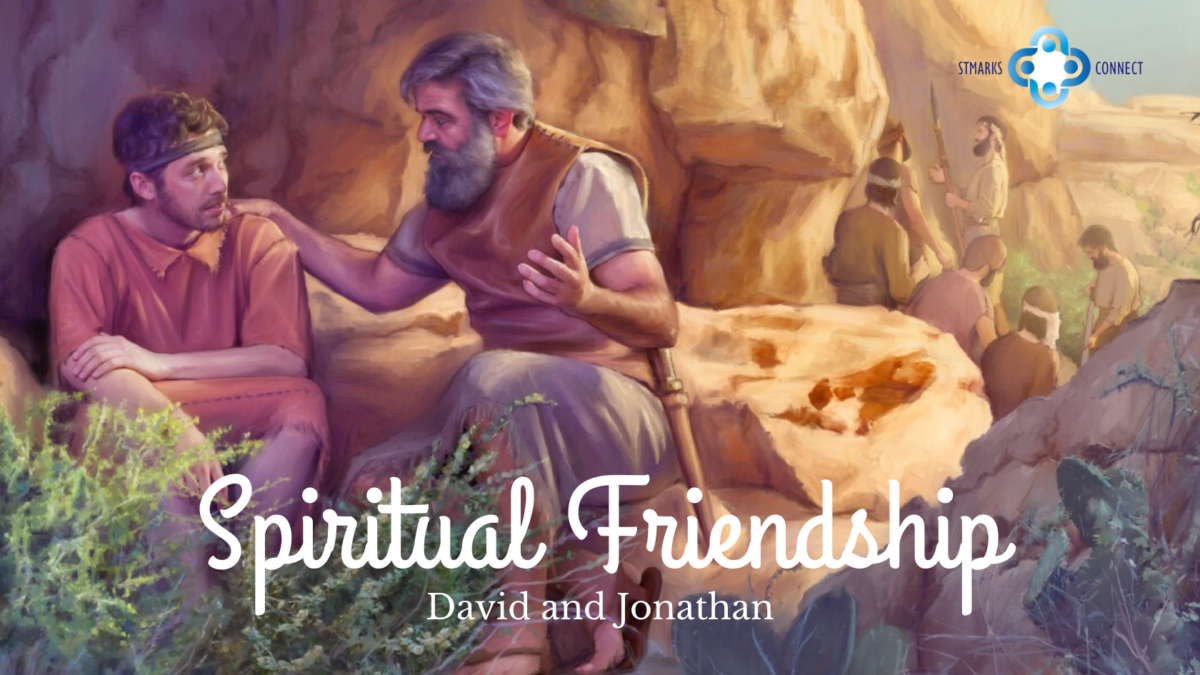
Now when he had finished speaking to Saul, the]soul of Jonathan was knit to the soul of David, and Jonathan loved him as his own soul. 2 Saul took him that day, and would not let him go home to his father’s house anymore. 3 Then Jonathan and David made a covenant, because he loved him as his own soul. 4 And Jonathan took off the robe that was on him and gave it to David, with his armor, even to his sword and his bow and his belt.

Also read Ecclesiastes 4:9-12

9 Two are better than one,
Because they have a good reward for their labor.
10 For if they fall, one will lift up his companion.
But woe to him who is alone when he falls,
For he has no one to help him up.
11 Again, if two lie down together, they will keep warm;
But how can one be warm alone?
12 Though one may be overpowered by another, two can withstand him.
And a threefold cord is not quickly broken.

Discussion Questions

  1. Exploring the relationship between David and Jonathan, discuss how the two of them epitomized the concept of Spiritual Friendship.
  2. What are some other Biblical examples of friendship that you can think of in the Bible?
  3. Some of us consider ourselves to be “lone wolves”, not requiring the company of others. How do we reconcile this lifestyle with what we are taught about friendship in the Bible? Is it wrong to not have close friends? Furthermore, if I struggle to make friends, how do I overcome this?

Love Your Soul

Love Your Soul

By Monica

Original post by Becoming Fully Alive blog site


Have you ever felt like you were playing with fire? That its smoggy, ashy fumes are choking you but you still don’t draw yourself away, even when your hand is being burnt.

It’s a picture of captivity. Why don’t I guard my soul as vehemently as I guard my body? Perhaps it’s because I just don’t know how valuable my soul is.

When Scriptures speak of Jonathan’s love for David the prophet, it says, “the soul of Jonathan was knit with the soul of David, and Jonathan loved him as his own soul.” (1 Samuel 18:1)

So what does it really mean to love your own soul?

“Know O beautiful soul that you are the image of God, know that you are the glory of God, know then, O man, your greatness and be vigilant.” -St Ambrose of Milan

Sometimes we are blinded from this very greatness that St. Ambrose speaks of. We feel so human, in every broken kind of way. Our memory fades from the calling to which we received. We have unlearnt that we are made for greatness, by Greatness. Our minds haven’t quite descended into the depths of our hearts to know these truths.

“The more we get what we now call ‘ourselves’ out of the way and let Him take us over, the more truly ourselves we become.” -C.S Lewis

If only we knew of the way God looks at you and me. It’s in the same way He looked at a shepherd boy—David—and saw in him a king. Each of us is in the process of becoming. Becoming beauty out of the ashes. Living in the dirt of our own sin, but destined to be butterflies. Perhaps living the resurrection just means being yourself, in the fullest way. Dark but lovely. No matter how dark we are, “God’s gifts and His call are irrevocable” (Romans 11:29). Not even an inch of darkness can out shadow the shine of your lovely.

“Like Michelangelo who looked at a rough, shapeless stone one day and saw a statue of David in it, Jesus was constantly looking at people in terms of what they can become. We may be defeated, degraded, soiled, enslaved by our pas­sions, yet through Christ we can be redeemed.”  -Anthony Coniaris

It’s in this knowing that we learn to guard our souls zealously. We learn to build the walls of Jerusalem because we know that deep inside there is treasure. So, brush off the dirt and be ready to receive the promise of the Father.

“For you have need of endurance, so that after you have done the will of God, you may receive the promise.” Hebrews 10:36

The promise of the Father, the Holy Spirit, will bring to your remembrance all things. Remembrance of who you really are. We were made for worship, and every moment in our lives we are bowing down to something, so if in those moments we don’t see God, we are worshipping an idol. So, allow Him to bring us prostrate before the throne of grace – let Him point us back home, back to where we belong.

“He is the source of holiness an intellectual light for every rational power’s discovery of truth, supplying clarity, so to say through himself. He is inaccessible in nature but approachable in goodness. He fills all things with power but only those who are worthy participate in him. He is not participated in all at once but shares his energy in ‘proportion to faith”. He is simple in substance but manifold in powers. He is present as a whole to each and wholly present everywhere. He is proportioned out impassibly and participated in as a whole. He is like a sunbeam whose grace is present to one who enjoys him as if he was present to such a one alone.” -On the Holy Spirit, St Basil the Great.

 Original blog found at- https://becomingfullyalive.com/love-your-soul/

A Life of Fulfilment

A Life of Fulfilment

Adapted from a sermon by Fr Mark Basily


Passage: Luke 9:10-17

We read about the enlightenment the disciples experienced when the Lord multiplied the five loaves and the two fish. This story is mentioned in all four gospels and is recounted on numerous dates in the church’s calendar.

Just before the blessing, we read an important encounter between Jesus and His disciples. Jesus sends the disciples out to preach, to heal the sick and to proclaim the Kingdom of God. He tells them not to take anything with them- just go and preach.

They do as the Lord says and they return excited from what they had seen and witnessed in the ministry. And the apostles, when they had returned, told Him all that they had done. Then He took them and went aside privately into a deserted place belonging to the city called Bethsaida (Luke 9:10).

And then we continue into the story of the five loaves and two fish. When the people of Bethsaida knew that Jesus had entered their city but was in a deserted place, they travelled to see Him. Jesus spent the whole day with them healing the sick and preaching about the Kingdom. The day wears away and the miracle follows.

What takes place here is like a sandwich. You have preaching and healing in the beginning, a day full of ministry and high activity. This is followed by the next layer, of more people flocking to Christ and more healing, preaching and ministry.

But in the middle, we find Jesus takes the disciples away privately to a deserted area. This is the meat in the sandwich of this story. Oftentimes, we can forget this vital part. Imagine eating a sandwich that was just bread. No one eats a bread sandwich, there must be something to give it flavour. Our lives become as dull as a bread sandwich if we go from activity to activity. Bread on bread. There’s no meat, no filling.

It is important that we learn to apply this to our spiritual life. After every activity, there needs to be a layer where I spend time with God. I tell Him about all that I have done and He takes me away to a private place. It is a very beneficial spiritual exercise to meet with Christ at the end of each day.

We learn to imitate the disciples that came to Christ at the end of their ministry and told Him all about what they had done. In our evening prayers after we have prayed our formal prayers (e.g. from the book of hours/Agpia) that we tell God about our day. It is good to give God a run-down of all that happened.

“This morning I woke up and everything was okay but then I got frustrated with one of the kids, I could’ve been gentler. I got to work and had that meeting, thank You for giving me the strength and wisdom to navigate through what was so daunting before I entered. By the time I got to lunch, I forgot that I was meant to be fasting, sorry, God.”

Or, “I went to school today and I got my results for a test, thank You for helping me. When I was in the playground with the boys and I guess, I was a bit rough.”

When you give God a run-down of your day, you will quickly see the areas where you give thanks for His providence and guidance, or repent and need change, and then, it is as if God takes you away to a deserted place away from this world and it troubles. From there, I can start with my next job, ministry, or activity. Between each layer of activity, we need to give it substance, we need to have quiet time with Christ.

A newly married woman once told me that her husband has a habit of waking up at 5am to spend time in prayer and reading the Bible. He then starts getting ready for work. When he comes home from work, the first thing he must do is to go his prayer room and spend time with God before anyone else.

After each activity, I make time for the Lord and tell Him about all I have done and He, in turn, takes me to a deserted place away from the world. This provides the context of blessing. This is where we draw near to the Lord.

The Lord is near to all who call upon Him – Psalm 145:18.

We draw near to the Lord when we tell Him about all that we have done and that provides blessing and enlightenment to our lives.