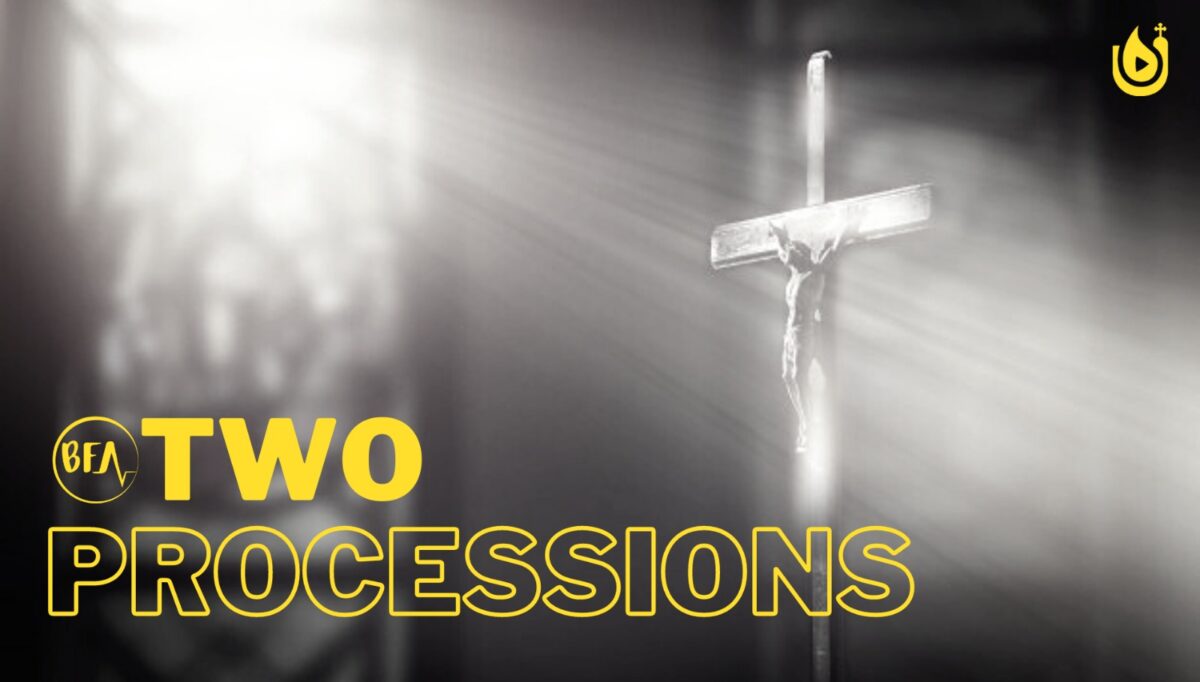
Two Processions
Guest post by Becoming fully
alive blog site
Well, He’s dead.
In
the end, they took Him and nailed him to a cross, watched Him suffocate under
the weight of His own body, and then stabbed Him to make sure He was dead. Then
everything seemed to go mad; the Veil of the Temple split down the middle,
blasphemously revealing the Holy of Holies. The earth started shaking and the
ancient dead burst from their tombs, as though strolling around Jerusalem
was the most natural thing in the world after a thousand years of bodily
decay. They say that if you put your ear to the ground, you can hear the whole
netherworld beginning to creak and shudder; the dead are waking up, and the
Devil is screaming.
It
all seems a lot of fuss for one dead man. You can see Him there, moving down
the path toward His tomb. He’s the bleeding bundle of cloth at the front of the
group. The man holding His feet is Nicodemus; one of the wealthiest men in
Jerusalem. The man holding His shoulders is Joseph of Arimathea. That woman
behind them, the one who can’t seem to stop crying, is called Mary. She comes
from Magdala, and unlike Joseph and Nicodemus, she is not the religious type.
We don’t know much about her, but we do know that when she first met her
Teacher, her body was home to no less than seven spiritual parasites.
They were old, terrible
creatures who fed off her misery and desperation. Back then, she had plentiful stores of both, though we don’t know
precisely why. Perhaps she had done terrible things or terrible things had been
done to her. At any rate, she was not what anyone would call a “pillar of
respectability,” and it hadn’t helped her Teacher’s reputation to have her
hanging around. But He was the one who freed her. All seven of her demonic
tormentors had screamed and fled when He came along, and they never came back.
Since then, she has followed Him; and she follows even now, when all that’s
left to follow is a bleeding corpse.
There are others walking with
them, following the blood-soaked bundle that was their Teacher.
Surprisingly,
you are present too.
You’re
part of your own procession, a larger one, invisibly leading Joseph, Nicodemus
and their bloody bundle of linen towards the tomb. Your procession is headed by
golden crosses on poles and at the very back, just in front of Joseph and
Nicodemus, men are carrying icons of Jesus’ burial and crucifixion, being
censed by bearded priests wearing golden cloaks. Although there are more people
in your procession than in the ancient one behind you, yours is a good deal
less serious. Where Joseph and the Mary’s are burying a brutally murdered
Friend, you are attending a religious festival. The atmosphere is solemn
enough, with the icons and the incense and gold crosses on poles, but in your procession
people are distracted, occasionally chatting to one another, making quick
remarks about Uncle So-and-So’s chanting voice and what they’re going to eat
once the service is over. They’re tired because they’ve been in Church for nine
hours. Mary, Joseph and Nicodemus are tired because they’ve just spent nine
hours watching their Friend asphyxiate and bleed to death.
And
so, the two processions make their way slowly to a new tomb in a garden; one
decked in white and gold, the other wet with tears and blood. You seem to be in
two places at once. On the one hand, you’re walking around your local Coptic
Church holding a candle, singing “Lord have mercy” in a tune which seems deeply
sad and deeply joyful at the same time. On the other hand, in some mysterious
way, you are also walking towards a garden in Jerusalem to put a blood-soaked
corpse into a new tomb. Some would say you’re not really in the same place as
Joseph and Mary and the bloody bundle; you are in a Coptic Church on Good
Friday. You might imagine that you’re following a group of first-century Jews
to a new tomb outside Jerusalem, but imagining doesn’t make it true. That’s
what some people would say. Perhaps they’re right. But those people have
probably never been to a Coptic Church on Good Friday, and so we might wonder
how they can be so sure.
As
you walk around the Church in procession, you notice some of the tired faces
around you. A few places ahead of you in the procession is the man who taught
you to be a Sunday School teacher. Like Joseph and Nicodemus, he’s the
religious type. He’s attended every Holy Week service so far, morning and
night, and he knows more about the Church and its history than anyone you’ve
ever met. He loves this kind of service. His eyes are always closed during the
long hymns, not because he’s sleeping but because he’s contemplating the deep
nuances of the ancient hymns. He’s also one of the kindest and most
self-sacrificing people you’ve ever known. You can only see his back from where
you are, but you’re sure that his eyes are closed now too.
The
procession takes you up the back of the church, where a woman called Selena is
leaning against a pillar. Selena still comes to Church for the big occasions,
but she’s not really the religious type. She has a complicated history, which
she doesn’t like to talk about. A combination of things she’s done and things
that have been done to her have convinced her that she isn’t pious or holy
enough to be a good, church-going Coptic girl. So Selena only comes on Good
Friday and Easter Sunday, because the services are crowded and she can slip in
the back without really being noticed. She doesn’t understand the long hymns,
but she likes the processions. In the processions, Christ comes to her at the
back of the Church, meaning she doesn’t need to wade through an ocean of harsh
eyes and perfect people to get to Him. The priests and deacons carry Him around
the whole Church, and she can even reach out and touch Him, like the bleeding
woman in the Gospels. You meet her gaze as you pass her, but she looks away.
Over
there in the corner is the kid you kicked out of your Sunday School class last
week. You probably shouldn’t have lost your temper, but in your defence, he was
being an arrogant little punk. He hit another kid hard across the back of the
head, and when you yelled at him, he acted like he couldn’t even hear you. But
you remember now that he’s Selena’s younger brother, and you don’t really know
what his family is like. The one time you visited his house you noticed that
his mother was limping. The father was in the house but he didn’t come out to
say hello. In the car on the way back, your mentor said, “Pray for them.
Especially for the father.” You didn’t ask for details. You hadn’t been
thinking of that when you kicked him out. You should probably talk to him
later.
As
the procession takes you through the church pews, you see the faces of your
friends, your teachers, your relatives, even one of your old crushes. Mostly
you don’t acknowledge them; sometimes, you exchange a quick smile or nod. You
have seen these faces nearly every week for years; at liturgies and fundraisers
and functions, at fantastically failed church plays, at homeless drives and
hospital visits, soccer competitions and youth camps. But it strikes you all of
sudden, how strange it is to be here with all these people. I mean, in one
sense, it’s no surprise that the usual people would turn up to Church on Good
Friday, as they have done for years. But in another sense, it all seems like a
strange coincidence that these people, with whom you’ve spent so much time
doing such boring, normal things, should be present with you at something so
important. This is no parish camp or trivia night; you’ve all come here to bury
God. That bloody bundle of linen behind you contains the Firstborn over All
Creation, the Word of God, the Father’s Wisdom and Power. Now that He is dead,
the whole Kingdom of Death is being overthrown; angels are pouring down into
Hades to join the coup. You’d expect burying God and the overthrow of Hades to
be a unique and monumental occasion; something that removes the mundane
existence you carry out day by day. And yet, there is your old mentor, your
punk Sunday School kid, your old crush, your friends, the woman who leads the
Sunday School service, the man who runs the bookshop, the lady who makes
sandwiches on Sunday mornings.
You
reach the end. Joseph and Nicodemus lay down their load and let the women pour
a last libation of myrrh and spices on Him. Your parish priest is with them, sprinkling
rose petals as red as the blood seeping through the linen. You remember that
those hands, sprinkling rose petals, are the hands with which he played
volleyball at your last camp. Now, he is using them to anoint the body of God
for its burial. You look around at the tired, familiar faces, watching Abouna
wrapping the tiny icon in white cloth. No-one is joking now. They are either
singing, “Holy God, Holy Mighty, Holy Immortal” or saying nothing. And again,
you are surprised that you should all be together here, at this place where the
whole world turned upside down.
When
all is done, Joseph and Nicodemus seal up the tomb, locking their Teacher in
Hades to do battle with its dark prince. Abouna kisses the door of the tomb and
begins to read Psalms while the ancient mourners go home to weep and ponder the
spectacular disaster that had become of all their hopes and dreams. Selena
slips quietly out the back. Your old Sunday School mentor stands in the
sanctuary, eyes closed and arms folded. When the chanting stops, your class
punk is unusually quiet in his corner seat; he is praying that God will teach
his parents how to love each other. You realise that you’re glad they were all
here with you, to see God die and come to rest in the earth.
It’s
only as you leave that you realise who had been walking next to you in the
procession. He never said a word, but He had directed your attention as you
walked; He had pointed wordlessly to Selena, to your old mentor, to your Sunday
School child. And He had looked back at you from inside each of them; from the
peace that hung around your old mentor, from Selena’s downcast eyes, especially
from your little punk Sunday School kid. When you reached the end of the
procession, you watched Him wrapped in linen and sealed behind the black
curtains of the sanctuary. But even then, somehow, He hadn’t left your side. He
was walking beside you while He was borne behind you in burial clothes; just as
He was still in the bosom of His Father, even when He went to the depths of
Hades. You realise now that it is no coincidence that you were all here
together. You have things to do.
And
He’s not dead.
“Bear one another’s
burdens, and so fulfill the law of Christ.” (Gal 3:2)
Original blog post found at- https://becomingfullyalive.com/two-processions/