The Sweeter Song

The Sweeter Song

by Nancy Gwany


Once upon a time in a faraway land, there lived a King and His two daughters, Restriction and Devotion. The King loved His daughters very much and could not go a day without seeing them. Despite all His responsibilities over the Kingdom, He ensured that every day they walked together by the river that flowed through the city. On their walk, the girls would relish in the silence while focusing on the sound produced by the flow of the river stream. Although standing in the presence of their Father was enough, it was the anticipation of the topic of discussion that excited them the most. Each walk was accompanied by a new lesson that often delivered the same message. A message of Truth, Grace, Compassion, Forgiveness, Mercy and Unconditional Love. When the King would speak, they felt as though the river itself would stop to listen to His voice. His voice provided a sense of security and comfort that surpassed all measure. The way each chosen word was delicately strung together made them feel privileged to be in His Presence. The softness in His utterance only emphasized His immeasurable love for them. They continued their walk until they stumbled across the border of the neighbouring city, at which point they would turn around and walk back towards the palace.

The girls often wondered what was beyond that boundary, and both Restriction and Devotion had asked their Father several times. It was always the same answer the King provided: “In due time, you will know.” “Due time” was slowly creeping up. You see, the neighboring town was one that let out a siren song that could only be heard once the children of the Kingdom became of age. The Father spent those daily walks preparing Devotion and Restriction for the time their ears would start picking up those few decibels that could forever alter their life. The siren song was so enticing but provided a false hope, invisible to all listeners. People felt compelled to answer the call and cross the boundary to the neighbouring city, only to be met by Destruction and Disaster. Coming back to the Kingdom was often difficult, although the gates were always open.

The next day, as Restriction and Devotion prepared for their walk with their Father, they sensed that something was different. However, they were reassured as they heard His voice that is “the same yesterday, today, and forever”. He sat them down and finally told them about the city beyond the border of the Kingdom. He told them all about the siren song, the story of those that followed it, and the destruction that was sure to follow if the call was answered. Restriction and Devotion were left with an aching feeling that they too may follow the siren song out of weakness.

Restriction came up with a plan and approached her Father. She asked to be locked in a room until the siren song was over.  Although Restriction will still be able to hear the song, being physically constrained, she would not be able to respond to the call. She would remain in the Kingdom; however, she would be forced to give up her daily walk with her Father. Not wanting to impede on the freedom He raised His daughter with, the King reluctantly agreed. Oh how He wanted to warn her, tell her that His Kingdom was a Kingdom of Freedom!

Devotion witnessed her sister’s plan, but she had a different proposal. She shared her plan with her Father and asked for His help, which He joyfully agreed to.

The next few days passed in total silence until one afternoon ‘it’started. Restriction and Devotion started hearing the siren song. Immediately, there was banging and loud aggressive cries’ coming from Restriction’s room. Devotion, however, wasn’t constrained in a room. She quickly looked around in a panic as she felt herself slowly getting pulled towards the siren song. Before she could take the next step, her Father appeared, swiftly picked her up and cradled her in His arms. He whispered to her in an old familiar way. As soon as she heard His voice, the siren song in the background reduced to a low murmur. She focused on the voice she was accustomed to hearing while embracing the comfort of His arms. Just like that, the siren song was no longer a threat. It had become an irrelevant sound in the background compared to the voice of her King, the sweeter song.
Facing Reality (Barriers to Repentance)

Barriers to Repentance 7/7

Facing Reality

by Shery Abdelmalak


If I am accountable to my own standards then I am righteous in my own eyes. Where was this logic adhered to? Judges – a time of utter chaos. By accepting this logic, we choose internal chaos over the healing of repentance, since our sins must first be brought to light before we can be healed.

Humans are creatures of habit and of routine. Change is a scary thing for us all. Sometimes we even prefer to accept our sins than to overcome them. We choose to remain in our human states than to pursue the heavenly. We choose to be waves of the ocean, tossed back and forth, lacking stability and a firm foundation. We must look to be righteous in God’s eyes, and pursuing His standards and not our own.

“I can’t repent because I don’t remember my sins”

Pray to remember. We are held to our own standards and it is our duty to expose our sins for the purposes of overcoming them. To him who knows good and does not do it, to him it is sin (James 4:17). We are not called to live an indifferent life. We are called to sanctification. If those around you do not see a difference between you and others, then something is wrong. Pray for your weaknesses and your sins to be revealed to you. Something as simple as eating a meal would cause tears of repentance in Abba Isidore. He says,“I am ashamed of myself because, being a rational being, I eat the food of an irrational creature; I desire to live in Paradise where I shall enjoy the food that is imperishable.”Abba Isidore knew that there was always something higher than him and repented for things that none of us would classify as sin.

“Spiritual life is too hard. Why do I have to give up so many of things that I love?”

Don’t go looking for weaknesses without first arming yourself with Christ. HH Pope Shenouda III says, “You reveal your weaknesses to obtain power from him. You reveal with regret all your sins, then He will grant you Absolution and forgiveness.” You are choosing to fight a losing battle if you do it alone. If this is the case, then your reluctance is a given. Arm yourself with Christ. Empty yourself and you will be filled with all strength and knowledge to withstand the wiles of the devil.

“But I know myself. I know how God made me. I can’t change that.”

If this does not implore you to repentance then how could you truly know yourself? If you knew yourself, you would recognise your worth can only come from the One that dwells within. Delve deeper and see your true self. It makes no sense by human logic that looking for flaws could be joyful but God doesn’t play by our rules. In Him, our weaknesses are turned into perfect strength.

A monk once asked the Abbot of the monastery to pray for him as he was struggling to overcome the devil. The abbot then spoke to the devil about this monk…

“Please go easy on this servant. He is struggling greatly with the temptations you have you put before him.”

“Who? I haven’t been anywhere near him.”

There are two keys things to note from this interaction.

  1. The monk that claimed he was fighting against the devil was really fighting his own will.
  2. The abbot of the monastery was in communication with the devil. He had a relationship with the devil.

The fight against the devil will only commence when we fight against our own wills and desires. Otherwise, the devil will not waste his time on you. The true tragedy in our spiritual lives is when the devil makes no effort to fight us at all. Only when our weaknesses and sins are given over to God in true repentance, will the devil ever validate our spirituality by giving us any form of challenge in temptation.

To have a relationship with God is one thing, to have a relationship with the devil is a whole new level. When the Jews saw the works of St Paul and St Peter that even their handkerchiefs and aprons were enough to heal the sick and exorcize evil spirits, they began to imitate their actions.

“We exorcise you by the Jesus whom Paul preaches!”

“Jesus I know, and Paul I know; but who are you?”  The devils answered, before overpowering them and prevailing against them so that they fled out of the house naked and wounded (Acts 19:15).

The devil will only make himself known to those who fight in repentance to be near to our God.

St Athanasius recounts the struggles St Anthony faced during his time in the desert;

“Straightaway phantasms of this kind caused a phantom earthquake, and they tore apart the four corners of the house, and entered into it in a body from all sides. One had the form of a lion, another had the appearance of a wolf, another was like a panther, and all the others were in the forms of serpents, vipers, and scorpions. The lion was roaring as a lion roars when he is about to slay; the bull was ready to gore him with his horns; the panther was prepared to spring upon him; and the snakes the vipers were hissing.”

Reading this, knowing would be more than enough to scare anyone away from a life of spiritual struggle. Not for the one that is filled with Christ. At this moment, he laughed. St Athanasius continues, “The blessed man Anthony was not disturbed by their commotion, and his mind remained wholly undisturbed.”

St Anthony was filled completely with Christ, even to the very cells that comprised his being. He was not his own. He belonged wholly and completely to Christ. He had the authority of Christ trample under foot serpents and scorpions and all the power of the enemy.

The devil doesn’t fight fair. Lucky for us, neither does God. For while we were still sinners, He died upon the Cross for our salvation (Romans 5:8). How could routine ever compare to a life with Christ? Let us pray to overcome routine and face the reality of our weaknesses so that Christ may dwell in our hearts and minds. Glory be to God forever, Amen.

Humus

Barriers to Repentance 6/7

Humus

by Shery Abdelmalak


How long O’ Lord, will you forget me forever? How long will my enemies triumph over me? (Ps 13:1)When will the pain stop?  I have cried out night and day before You. My soul is full of trouble and my life is drawing near to the grave (Ps 88:3).In the darkness, in the depths, I cry out to You. I tried so hard, God. Why can’t anyone see that? Nothing is working. Why won’t You answer me? How could you leave me like this?

It is the psalms of King David that revealed the depth of despair and sadness. King David felt pain and turned it over to God. For the moments that he stopped looking down and looked up to God, he found comfort. He realised that he was dust, but dust that was carried in the mighty Hands of our God.

This is the means of overcoming one’s ego and pursuing Christ. Humus, from the Latin word, soil, is what we strive for, nothing more, nothing less. To know that from dust I came and to dust I shall return. I am what I am, period. How can you put so much emphasis on dust?Humble yourself before the Lord and He shall lift you up (James 4:10).

It isn’t always that simple though. When trials come our way, it becomes difficult to look at anything beyond myself. From dust I came, and from dust I shall return – this is not a matter of self-depreciation but the ultimate comfort. All the stress, the worry, the anxiety, goes away when I can put things into perspective. It no longer becomes my problem, but His – in His Hands in put all my worries.

The struggles of this life can often be looked upon with angst and doubt. Rest assured, as Fr Seraphim Rose once said, “Suffering is an indication of another Kingdom which we look to. If being Christian meant being “happy” in this life, we wouldn’t need the Kingdom of Heaven.”Do not lose hope during trials, these are key to faith and salvation!

What can develop during times of tribulation is what Fr Daniel Fanous calls an obsession with me. This is comprised of three main parts:

  1. One’s thoughts being central to self
  2. An ignorance toward those around one’s self
  3. Being stuck in one’s own thought world

To be in this state is often neglected as a legitimate concern. While other spiritual problems are targeted much sooner, the ego poses a problem that is not easily overcome because of a lack of recognition. Repentance cannot even begin when I am so focused on me. Overcoming feelings of depression, anxiety and all other spiritual related causes that weigh us down is vital to returning to God through repentance.

For this, Fr Daniel Fanous lists some strategies;

  1. A sustained and intentional effort. We all fall along the spectrum of egotism. Recognise your position and fight to overcome.
  2. Seek help, with organic causes and hormonal changes as these are beyond the realm of spiritual healing alone.
  3. Develop a strong relationship with your confession father. Make him accountable for the sins you commit. Open yourself up to him fully and be open to correction
  4. The centre of the battle lies in your thoughts. Fight to overcome all thoughts, even those that seem harmless. This will allow you to grow in discipline also.
  5. Cultivate an attitude of service that is willing and actively seeking opportunities to serve at all times.
  6. Actively decrease so that God may increase. Do not speak of yourself regardless of whether this is positive or negative.
  7. Cultivate joy and peace in not only your thoughts, but in those whom you choose to surround yourself with.
  8. Pray using the Agpia. Prayer that is unguided is likely to fall in the traps of self-obsession.

When we learn to overcome ourselves, this is the greatest joy. We are not the centre of our own lives, Jesus is. I must decrease so that He may increase (John 3:30), and in so doing, our joy is made full. 

Sometimes our perception of joy is skewed. Sometimes we chase happiness over joy. For whatever void presents, we fill it with momentary pleasures. While I may see nothing wrong with momentary pleasures and things that make me happy, but it is the underlying basis that causes the greatest harm. True joy stems for union with those around us. If hell is likened to complete separation from those around us, then eternal joy can be likened to unity.

St Macarius the Great was walking in the desert and found a skull lying on the ground. He poked it with his stick and it spoke saying,

“As far as the sky is removed from the earth, so great is the fire beneath us; we are ourselves standing in the midst of the fire, from the feet up to the head. It is not possible to see anyone face to face, but the face of one is fixed to the back of another. Yet when you pray for us, each of us can see the other’s face a little. Such is our respite.”

The greatest glimpse of joy in hell is when a person sees another. To be in hell is to be stuck in one’s self and have no interaction with those around them. To be consumed with one’s ego while on earth is to fall into the same torment that exists below. When the disciples of St John the Baptist came to him and told him all about Christ who was stealing his glory, his response was simple,

“He who has the bride is the bridegroom; but the friend of the bridegroom, who stands and hears him, rejoices greatly because of the bridegroom’s voice. Therefore this joy of mine is fulfilled. He must increase, but I mustdecrease.”(John 3:29-30)

To choose a simple life as a friend of the Bridegroom is to live a joyful life. To live life grounded – humus. In humility is the foundation of all virtuous fruits. Love, joy, peace, long-suffering (patience), kindness, goodness, faithfulness, gentleness, long suffering – all start with humus.

What were once prayers of despair and worthlessness are overshadowed with something much greater as He makes us whiter than snow.

I have trusted in Your mercy; My heart shall rejoice in Your salvation (Ps 13:5).For who in the heavens can be compared to the Lord? Who among the sons of the mighty can be likened to the Lord? God is greatly to be feared in the assembly of the saints, And to be held in reverence by all those around Him (Ps 89:6-7).I found the one I love. I held him and would not let him go, (Song of Solomon 3:4).  I am my beloved’s, and his desire is toward me (Song of Solomon 7:10).

Glory be to God forever, Amen.

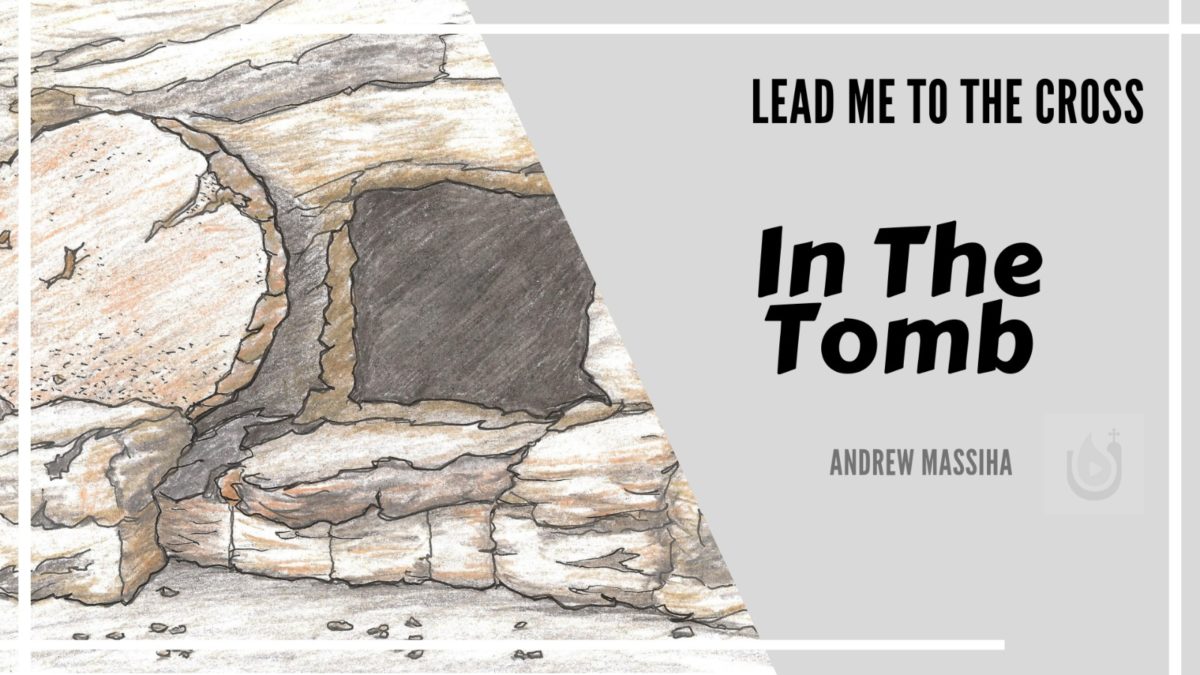
In the Tomb

Lead me to the Cross

In the Tomb

by Andrew Massiha


So you’ve probably just came out of the Good Friday service, ready to smash down anything you can get your hands on after not eating the whole day. The holiest week has come down to this. Abouna leaves us with the final psalm, “I lay down and slept.” What next? How do I sustain my spiritual life?

Let’s go back one step, to the final church rite on Good Friday which is the burial of Christ.The burial begins with the deacons singing the famous hymn, ‘Golgotha.’The tune of this beautiful hymn originates from the times of the pharaohs and this was the tune they used to bury their kings with. The church, in its wisdom, combines our heritage with our faith and uses this tune in the burial of Christ with words which explain the events that have taken place on Good Friday. Whilst the hymn is being chanted, Abouna has prepared before him a white cloth filled with red rose petals and an icon of the burial. He places the icon of the burial on the flower peddles and then puts fragrances and spices and wraps the cloth. He then places two candles or lamps on either side to symbolise the angels that were present at the burial, one at the Head of Christ and one at the feet.

So now that we know the events that have just taken place, what can we, as Christians, make of all this?

The first thing we ought to do is understand the significance of what a burial is. We know that a burial is the time when someone is put to rest as they have departed from this world. The weight of our sin has been lifted so we bury our sin and await our resurrected form in Christ our Saviour. The old has passed away and He is making a new creation out of us all. He is willing and able to change our sinfulness into righteousness, depending on what we are prepared to let go of. This Good Friday, what are you still holding on to? What stands in the way of you and theresurrection? During this time of burial, we must strive to hear the voice of our Lord saying, “Arise, go your way; your faith has made you well”(Luke 17:19).

We make a choice at thetime of burial. Do we choose to remain in the death of the tomb, with our sin, or do we strive for the glorious resurrection to come? We can leave Good Friday at, “I lay down and slept,”or we can strive to rise and carry on –“I awoke for the Lord sustained me!”

Let us therefore strive to leave the tomb with Christ,with our sins buried,and with our hearts filled with joy because the sin of man has been conquered and death has been destroyed!

The burial is the time that Christ overcomes the perils of sin. Those three days are crucial. For starters, if Christ was to immediately rise there would be speculation of whether He had diedor not. Beyond this, there is aprocess that our Lord completed before the resurrection could occur.During this time, Jesus firstenters Hadesand defeats Satan, taking with Him the souls of the righteous. We were finally able to enter His Eternal Kingdom.

We need to remember the process that Jesus took so that we cannot be so harsh on ourselves when we are trapped by a certainsin. Sometimes,we may have the perception that if we pray, if we fast,if we do 500 metanias, the sin will HAVE to go away. This is not always the case. There is a process. Just as Christ had to go through a process in Hades to defeat the devil and all his traps set against us, we too,as Christians should learn a key lesson from this, that is, to understand the sin that I am fighting will take time to overcome. There will be ups and downs, but I have assurance in that Christ conquered death and the devil so there will be victory, no matter how unlikely in seems in the moments of shame of sins committed and repeated.

Good Friday gives us the extra push we need to leave our sins on the Cross and be made new. The questionsI must ask myself are, at the completion of Good Friday, has all holiness departed from me? If your final day is tomorrow, would you be prepared to enter the Kingdom of Heaven? Are you spiritually ready to depart from thisworld just as Christ was ready, or is there something in this world still holding you back? Our Salvation came at a price. Time and effort for genuine repentance and prayer are what is required of me to be prepared for the resurrection that follows the burial.The resurrection is so close now and we must be sure that we rise a new creation!

May the burial of Christ remind us of the love God has for us, that He was willing to die on the Cross, rescue us from Hades and give us salvation through His Blood, to complete His creation, that is, you and me alike.

Good Friday

Lead me to the Cross

Good Friday

by Bethany Kaldas


‘Therefore a man shall leave his father and mother and be joined to his wife, and they shall become one flesh.’

Genesis 2:24

When we think of Good Friday, we do not tend to think of it as…well, good. The closest we come is in acknowledging the fact that it is because of the Crucifixion that we have been saved from sin. But even so we do it in a sombre, regretful tone, the same way we talk about the deaths of soldiers on a battlefield. We shed tears for a horrific and tragic event that happened to Somebody else, a long time ago, very far away.

But Good Friday is about as far from the commemoration of a terrible misfortune as you can get. It is not a commemoration at all. Good Friday is the resolution of the greatest love story in all Creation. And it did not merely happen. It is happening to us.

It is a story that begins with the fitting words, ‘In the beginning, God created the heavens and the earth.’ (Genesis 1:1). The world is created—marvels upon marvels that had yet to be seen in the universe! Substance where there was once nothing! Light in a cosmos which had been blind! Water to a land that had never tasted a drop! Living creatures of boundless forms inhabiting a once lifeless world! Each day something more and more wonderful!

…And yet it was incomplete.

Then came the sixth day of Creation, and something… Different happens.

‘Then God said, “Let Us make man in Our image, according to Our likeness.”’

Genesis 2:26

We know this story well. This is the creation of the first humans. But this is not just some distant tale about Adam and Eve. This is the beginning of us.

As Fr John Behr puts it, this is the announcement of God’s own project—humanity—a project that, unlike His other countless wonders, ‘is not completed by His word alone’ (Becoming Human, p. 35). God has said that humanity is to be in His ‘image and likeness’ (Genesis 1:26), and yet the creature that is formed of the dust falls away. Broken and confused, mankind comes to barely resemble the Being it was made after. Of all of Creation, humanity is the only work which is begun but not yet finished.

Fr John goes on to claim that through all of history, from the sixth day of Creation, not one human being has been seen on Earth. Until Good Friday. Until the Creator Himself came down to His Creation, and hanging on the Cross, on the verge of death, declared with utter finality:

‘It is finished.’

John 19:30

And finally, the sixth day of Creation comes to its end.

Good Friday is the day we are completed. It is the day we become the glorious Bride of Christ. It is the day we become the Church—we finally fulfil that image and likeness we were made for. This when we become the True Eve, who is to the True Adam, ‘of His flesh and of His bones’ (Ephesians 5:30). With the sacrificial death of the first True Human in all the universe, Christ Himself, human kind is finally born and finally united with Her Creator.

‘Thus the day of Jesus’ crucifixion is His wedding day, when He, the new Adam, is ‘joined to His wife’, the Church, in an everlasting marriage covenant.’

Brant Pitre, Jesus the Bridegroom

But it is not enough to know this happened—we must see that it is happening.

In his book, Jesus the Bridegroom, Brant Pitre describes Christ’s sacrifice in this way:

‘Jesus is united with His bride through the sacrifice of His own flesh and blood, poured out literally on Calvary and then miraculously in the sacraments of the Church.’

Whenever we partake of the Eucharist, we are participating in the very same sacrifice that was given on that Cross, the Cross we too often feel is only a distant historical event to be commemorated in ritual.

But it is even more than that. Through this sacrifice, the sacrifice that birthed humanity and wed us to our Maker, we see a reality that the saints before us realised centuries ago. An uncomfortable reality, perhaps, captured so perfectly in Romans 6:8: ‘Now if we have died with Christ, we believe that we shall also live with Him.’ It is the reality that we can only live if we first die.

We see this reality portrayed most potently in examples such as Saint Ignatius of Antioch. In his letters, he begged his friends not to do anything that might prevent his martyrdom. He pleads to them with all sincerity, ‘Do not hinder me from living.’ He realised that one cannot really have a life by trying to preserve it for oneself—true life comes through unity with Christ, and that through death with Christ.

Martyrdom seems like a radical idea to the modern, western mind—and by no means am I suggesting that we cannot be real, living Christians unless we hop on a plane and find someone who will kill us for our beliefs. We need not travel so far for martyrdom. For true martyrdom is not mere physical death, but the sacrifice of one’s whole self for the sake of Christ.

‘Until you have given up yourself to Him you will not have a real self.’

C. S. Lewis, Mere Christianity

And it is in this that we find the goodness of Good Friday.

God’s greatest work—the human race, the Church, His Bride—was completed and wed to Him through the voluntary sacrifice of His whole self. In precisely the same way, we can only be wholly ourselves—that most glorious creature, that image and likeness of God—if we give our whole selves away for His sake.

Good Friday is not a commemoration of a tragic event. Good Friday is when we find life in the giving up of life, when we die with Him in order to live with Him.

‘Therefore, my brethren, you also have become dead to the law through the body of Christ, that you may be married to another—to Him who was raised from the dead, that we should bear fruit to God.’

Romans 7:4

Covenant Thursday

Lead me to the Cross

Covenant Thursday

by Marc Eskander


So He said to him, “What is your name?” He said, “Jacob.”  And He said, “Your name shall no longer be called Jacob, but Israel; for you have struggled with God and with men, and have prevailed.”

Genesis 32:27-28

 Wrestling. It’s one of the oldest documented sports. It has existed since Creation, maybe not in the same format that UFC takes these days, but nevertheless violence has existed ever since Lucifer was cast out of heaven.

 Adam, Eve, Noah, Abraham, Job, Moses, David, Solomon St Paul, St Peter…the list goes on…they all had one thing in common – they all wrestled. They wrestled with their faith in God, with the devil, with their own will and ultimately God Himself.

 Jacob, probably the most infamous of these ‘wrestlers,’ tussled with God physically, “face-to-face,” as we are told in Genesis, and subseuently walked away with a permanent limp. A stark reminder of his one-on-one encounter with the Almighty. However, something else changed – his identity. He became Israel, meaning, to struggle or to strive and became a father to the nation of Israel. This nation was one that would wrestle with God.

 Fast forward a few thousand years and it’s a chilly Thursday night in Jerusalem. Jesus has just finished the Passover with His twelve disciples and makes His way to the Mount of Olives, specifically the Garden of Gethsemane, to pray… to wrestle?

The Garden

 Then He said to them, “My soul is exceedingly sorrowful, even to death. Stay here and watch with Me.”

Matthew 26:38 

 Jesus, in the Garden of Gethsemane, came face-to-face with God the Father. He was about to realise the task that lay ahead of him and the immense weight about to be laid on his shoulders, but ultimately, His willingness to take it all.

 Why was the Garden necessary? Surely Jesus knew what was going to happen? Surely He had accepted it in His heart and was ready to do it…

 The Garden represents a very important part of our life in Christ. It is a place where we come face to face with the prospect of pain and suffering in our journey with God. Where we are left alone to work out who we are and where we’re going. It is sometimes cold, dark and unfamiliar. In the garden you will be deserted by those who love you, it will be lonely. However, Christ gives us the strength to endure this.

 The last week of Christ’s life on earth was a battle – against public opinion and His closest friends, a battle with the impending suffering, and ultimately a victorious battle with death.

 Gethsemane is the place where Our Lord came to count the cost of this battle. He had come to reconcile His dread and fear of the immense suffering He was about to undertake with God’s will for Him and for our salvation. We need to enter our own personal Gethsemane. A place where seeds of prayer, tears, and watchfulness are planted. Where we can discover firstly our own malevolent and fleshly will, and then, learn to crucify that will and align it to God’s.

 A place where we can sit down, and really think about what it’s going to take for us to follow Him. We cannot embark on this path with uncertainty or inner conflict. Our pursuit of Christ and His will must be done with all our “heart, soul, strength and mind” (Mark 12:30-31)and be fully united in this journey. The bible is explicit about that from beginning to end,“…every city or house divided against itself will not stand.” (Matt 12:25) While this verse can be applied to many situations and virtues, I think the most poignant is our own house. Our house must be fully and wholeheartedly united in its resolve to follow Christ. Otherwise “the rains [will] descend, the floods [will] come, and the winds [will] blow and beat on that house; and it [will] fall.” (Matt 7:24-27)

 Throughout His ministry, Christ showed us the importance of regular prayer, exemplified in Gethsemane. Those remarkable words that Christ offered in His pain, “nevertheless not My will, but Yours, be done” (Luke 22:42). Christ’s request was to remove this cup of suffering, however, He didn’t have a Plan B. He didn’t ask for the suffering to be removed and then proceed to do His own thing. His request was immediately followed by His desire to align His will to God’s. That is how we should be. We cannot pray “thy will be done, on earth as it is in heaven,” if our heart desires the will of our flesh. This is a double minded prayer, lacking integrity.

 He also taught us the importance of solitude and watchfulness. These two go hand in hand in our journey with God.  Finding time for solitude allows us to shut out the invading thoughts of this world and of ourselves and the many distractions that we constantly encounter. Through this process, we can learn to be watchful. To be watchful so that the door of our heart is tightly shut to the enemy, and we can concentrate on the task at hand. This task is coming face to face with our sinfulness, with our repentance, and with God.

 The Enemy

“The spirit indeed is willing, but the flesh is weak.”

Matthew 26:40

 This fight is one that we must learn to apply in our lives. The verse above embodies this battle well. God breathed His own breath into us to give us life so that we constantly yearn to be united with Him, our Creator and Giver of all good things. While our spirit yearns for Him, the flesh remains to seek its own. We constantly question the direction we’re going and what God’s plan for our life is. Instead, we should question whether our determination to finding out what God’s Will is, may be actually sabotaged by following our own will.

 A life with Christ certainly isn’t a sweet pill. It is not a life with no problems and no worries, a life with no negative emotions or unhappiness. It is a constant struggle. A “daily death” as St Paul said in 1 Corinthians. A daily death of our desires, will, passions, lusts, and anything else that draws us away from that narrow way.

 It is difficult, no doubt about it. However it is this daily death of ourselves, that allows a new creation to grow in its place. Jesus tells us in Matthew 7:14, “narrow is the gate and difficult is the way which leads to life, and there are few who find it.” Facing up to God’s Will is hard, and countless times in the Bible people have tried to escape. It can be terrifying, illogical, painful and filled with doubt. Yet one thing is certain and that is the fact that God isn’t unsure about His Will.

 We sometimes try and negotiate with God: “why can’t it be done this way? Shouldn’t we consider the other options? I don’t think I can do this.”

 Our unwillingness to accept only prolongs our pain, and instead of struggling with God to come closer to and love Him, we are resisting and running away from Him. The next question that we logically ask, what is God’s will for your life? I don’t know. No one does but God. However…

 Abraham learnt about it in his pain of being childless.

Job found it in his suffering and extreme loss.

St Paul discovered it in his blindness.

Moses uncovered it in his 40 years leading the disobedient tribe of Israel.

And Christ accepted it in the Garden, sweating blood and bearing the weight of infinite iniquity.

 I think we can see here clearly that our submission to Him, the suffering and pain in our lives, our constant struggle within ourselves to reconcile our will to His, to know him further and to become closer to him-  are victories in themselves. However, they are the keys to discovering where God wants us to go.

 Jesus and Jacob both struggled with God, and both were wounded. Both asked requests of our Father. Jacob received his blessing while Christ was asked to yield to God’s plan for our salvation.

 Both ‘wrestles’ brought forth new identities. Jacob, in his name change to Israel, and Christ through the transformation of our identity from lost to found, and from dead to alive. Christ improved on the example of Jacob in that His struggle and suffering redeemed us, and gave us the blessings that are rightfully His. He took on the wounds that we deserved as “ He was wounded for our transgressions, He was bruised for our iniquities”. (Isaiah 53:5) 

 In Christ, our struggles become our defining moments. They shape our Christ-like identity, they allow us to know ourselves and therefore to know our Creator.

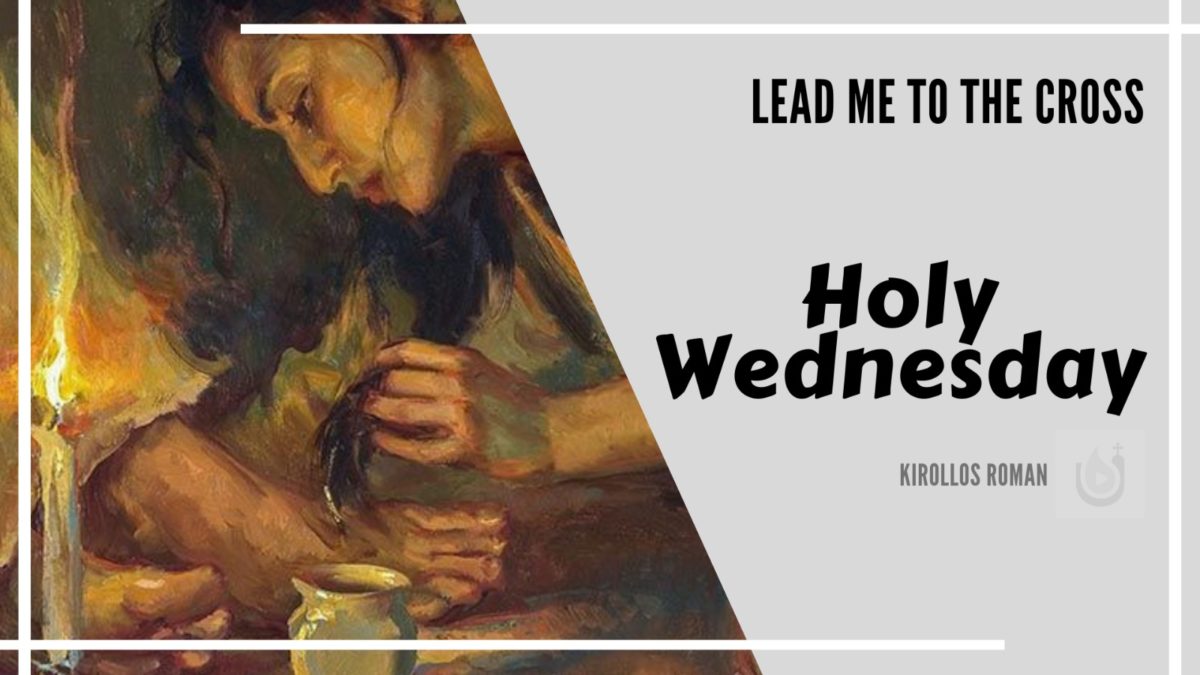
Holy Wednesday

Lead me to the Cross

Holy Wednesday

by Kirollos Roman


On Holy Wednesday of Pascha week, we generally remember two characters. The character of Judas Iscariot, and conversely, the character of the woman who poured the fragrant oil on the head of our Lord and Saviour Jesus Christ. A stranger who pleased the Lord on the same the day His disciple betrayed Him. This annual comparison never fails to ask us the question: who am I? Judas Iscariot, who betrays Him. Or the woman who poured the fragrant oil.

The story of the woman who poured the fragrant oil, as we read in the Gospel of Saint Matthew 26:1-13 and Saint Mark 14:3-9, is a story of silent love. She never spoke a single word. It appears she chose not to, despite what she may have heard against her. Some said: “why was this fragrant oil wasted” (Mark 14:4), while others, “criticized her sharply” (Mark 14:5). This woman had so much to say, but without words – silent love. This type of love, in the eyes of God, is much louder than any love with words. There is a silent love that can be shown, more powerful than any word that can be said. “For He will quiet you with His love” (Zephaniah 3). On the cross of our Lord Jesus Christ, what words were left to say? Christ spent years preaching and teaching. Performing thousands of miracles and acts of compassion. But there came a time of silence – the Cross. On the Cross, He offered us His undying love. A silent love. A love worth a thousand words never spoken. Precious in the eyes of the Lord are those who love with more than words.

On another occasion, fragrant oil is poured not only on the head of our Saviour, but His feet (John 12:1-19). St Paul comments and says: “And He (i.e. Christ) is the head of the body, the Church” (Colossians 4:18). Who then is the feet? The poor, sick and helpless. St Ambrosiaster says: “Because our feet are low and in need of honor, we adorn them with shoes”. Thus, silent love is two fold – love of the head, and love of the feet. Love of the head in our attendance of the daily Pascha. Love of the head in our chanting of ‘Thok Te-tee Gom’. Love of the head in our persistent prayer, contemplation and meditation. Love of the head in our tears of repentance. All of these, are moments of fragrant oil on the head of Christ.

What about the anointing of the feet? The feet that others questioned: “Why was this fragrant oil not sold ?” (John 12:5). The feet that were wiped with the head of her hair, a woman who couldn’t bear to look Him in the eye. Who are the feet of Christ? They are the forgotten. The weak. The hurt. Those who don’t appear as apparent as the head or the neck or the shoulders. These are the feet of Christ. For what is lower than the feet? But be assured, the oil that anoints the feet is valuable in the eyes of God. Jesus said, “Let her alone; she has kept this for the day of My burial” (John 12:7). When you offer your love to those in need, be assured it has reached the head of Christ. Let me practice this love in the final three days of the Pascha. What is something of value in my home that I can offer to someone forgotten, weak or hurt? It must be valuable like “ an alabaster flask of very costly oil of spikenard” (Mark 14:3). And again, be assured, it is not a waste, for it will anoint the feet of Christ, and please Christ Himself.

Every year during the Holy Pascha, we’re faced with the question: who am I? Judas Iscariot, who betrays our Saviour; or the woman who poured the fragrant oil. Judas Iscariot, who sold Him for thirty silver coins; or the woman who bought His love for three hundred denarii?

In the first epistle to St Timothy, St Paul teaches his disciple: “a bishop…must not be greedy for money” (1 Tim 3:3). Why is that? The truth is, if I hold anything in my life more precious than God, this leaves me room to deny Him. Judas Iscariot loved money more than He did God, so he stole from the church’s money box. Jesus asks the rich young ruler: “If you want to be perfect, go, sell what you have and give to the poor…and come, follow Me”. But he could not deny his riches. So we read: “he went away sorrowful, for he had great possessions” (Matt 19:22). Again, the sons of Eli the priest were greedy. They took portions from the burnt sacrifices for themselves, and so led the whole Kingdom of Israel astray.

What about me? Is my relationship with God based on possessions? Do I only pray to Him when He gives me? Or when I want something. The church urges us to strive to be like Job on this day, even naming today, “Job Wednesday,” so that we are continually reminded of his faith on this day.  Job lost everything. His money. But also his family. His livestock. His health. And after all this, he says: “The Lord gave, and the Lord has taken away; Blessed be the name of the Lord.” (Job 1:21). Let me be like Job. On Holy Wednesday, the Church reads the whole book of Job so that we imitate him and by extension, imitate Christ. Let us learn to hold our faith more precious than money and all other worldly cares.

Holy Tuesday

Lead me to the Cross

Holy Tuesday

by Rebecca Kozman


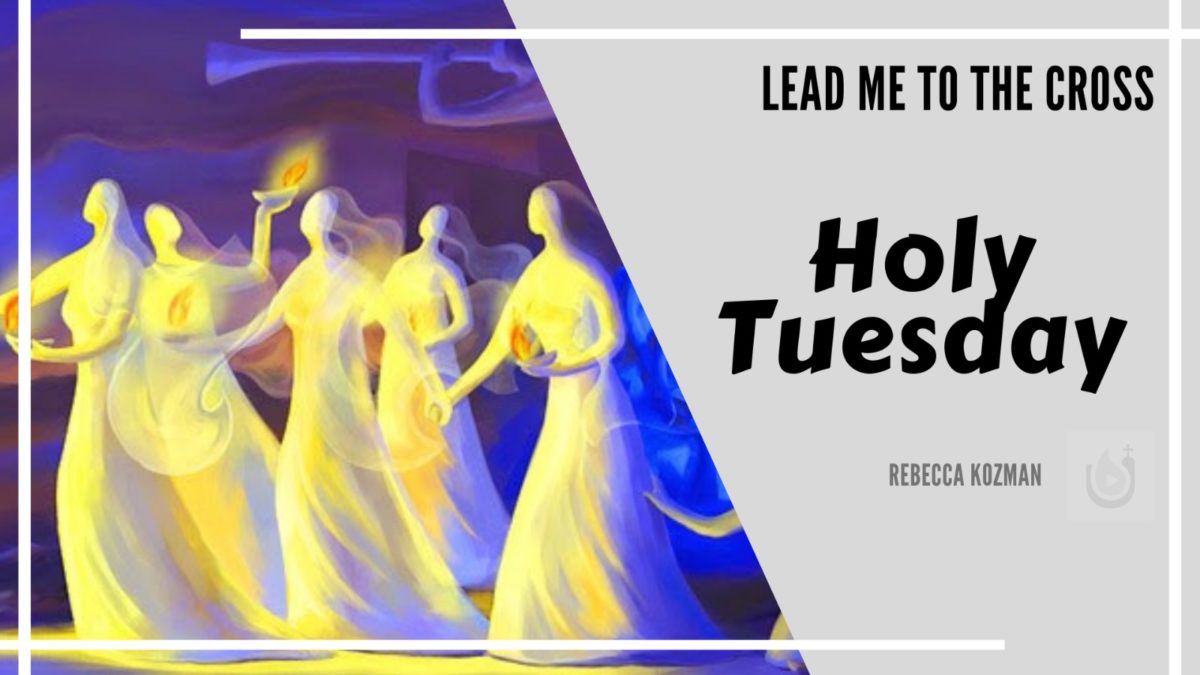
Today the Church focuses on the Lord as our Bridegroom, so that we may have hearts that desire Him and imitate the five wise virgins who were prepared and ready for their Bridegroom. The readings of this great and holy day surround two major themes – the difference between those who choose to follow the way of the Lord and the rest of the world, and the Kingdom for all people who have kept His promise and wait on His arrival  as opposed to a specifically chosen nation.

There are two parables we should contemplate on when we view the Lord as our Bridegroom; the parable of the wedding garment, and the five wise and five foolish virgins. In the Gospel of Matthew 22:1-14, we read the first parable and find Christ comparing Heaven to a wedding banquet prepared by a king for his son. Many people were invited, but when the time for the banquet came, those who were invited refused to come and made excuses. In fact, the king’s servants who were sent to spread the invitations were mistreated and killed! The king furiously sent an army to avenge the death of his servants, as well as invitations to anyone he could find to fill the wedding banquet. But he noticed a man not wearing a wedding garment, so he cast him out.

The king here is God the Father, and the son is Jesus Christ. Israel is the nation that held the invitation to the Kingdom, but when the time came for the Kingdom to appear, they refused to believe it. Many prophets and even disciples had been killed spreading this message. The king’s vengeance on the death of his servants can be interpreted as a prophecy of Jerusalem’s destruction by the Romans. This isn’t to say that God looks for revenge, but that He is patient and will not tolerate wickedness forever. His judgement will come to those who reject His offer of salvation – His Son. The wedding invitation is offered to anyone and everyone, strangers both good and bad. The message of the Gospel is that Heaven is for everyone who accepts Christ and wears the wedding garment, a symbol of the righteous life which is united fully with the Lord. We eventually find out later in this Holy Week that Judas was the man without the heavenly garment, because he not only denied salvation but also betrayed our Lord.

The second parable of the five wise and five foolish virgins can be found in Matthew 25:1-13. This Gospel compares those who are celebrating by eating, drinking and sinning, with the ready, watchful, and righteous servants of God. This passage begins our focus on the parable of the ten virgins. This parable has a unique role in the Church as it not only prepares for Pascha but also is a daily reminder as the Gospel of the First Watch of the Midnight Hour. The context of this parable is important in order to fully understand what Christ is trying to teach us. It describes a first-century Jewish wedding, whereby the bridegroom and his close friends go to the bride’s house for a small ceremony and procession through the streets at night, before returning home. The ten virgins would have been the bridesmaids, and they expect to meet the groom as he comes to the bride’s house. Each person in the procession was expected to carry their own lamps. If they didn’t have one, they were assumed to be a party crasher and couldn’t attend the celebrations. Now, the virgins did not know when the groom would arrive to the bride’s house, so they had a lamp lit at all times, ready for him. This meant they needed to have extra oil in case their lamps burnt out.  See where this is going?

In the parable, the five virgins who had extra oil represent those who are looking with eagerness for the coming of Christ. They have faith and determination to be ready at any given time. The other five virgins without the extra oil represent false believers who enjoy the things of the world without true love for Christ. They are more excited about the after-party than actually seeing the bridegroom. Their hope is that their relationship with the true believers, those who had extra oil, will bring them to the kingdom at the end. So, when the foolish virgins say, “give us some of your oil,”it means that one person’s faith cannot save another.

Christ says that His return will be like what it was in the days of Noah, where lives were centred on worldly and sinful things. We should also remember that those in the days of Noah were warned of the flood, and judgement eventually came. Those who ignored the warnings were not ready, and so it came unexpectedly.

The emphasis on constant readiness is a challenge for us. We also can appear not ready in the same ways as the evil servants. Upon His return, we must follow the Lord’s commandments and teachings, treat each other with love and not give in to worldly pleasures and desires, because the Kingdom of Heaven is much better! Don’t lose yourself to this world, give yourself to Christ and prepare yourself for His joyous coming so that you may finally be united with your Bridegroom!

May God guide you all through the rest of this Holy and Blessed Pascha Week, giving you the strength to maximise your relationship with God and fall in love with Him.

Holy Monday

Lead me to the Cross

Holy Monday

by Meray Shehata


Where are my fruits?

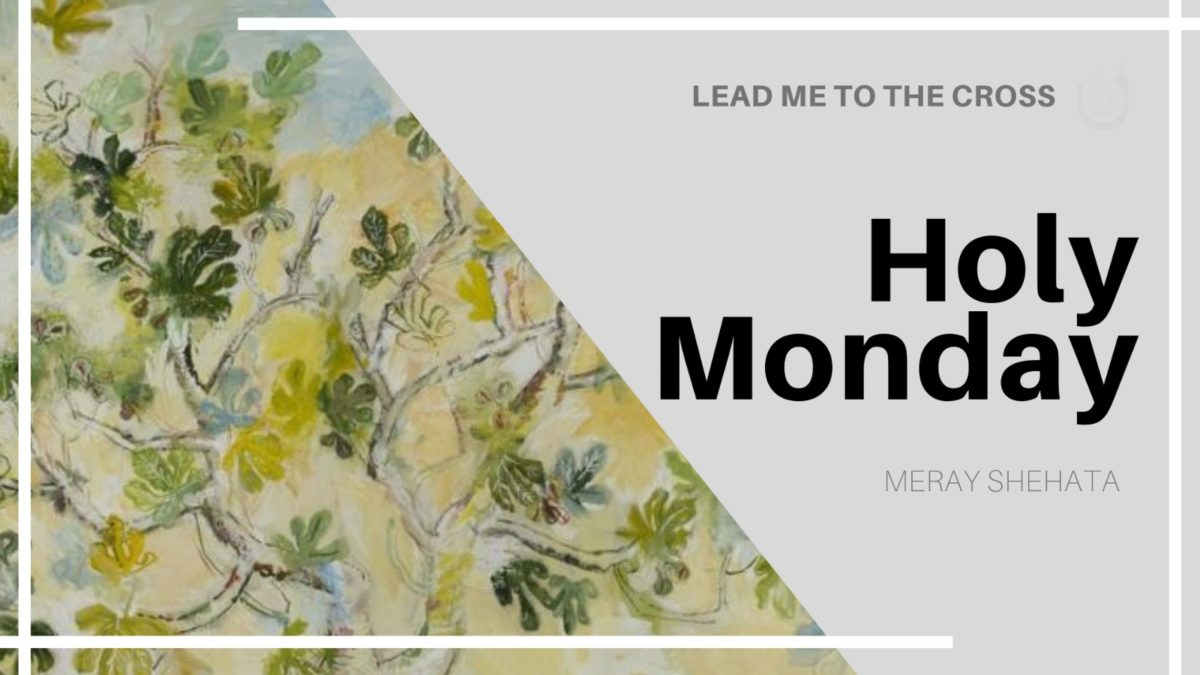
Think of the fig tree. One of God’s creations planted as a seed as all the other trees were, cared for and given water. Jesus expected great things from this plant as He gave it the perfect environment to thrive and flourish.  Now when it came time for Jesus to reap the fruits of the tree and found none, He cursed the plant.

The lesson for us is that we are not living a life that is our own. Each day, each hour and each second of our lives have been gifted to us. As with the fig tree, which has been granted so much time to bear fruit, each one of our breaths is counted.

Our God is a merciful, just and kind God. He waits at the door of your heart seeking to enter and provide you with your heart’s desire, He waits to come in and give you salvation. In return, He has one request. Repentance. If the plantation of your heart is fruitless then what good is it then to be cut down?

Seek the Lord while He may be found,
Call upon Him while He is near.

Isaiah 55:6

As we are living on borrowed time, it’s important to remember that everything ends except for the Lord. He is patient and gives us enough time to change and bear fruit. Even more, God is just, He knows the complexity of your character. How comforting is it to know that, “The Lord is not slack concerning His promise, as some count slackness, but is longsuffering toward us, not willing that any should perish but that all should come to repentance” (2 Peter 3:9)

Let’s look at the tree from another angle. The fig tree was a beautiful tree. “And seeing from afar a fig tree having leaves” Jesus being hungry went to inspect it as this wasn’t the season for the fruit. So not only was the tree not meant to have fruit, but it was lavishly displaying its leaves when other trees had nothing to show but bare branches.

Our lives can also appear abundant. Maybe our leaves portray us as; having the perfect career, an impeccable church servant or a flawless family. Others can be deceived by the extravagant leaves we parade; we may even fall into the trap and see our self falsely. What about God? Will He be deceived by the show we flaunt? Or, will He look deeper to find fruit?

“Examine yourselves as to whether you are in the faith. Test yourselves. Do you not know yourselves, that Jesus Christ is in you?—unless indeed you are disqualified”

2 Corinthian 13:5

As with the fig tree who bears leaves and no fruit, we cannot become half-hearted Christians. The cursing of the fig tree was symbolic of the cursing of the nominal Christian. The alleged believer who is unrepentant and faithless is undeserving of the kingdom of God. Which is why our actions, thought and feeling should reflect our citizenship in Heaven.

“Enter by the narrow gate; for wide is the gate and broad is the way that leads to destruction, and there are many who go in by it. Because narrow is the gate and difficult is the way which leads to life, and there are few who find it.”

Matthew 7: 13-15

Palm Sunday

Lead me to the Cross

Palm Sunday

by Amy Saleam


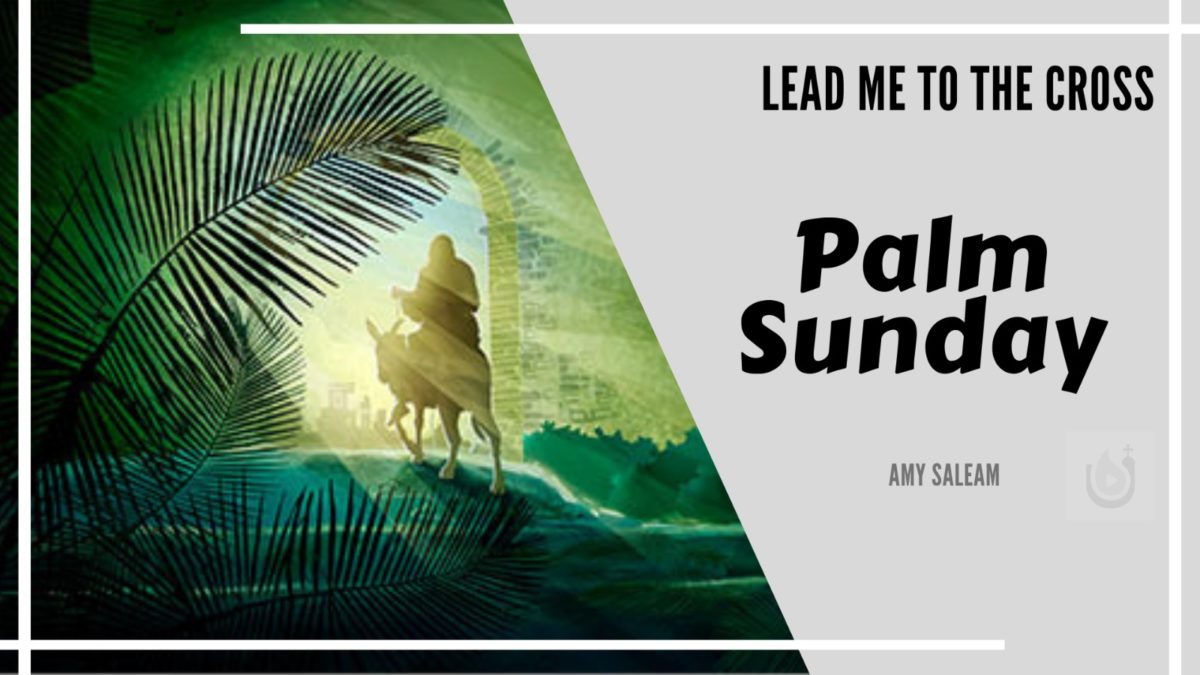
 Here we are, the first day of Holy Week – Palm Sunday. Palm branches have claimed the name of today but they are merely what make it unique. The Gospels paint a picture of a crowd lined along the road as Jesus entered Jerusalem. Riding on the beast of burden, a path of palm trees and worn clothing formed a carpet of endearment before Him. “Hosanna… blessed is He who comes in the name of the Lord,” He was praised. When we look at stories in the Bible that recount the life of Christ, there is always a message deeper than what appears on the surface. So what is today really about?

No beautiful horse, no guards for protection, no army around Him – no grand gestures. Despite who Christ is, all His Glory and Greatness, He chooses to enter the city with complete humility, seated on an animal who contradicts all things royal. The humility demonstrated by Christ on Palm Sunday poses the perfect snapshot of who Christ is, and who we are to be, so that our lives may be shadows of Him.

Christ leads the example of humility by choosing to humble himself without need to be humbled by another. Just as he chose to enter with humility, days later, he also chose death on our behalf. Not because He was forced to, not because He owes it to us, but because of His love for us. Allowing Himself to be placed at the forefront of humiliation and pain, He nailed our sins to the cross. And so you see, the triumph of Christ does not lay in the praise of the people on Palm Sunday, but through His passion towards us that would be soon demonstrated.

Can Pride and Humility Co-exist?

“How could he speak to me like that?”

 “Why does she think it is okay to ignore me?”

“How could he say that to me?”

Undoubtedly, these thoughts have crossed your mind; I can be the first to put my hand up to this. These are what we call ‘finger pointing’ thoughts and are a product of pride. When you spend your day focusing on “me” – how you feel, replaying a hurtful interaction, or even just focusing solely on ticking off your to-do-list for the day, you occupy your mind with thoughts of, “I” rather than thoughts of Him. We end off our self-consumed day with a one-minute prayer as though we are doing God a favour in our “busy” lifestyle by remembering Him, mid yawn. The danger of this is that it provides perfect opportunity for pride to make itself a comfortable home within us. Just as light and darkness cannot simultaneously occupy the same room; humility and pride cannot live in the same heart.

When self-absorbing thoughts become our daily practice, our vision of Christ becomes blurred and His voice harder to hear. So, if we are to reflect the humility of Christ, we need to let go of ourselves and fill our lives with Him through prayer, Scripture and fellowship. When we do this, we learn that a humble response towards others rejects the shame that follows a proud reaction, and rather it embodies wisdom – a wisdom that comes from knowing Christ.

“By humility and the fear of the Lord, are riches and honour and life”

Proverbs 22:4.(NKJV)

The Bible tells us that when we embody Christ’s humility, we are given life and nourishment. So when we are humiliated and hurt by others, let us be reminded that a meek heart and humble response is a reflection of Christ and honours God. If we are to know Christ, we are to personify humility. The more you are filled with Him the sooner pride will know it has no place in you.

The True Victory

“The way to Christ is first through humility, second through humility, and third through humility. If humility does not precede and accompany and follow every good work we do, if it is not before us to focus on, if it is not beside us to lean upon, if it is not behind us to fence us in, pride will wrench from our hand any good deed we do at the very moment we do it”

– St Augustine

Upon His entrance into Jerusalem, the crowds shouted “Hosanna,” meaning ‘save us.’ They were desperate to be saved from the Roman rule over them, ignorant to the fact that the true saving they needed was the one of their heart – but Christ was well aware.

We are very much like the Israelites on Palm Sunday. We come before the Lord and ask Him to fix our problems and change our circumstances, forgetting that perhaps it is the condition of our heart that requires edification. Before we point the finger at the other person or question why certain things had to happen to us, let us go to God in prayer that he may humble and change our heart.

A humble heart gives us a Christ centered perspective of our situations. Through this, we are then able to truly forgive and extend grace to others, even if we are placed in the most unwanted of situations. As Saint Augustine perfectly puts it, if humility does not take precedence over all that we do, our efforts will be fruitless and the true saving of ourselves overshadowed. Perhaps I dare to say that the core of many of our problems and even our external concerns is because we overlook the real issue within us. You see, Palm Sunday demonstrates that beyond the circumstances that we may deem unbearable, and problems that we desire be removed, Christ came for a greater purpose than to save us from inconveniences – but came to purify our hearts and give us life through Him. He did not enter Jerusalem to conquer the Romans, but to conquer much more than that.

It’s not too late

“Of all the afflictions that burden the human race, there is not one, whether spiritual or bodily, that cannot be healed by the Holy Scriptures”

– St John Chrysostom

As we approach the end of Lent and begin the Holy Pascha today, let us be reminded of the beauty of this season. In a few days time we celebrate not only the resurrection of Christ, but also the resurrection of our renewed self. This was something beautiful that I was reminded of by one of our Church Fathers recently. And so as we spend this week reflecting on the lead up to Easter Sunday, let us encourage one another to die to ourselves and celebrate not only His resurrection, but ours also. Although none of us can say we are without blemish, let us confide in the fact that we can leave it all at the cross and have a fresh start. Just as Christ was welcomed into Jerusalem, may we welcome Him into our lives.

Not just on Palm Sunday but every day this Holy Week, may we look to His word and reflect on Scripture, pray fervently, repent wholeheartedly and return to Our First Love.

Lord, consider our laments and hear our cries for help as we come before you. Protect us from thoughts that pierce through our hearts and break us down. Help us reflect Your humility through actions that honour You. Show us that when we wait, you bring light to the darkness. Show us that when we trust, you take over and fill us with Your peace. Help us take refuge in You as the only one that can fill and satisfy our hearts.

Glory be to God, forever. Amen.