Lamb of God

Lamb of God

By Monica Gerges

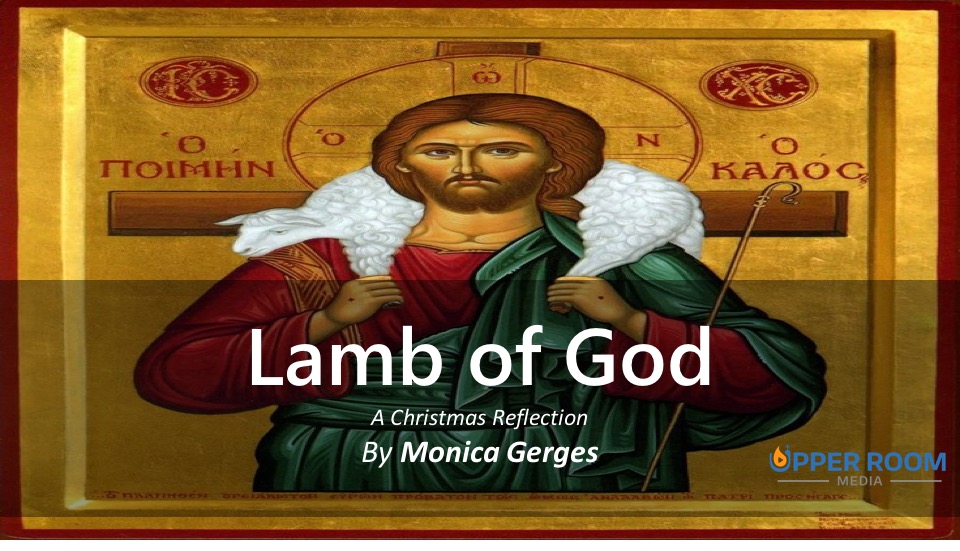
Although we celebrate the birth of Christ during the Feast of the Nativity, we can’t overlook the implications and ultimate purpose of Christ’s incarnation and birth because, just like many of the other major feasts, Christmas should serve to remind us of God’s humility, sacrifice and love for us. Christ comes as “the Lamb of God, who takes away the sin of the world!” (John 1:29) and unsurprisingly the scripture is riddled with imagery likening the Messiah to the perfect sacrificial lamb.

The sacrifice of lambs plays a very important role in Judaism, of particular importance to us is the Passover sacrifice and the sin/purification offering. The Feast of the Passover is one of the main Jewish holidays and a celebration in remembrance of God’s deliverance of the Israelites from slavery in Egypt. In fact, the slaughter of the Passover lamb and the application of its blood to the doorposts of the houses (so that the Angel of Death would pass over that house) is mimicked when Christ’s blood is shed on the wood of the Cross to save us from the Angel of (spiritual) Death – Christ is our Passover lamb. During the sin/purification offering, an individual’s sins were ‘transferred’ to the lamb which was then killed for the forgiveness of their sins; similarly, the sin of all humanity was placed on Christ who was then crucified so that we could be saved.

When faced with conditions of stress or pain, most animals vocalise their trauma and do everything in their limited power to escape such circumstances, however lambs which are simply small, weak animals are instead, silent and submissive. Similarly, Christ was “oppressed and He was afflicted, yet He opened not His mouth; He was led as a lamb to the slaughter…” (Isaiah 53:7)

It is through Christ’s death on the cross as God’s perfect sacrificial lamb that we can now attain eternal life. The fact that God Himself has provided the offering that atones for our sins is part of the glorious good news of the gospel and may this season always remind us of God’s infinite love for us.

Glory be to God forever. Amen.

Hebrews 12:14 – A Contemplation

“Pursue peace with all people, and holiness, without which no one will see the Lord.”

Hebrews 12:14

By: Christine Azer

As I was contemplating this verse, I was struck by the specific use of the word “pursue” which implies an active decision rather than a passive action. As Christians, we aim “if it is possible, as much as depends on you, live peaceably with all men” –Romans 12:18. Contrary to the belief that a person must first be peaceful to show peace to others, pursuing peace helps us attain this sense of calmness. We are responsible for taking the first step in mending a damaged relationship.

The consequences of showing peace to others are not only self-beneficial but critical for the salvation of others, as expressed through the end of the verse. Evangelising can occur unnoticed to the evangeliser; mainly when others observe the lifestyle of a Christian and admire it. They seek the peace that we show to others.

A perfect of example of this active pursuit of peace is seen in Genesis 33, where Jacob attempts to mend his relationship with his brother, Esau. To pursue peace, firstly, we must pray fervently to have peace with someone; this is necessary because Satan makes it difficult for us to be united in Christ as he promotes division. Jacob “wrestled” with the Lord because the lack of peace between him and his brother troubled him. Secondly, pursuing peace requires humility, as seen through Jacob when he “bowed himself to the ground seven times”. Thirdly, he offered physical gifts, “receive my present from my hand”, which was his way of pursuing peace.

We also see this in the character Ibrahim El-Gohary, the Egyptian prime minister during the late 18th century, who acted as the peacemaker between his brother and his brother’s abuser. From his actions, we too are called to act as peacemakers not only to mend our own relationships with others but to promote peace between all people.

“Blessed are the peacemakers, for they shall be called sons of God”- Matt 5:9

Glory be to God. Amen.

The Greatness of John the Baptist

The Greatness of John the Baptist

By Fr Mark Basily

Imagine Fr Yacoub told you that you were the greatest person in St Mark’s Church. Now imagine Bishop Daniel told you that you were the greatest person in the diocese of Sydney. Now imagine Pope Tawadros said that you were the greatest person in the Coptic Orthodox Church. Well here we have, in Luke7:28, Christ Himself saying that John the Baptist was the greatest person to ever live! Why is that though?

We all aspire to be great in our endeavours, whether it be at work or in various services. So what can we learn about St John the Baptist that made our Lord turn to him and say “you are the greatest”; it was his humility as displayed by his words. Often from someone’s words you can tell what he or she was about. It illustrates the principles that person stood for. So today we will look at five comments from the mouth of this great saint to try to understand why Christ said “among those born of women there is not a greater prophet than John the Baptist; but he who is least in the kingdom of God is greater than he”. Luke 7:28 

  1. “A man can receive nothing unless it has been given to him by Heaven” – John 3:27
    Here we see that St John the Baptist believes that everything he has and everything he owns has been given to him by God. This is a beautiful principle to live by. We become relieved when we realise that everything I have, even my possessions belong to God. Recently the fathers went to visit a family who built a nice big house. When the fathers went to visit, the family said “This house is not ours, it belongs to God and His Church. Whatever you need that’s in this house, it’s yours.” So I decided to take them up on their offer and half jokingly I said that we need a studio in your house. Now we permanently have one of their rooms as a studio for when the Church needs to record music. So this idea that everything of mine is God’s is one of the reasons why St John the Baptist is so great.
  2. “I am not the Christ” – John 3:28
    At that time, St John the Baptist was baptizing and he had a large following and so it was very easy for him to accept it when people asked him whether he was Christ or not. St John Chrysostom says that St John the Baptist could’ve taken all the glory for himself. Rather, he referred the glory to someone else; Christ. So the second principle we learn is to refer all glory to Christ. When Anba Antonious Morkos, bishop of South Africa, came to a youth meeting he spoke extensively about the achievements in his diocese. A youth put up their hand and asked ‘How can you not feel a sense of pride when you speak about these things?’ For Sayedna he was very clear, he said ‘all the achievements are God’s work, I just happened to be used in the process’. So in my life, if I live attributing all success to the Lord, then I’m on the path to greatness that St John the Baptist was.
  3. “I have been sent before Him” – John 3:28
    St John the Baptist understood very well that his mission in life was to prepare the path of glory for Christ. This is another quality of greatness, if I am able to prepare a path for people. Often we prepare pathways for ourselves and make decisions to please us, but what if I could live like John the Baptist, preparing others for glory. Fr Daniel Fanous is currently doing a PHD about Pope Kirollos; a man who we all know barely gave sermons and didn’t write many books. Due to this, people concluded that he wasn’t good at giving talks, that’s why he never did it. However, Fr Daniel found in his research proof that Pope Kirollos was a brilliant writer and an excellent speaker. One of his sermons was distributed to thousand of churches; but then Pope Kirollos just stopped. He did this to create pathways for other people. He ordained Bishop Gregarious to be the official spokesperson for the Church and Bishop Shenouda to be bishop of education, who later became pope. This is the way John the Baptist lived and hence he said, “I have been sent before Him”.
  4. “Therefore this joy of mine is fulfilled” – John 3:29
    In this verse, St John the Baptist likens himself to a best man who is joyful to see the bridegroom married to his bride. In our lives we always pursue what will make us happy. For this great saint, his joy was extracted from others and from seeing Christ. Imagine if I am joyful by seeing others’ lives going well, if I share in the joy of someone else. Before I became a priest, I saw how God worked in my own life. After I became a priest, I saw how God worked in others’ lives. This is one of things I love about priesthood that I am continuously sharing in the joy of others. If we partake in the joy of others, then surely we are on the path to greatness.
  5. “He must increase, but I must decrease” – John 3:30
    This comment stands against everything society and the whole world teaches. The world teaches that if need be, trample over others to attain success. However, here we have the greatest prophet on Earth saying that someone else must increase and I must decrease. This principle is one to be lived out not only in service but also in our own homes. Imagine this idea being implemented between a husband and a wife or between co-workers. To humble yourself to allow others to be glorified is a step on the pathway to greatness

These five statements give us an insight into why Jesus calls St John the Baptist the greatest.  It is St John the Baptist’s humility, shown by his statements, that constitutes to his greatness. So today I pray that we all aspire to this kind of spiritual greatness and not after worldly greatness so that the Lord may likewise look to us and say, “you are great”.

Glory be to God

Extra! Extra! Read All About It

Extra! Extra! Read All About It

By: St Mark’s Youth

I don’t consider myself an avid reader of the daily newspaper, but like a lot of people, I’ll pick it up every so often so long as it’s nearby or I’m having my breakfast at Maccas. Usually I would just flip to the back and glance over the sports section, reading up on everything from the football to golf just to pass time while I wait for my order to come out. On this one particular occasion however, I noticed the Pope of Rome on the front page smiling infectiously whilst passing through the crowd swarming around him. The best part though? The title read – “Christ is coming!” From what I understood, the piece was declaring the Pope’s upcoming visit to the US at the time, perhaps the title suggesting he was a figure of Christ on earth. I didn’t get time to read the whole way through, my bacon & egg roll came out before I could finish the article but still – talk about good news!

It’s not every day that we hear or read about good news. Unfortunately, we live in a world that is getting significantly darker each passing day, so anything that shines even the slightest of lights in our lives should be met with joy. That’s not really the case though is it? Each passing day we read about another shooting, another killing somewhere in the world, another terrorist attack, more hurt, more pain, more and more darkness. So where will the good news come from, if there is any left at all? Fortunately, by the grace of God we have been given the ultimate Good News, readily available to us every moment of every day – the Gospel.

So then, it begs the question, what is Gospel? The word “Gospel” comes from old English “God spell” meaning “glad tidings” or “good news,” and is a direct translation of the Greek word “Evangelion.” This is why we call the writers of the 4 Gospels “evangelists,” because they spread the good news. And what was the good news that they were spreading? Salvation!! It’s the ultimate Good News. Christ conquering death by the power of His own death, breaking the gates of Hades and opening up Paradise for us to enter into eternal life with Him. That’s some pretty great news.

But hang on, does that mean the 4 books we call “The Gospels” are the only ones that talk about the Good News of Salvation? What about the salvation of the Israelites in the Exodus from Egypt? Or the salvation offered to Rahab in the battle for Jericho? And surely the three youth rescued from the fire got a taste of this salvation? The truth is, the entire bible is filled with good news! The pinnacle of this good news being the life and works of our Lord Jesus Christ written by evangelists – Christ died, rose again and ascended to Heaven to prepare a place for us!

Okay, so we have this Good News, sweet, what next? Well, like we said, the world is in need of some good news, it is a dark place, and when you’re in a dark room and you want to see, what do you do? You turn on a bit of light.

“Let your light so shine before men, that they may see your good works and glorify your Father in Heaven.” (Matt 5:16)

This light that is in us is the Good News of Salvation and if we are called to be the light of the world then ultimately we are called to be the Gospel. How? Are we supposed to walk around yelling on the streets “Repent for the Kingdom of Heaven is at hand”? Sure, but these days that would warrant a trip to the mental health department. The key is in the verse above spoken by our Lord Himself, “that they may see your good works,” He said, not “words” but “works.” Our Lord Christ knew that actions spoke louder than words. St. Francis of Assisi used to reiterate this sentiment when he taught his own disciples saying, “preach at all times, and only use words if you have to.” It is not enough to talk about giving – I must give. It is not enough to talk about loving – I must love. People don’t want to hear about Christ, they want to see Him!

There is a beautiful story about a missionary who travelled to a country in Africa to serve in the villages there. The problem was, he didn’t know the language. So he made a conscious decision to serve them, heal their wounds, feed them and above all, love them as best as he could until one day many years later, he died. The organization or church that he was a part of decided to send another missionary but this time, someone who knew the language in order that they may preach to the villagers also. When the new missionary arrived in the country, the first thing he did was assemble the villagers in one place, and he began to preach to them about our Lord Jesus Christ. He told them of all the wonderful things Christ did when He was on earth – how He cared for the children, how He healed the broken, how He loved everyone, until one villager stood up and said, “What are you talking about? We know this story already.” The man, taken aback responded, “How? No ones ever told it to you.” The villager confidently replied, “No we know this man you’re talking about – we just buried him last week.”

We have been given the only gift capable of healing the world, the only news that has the capacity to bring light to this slowly dimming planet. Because of this gift, I am no longer brought under the darkness of this earth – for I am light. Because of this gift, many around me, myself included, no longer have to live in captivity to pain and hurt – for I am encouragement. And because of this gift, many around me can finally see the beautiful and precious face of our Friend Jesus Christ – for I am the Good News.

Christians in Iraq

Christians in Iraq – My Experience

By Dr William Boctor

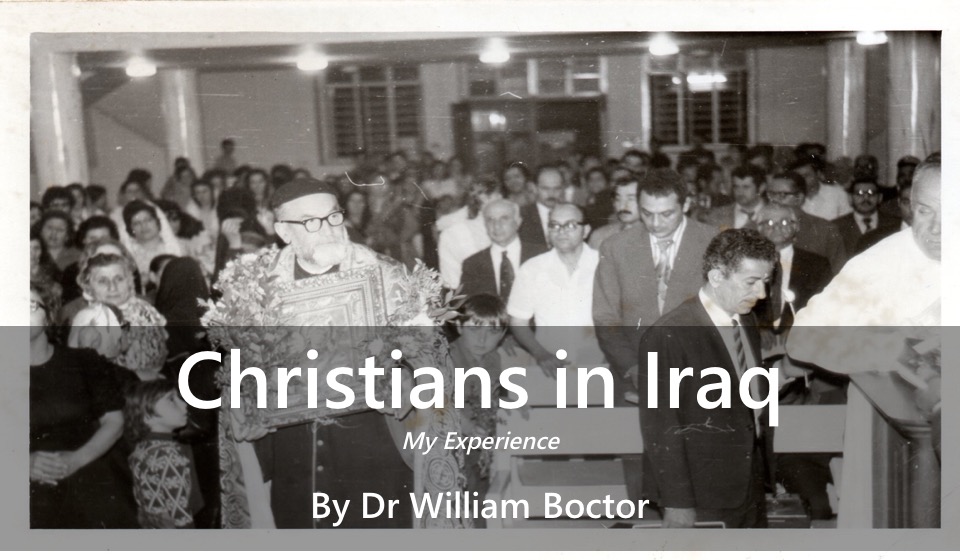
It may be useful to record my experience in the Syrian Orthodox Church in Baghdad, Iraq, in the period 1974-1977. The priest in the picture is KHOURY Soliman Daoud who was a school Head Master before he became a priest. He showed great love to the Copts and was eager to let them even know each other.

In late 1975, I sent a letter to H.H. Pope Shenouda acknowledging the dedication and service KHOURY Soliman is giving to the Coptic expatriates in Baghdad. H.H. Pope Shenouda responded with a tape in which he thanked K. Soliman and sent to us a Papal message which, I guess, was not common then. I wish to report some points:

  1. Out of respect to H.H. Pope Shenouda, K. Soliman asked us to stand up while listening to the Papal message
  2. Soliman was so happy to receive thanks from H.H. While commenting on His Holiness’ message, he couldn’t stop his tears and said “I don’t deserve that my name to be pronounced on the apostolic mouth”.
  3. Later he made a special liturgy service to us and asked a Coptic Deacon aged in his 20’s to teach him the Coptic liturgy.
  4. One day K. Soliman told me that we are invited for Dinner at his house. I said “Thanks, but how many?” He answered all of the church!! I was amazed and asked how he will move them to his house. As most of them had no cars. The waiting list of a local new car was over 3 years, while imported cars were allowed for expatriates, those coming from Egypt didn’t have enough cash to import.
  5. He responded that his family will be waiting to move people from the church to his large house.
  6. Overall, Christians in Iraq were well educated and had large families. K Soliman has 11 sons and daughters.

I have to mention that I needed to import a new car, as Baghdad is as big as Sydney. A family from Mosul gave me the cash that I needed.

I worked in industry and in Academic research. I found out that both were far more advanced than the Egyptian equivalents. It was clear that Egypt suffered a lot and lost its leadership because of the mostly lost wars with Israel and Yemen.

It is sad to think about them now and wonder how they are suffering.


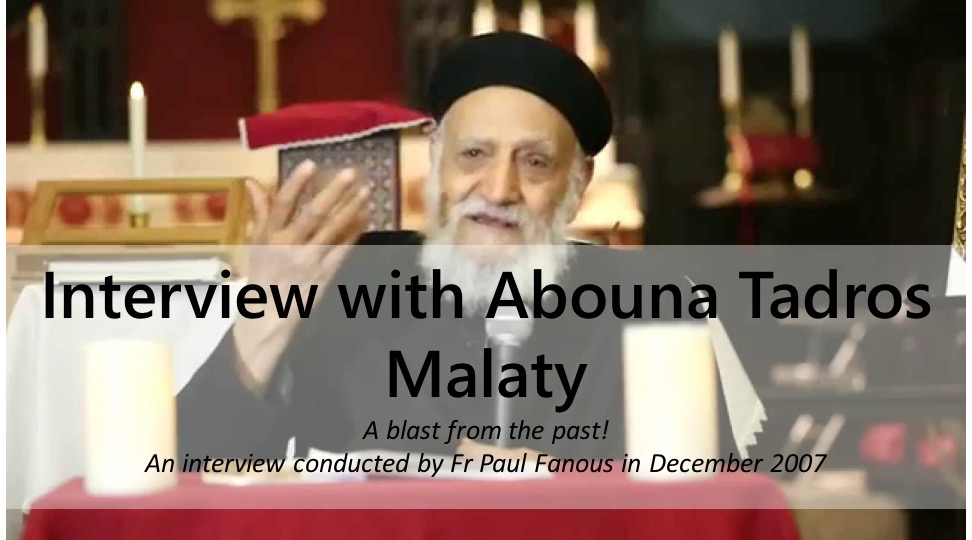
Interview with Abouna Tadros Malaty (Fr Paul Fanous)

Interview with Abouna Tadros Malaty:
(Interview from St George Youth Magazine – December 2007)

Interview by (Father) Paul Fanous, marking the 45th anniversary of Fr Tadros ordination as parish priest of St George church in Sporting, Alexandria. 
He was ordained 26th of December by the late Metropolitan Isaac.

When were you were born?
In 1937.

When were you ordained a priest?
In 1962.

What’s your higher learning like?
Bachelor of commerce and arts, majoring in philosophy and sociology.

Favourite food?
The Bread of Heaven

Favourite saint/father?
St George.

Favourite book?
The Bible. It also varies from time to time. Sometimes the sermons on the New Testament lessons of St Augustine. Or the Priesthood by John Chrysostom.

Favourite saying/quote?
The great miracle of the Lord Jesus Christ that He changes Earth to Heaven and men into angels of God. This was by St John Chrysostom.

Most memorable moment?
The current moment in our lives are the most memorable moments.

What is your vision of the church in Australia in the next 20 years?
What can I see in it? I believe it is guided by the Holy Spirit and we leave it in the hands of God. There is no special vision except to be directed by God.

Your advice on how we should implement that?
Through prayer and love, and always being joyful in the Lord Jesus Christ. Also we must always witness to the Gospel.

Best thing about the youth of today?
I see in them, that they are eager to be true members of the Body of the Lord Jesus Christ.

Worst thing about youth of today?
When they despair.

Advice for the youth of Sydney?
Don’t belittle yourselves. Remember the Grace of God.

Nickname for Tasoni?
She is called Mimi.

Favourite thing about Tasoni?
When she discovers any problems about any person, she is very longsuffering with her dealings with them. She enters into long conversations and discussions with them, in an attempt to console and comfort them. She always speaks openly with them, without guile.

How did you meet Tasoni?
I don’t remember. Abouna Bishoy Kamel told her to pick up something from me.

Advice on growing up?
I feel time is very precious. I did not waste my time.

What is the meaning of life?
Christ is my life.

Best part about being a priest?
The best part is to enjoy the Bible. It is my paradise. It is the pastor for me and the people.

Worst part about being a priest?
Nothing. Everything is enjoyable. I love my work as a Priest.

Who was the major spiritual influence from your youth?
Father Luke of St Macarious Monastery. He became Bishop of Girga in Upper Egypt. He is my father in confession and I loved him very much because he was very spiritual.

Major turning point in your life?
When I became a priest.

Did you ever play sport/favourite sport?
I do not remember. When I was young perhaps.

What was the longest holiday of your life?
I have no holidays.

What was the drive for writing so many books?
The motivation was that I enjoy writing for myself. I feel that all my inner emotions and senses are absorbed in it. It satisfies all my inner feelings.

Most significant encounters with Pope Kyrillos?
When I visited him to say sorry that for a long time Father Bishoy and I did not meet him. He answered me, ‘I am interested not in visiting but you working on behalf of the Church.’ He wanted us just to work and not to visit him.

How many of your spiritual children became full time servants? For example priests, monks, deaconess, nuns?
I am not interested in numbering anything in my life. Even the books. I do not know how many books I’ve written.

What advice can you give to young people struggling with sins?
– To work together, everyone helping the other. We must feel that we are members of One Body.
– To discover their situation as children of God. They have to realise that they have the power and strength from God and therefore they must never despair.
– To pray for the salvation of the whole world.
– I hope that you continue your life in the same spirit of the early fathers of the Church. To walk in their steps is very important.
– To feel that the Bible is your paradise.
– To enjoy the communion of the Holy Trinity: God as a Father, The Lord Jesus Christ as a close friend, and the Holy Spirit as dwelling in your heart.

What do you hope to see/experience when you get to heaven?
When I will go, I will let you know.

+++

Loving Your Enemies

†
Loving Your Enemies

Sermon by: Johnny Sharkawi
Article by: St Mark’s Youth

What does it mean to be a Christian?

What differentiates Christianity from any other religion?

Simply – Love.

“44 But I say to you, love your enemies, bless those who curse you, do good to those who hate you, and pray for those who spitefully use you and persecute you, 45 that you may be sons of your Father in heaven” – Matthew 5:44-45

So what is love? And what does it mean to love?

There is a deeper understanding which Christ has shown by His example, through being crucified on the cross for us. He has shown us something that is far greater than we are capable of doing on our own. Because God is love and as we are created in God’s image, we are created with love installed within us. However, it takes daily reminders through prayer and repentance in order to renew the love in our hearts, to the point that we can even love our enemies.

 But how do we do good to those who hate us?

The more we love God, then the more we take from his love and are able to love others. And so the closer I come to realising that I have been forgiven by God, then I begin to ask myself who am I to not forgive my brother? The solution to loving our enemies is simply to love God and to realise that we are in fact that enemy that was and is forgiven by God. Hating our enemies, ridiculing them and seeking revenge for their hurting us can only be done by someone blinded with dirt in their eyes to not see the hypocrisy in the action. This dirt comes from sin and evil thoughts like hatred and lustful desires. And so we need to wash out our eyes so we can see clearly, just as God wants us to see. We need to wash our eyes daily to see how Christ wants us to see Him in others.

We do this through repentance and prayer, which is the only way to clean our eyes in order to look at our neighbours with love. And when we pray, we beg the Lord for a repentant and loving heart.

We are not of this world, and as Christ says “I am the way, the truth, and the life.” So why do we jeopardise our salvation with worldly matters and things such as having hatred towards our neighbours?

Glory be to God forever Amen.

Our Relationship With God

 Our Relationship with God

Sermon by Bishop David (Bishop of NY & NE, USA)
Article by St Mark’s Youth

If an Orthodox Christian were asked to name the most important thing regarding their spiritual life, the answer would be “my relationship with God”. How well we know God, through not only our personal but communal worship, ultimately determines our salvation. This important relationship is determined by our understanding of who God is, i.e. the God-image we have created in our minds. The focuses of today’s sermon are the famous Parable of the Talents and The Prodigal Son, taken from the Gospel according to St Matthew (Matthew 14-30) and St Luke (Luke 15:11-32). By analyzing the three main characters of these parables, Bishop David talks to us today about three different levels of relationships.

 1. The Relationship of the Slave

In the parable of the talents, upon being asked for a return on the talent he had received, the wicked servant said “Lord, I knew you to be a hard man, reaping where you have not sown, and gathering where you have not scattered seed” (v 24). Already, this servant created the false image of a purely vengeful God in his mind. A God who is unfair and claims what He has not worked for. Hence, due to tremendous fear, the servant said, “I was afraid, and went and hid your talent in the ground” (v 25). We must ask ourselves, is this me? Is this how I view God? Bishop David says that the problem with this relationship is that it is based only on fear of God or the gravity of His punishments. There is a lack of love in this relationship. If our image of God is like this wicked servant, then we will very likely behave like him and likewise be cast “into the outer darkness” (v 30).

2. The Relationship of the Hired Servant
Using the example of the parable of the prodigal son, Bishop David reminds us that a hired servant is one who works, earns his pay and leaves at the end of the day. When the son returned to his father, he asked to be treated as one of the “hired servants” (Luke 15:11-32). Bishop David teaches us that the secret in this parable is that the son did not want to come back with all his heart but rather wanted to work as a hired servant. The son forgot who he was to his father and just wanted things of this world. Do we have this transactional relationship with God? Do we come to God chasing after money, careers or good grades rather than Him? As sayedna said, “This is the problem with the hired servants. They come to church because they need something from God.” Like cleaner fish to a whale, so also are these hired servants to God. Once again this affiliation with God emerges when one imagines God as merely a giver of things and not a Giver of life.

3. The Relationship of the Son
The relationship of the son is ultimately centered on love for God; As it is written, “We love Him because He first loved us”. The son realises that by grace, through baptism and living the life of the church, he will inherit the kingdom of God and so, in turn, seeks after it. The son’s eyes are not focused on the Earth, but rather, on God and His Heaven. He correctly understands God to be the one who “so loved the world that He gave His only begotten Son that whoever should believe in Him should never perish but have eternal life”. (John 3:16). When God gives the son things, he is joyful not because of the gift but because God is the Giver. Bishop David provides us with a very beautiful example to explain this relationship: When a husband gives a wife a wedding anniversary present, though the gift may not have much value itself, the wife is extremely joyful because it came from her husband. Likewise the source of the son’s joy is God and subsequently, his relationship is one of love.

May the Lord give us the grace to understand that we are His beloved children whom He holds dear. As it is written, “he who touches you touches the apple of His eye” (Zechariah 2:8). We pray that the Lord give us a better understanding of who He is so that we may worship Him in love and enter into His joy in the last day.

Glory be to God Amen.

The Unforgivable Sin

The Unforgivable Sin

By Daniel Ishak

“Therefore I say to you, every sin and blasphemy will be forgiven men, but the blasphemy against the Spirit will not be forgiven men. Anyone who speaks a word against the Son of Man, it will be forgiven him; but whoever speaks against the Holy Spirit, it will not be forgiven him, either in this age or in the age to come.  Matthew 12:32-33

When reading through the Bible, one of Christ’s most attractive attributes is His abundant forgiveness. The gospel are filled with stories of people who have been judged by men, but then forgiven by Christ.  When they brought the adulterous woman before Him to be stoned, Christ looked to her with a sense of compassion and forgiveness, and told the scribes and Pharisees “He who is without sin among you, let him throw a stone at her first.” (John 8:7).  When everyone judges, Christ forgives.

But there is a sin that our forgiving Lord says cannot be forgiven: blasphemy against the Holy Spirit. “Therefore I say to you, every sin and blasphemy will be forgiven men, but the blasphemy against the Spirit will not be forgiven men. (Matthew 12:32)

At first glance, this seems so uncharacteristic of our forgiving savior. But when we take a closer look at who the Holy Spirit is, and what His role is in my life, we can begin to see why Christ was so strict in warning us of this sin.

Who is the Holy Spirit?
The Holy Spirit is God. He is the third Person of the Holy Trinity and equal to both the Father and the Son. He was there at the beginning of creation, and since then has been present throughout the Old Testament, and continues to be active in the New Testament. He is not only God in heaven above, but also God who lives inside me. Jesus told the apostles, “And I will pray the Father, and He will give you another Helper, that He may abide with you forever – the Spirit of truth, whom the world cannot receive, because it neither sees Him nor knows Him; but you know Him, for He dwells with you and will be in you. I will not leave you orphans; I will come to you.” (John 14:16-18).

What is His role in my life?
Living inside of me, the Holy Spirit has many important roles: two of His most important roles are leading me to Christ, and driving my transformation and repentance.

  1. The first role of the Holy Spirit is to lead me to meet Christ. When Simeon the elder saw Christ in the temple, it says that the “the Holy Spirit was upon him…He was led by the Spirit to the temple” (Luke 2:25). The Holy Spirit led Simeon to the temple to meet Christ. He has the same role in my life today – He leads me to meet Christ. There’s a beautiful quote which states, “Just as the air remains in itself invisible to us but acts as the medium through which we see and hear other things so the Spirit does not reveal to us His own face but He always shows us the face of Christ.” When I lose sight of Christ and fall astray, the Holy Spirit leads me back to the temple where I can see Christ.
  2. The second role of the Holy Spirit is to transform my life. We see this clearly in the life of St Peter, an iconic example of spiritual renewal. When told by the servant girl in the High Priest’s house that he was a follower of Christ, Peter gave in to cowardice and denied Christ. However, when the Holy Spirit came upon him on the Day of Pentecost, his weak faith was transformed into perfect faith. He no longer feared people, and so preached to three thousand people, then to five thousand and after that to the Sanhedrin! We see a transformed St Peter. What happened in this period? It was the reception of the Holy Spirit. St John Chrysostom says about St Peter that “He raised his voice, he spoke with great confidence that they might perceive the grace of the Spirit. He who could not endure the questioning of a poor girl now discourses with such great confidence in the middle of people all breathing murder upon him. This in itself became an indisputable proof of the Resurrection, for wherever the Holy Spirit is present; people of clay are changed into people of gold.” Likewise, the Holy Spirit is the Person who drives my repentance and transforms me.

What is blasphemy of the Holy Spirit?
Blasphemy of the Holy Spirit is the complete and continuous rejection of the Holy Spirit and His power in my life.

As we saw above, the Holy Spirit is the one who shows me the face of Christ, and who drives my repentance – and so when I make this conscious decision to reject Him continually, my heart eventually becomes so hardened that I will never repent, and as a result lose my chance of salvation. It is the complete and continuous rejection of the Holy Spirit that is the deadly sin, as it is rejecting His power to transform me and lead me to a repentance that produces eternal life.

There’s a big difference between a man who falls in sin, but is repentant, and desires to overcome his sin, and the man who fall in sin – aware of his wrongdoing – and refuses to repent. The problem with the latter is that eventually his heart becomes hardened, and it is impossible for him to respond to God’s word. An example of this type of character is Pharaoh from the Old Testament. In Exodus 9:12, it says that “the LORD hardened the heart of Pharaoh; and he did not heed them.” God kept warning Pharaoh, sending him soft plagues in the beginning, and then the warning signs became increasingly harsh. However, Pharaoh was unrelenting. His heart became hardened, to the point where he could not heed the warning given to him by Moses and Aaron anymore. Likewise, God sometimes sends us little lessons in our lives. However, if we do not respond, our hearts can become so hardened that we no longer have the will to repent and thus, gain eternal life.

That is why we need to be mindful of the Holy Spirit and be conscious of His signals in our hearts so that we do not blaspheme against Him. He is continually trying to show me Christ, and to lead my transformation and repentance. Let us respond to Him, so that we do not be at risk of the grave sin of blasphemy against the Holy Spirit.

The pastoral irony of all this, of course, is that any Christian who asks a priest with trembling whether or not he has committed the unforgivable sin cannot possibly have committed it, for the question proves that the one asking it loves Jesus and fears being separate from Him.  Let such devout souls fear nothing.  They have clearly been caught in the fishermen’s net, along with other fish.  Let them persevere in their devotion, and rest assured of final forgiveness.

– Anonymous early church father.

May the Lord make us people of gold, a responsive people who continually repent and are welcoming of the Holy Spirit in our lives, singing with David the prophet, “do not take Your Holy Spirit away from me.” Having the Holy Spirit stay with us will then allow us to gain the kingdom and see the face of Christ eternally.

Glory be to God Amen.

Bears in Alaska

Bears in Alaska

By: Christopher Nour

I was 22 the first time I experienced ‘fear’.

We can all say we’ve experienced fear at various stages in our lives. Whether it be the fear of failing an exam or subject, a fear of failure, a fear of breaking the law or general phobias such as a fear of heights. In my 22 years on this Earth I have experienced all of these. From failing an exam, to having a police car pull me over for mobile phone use or speeding. I believed that I had experienced the full spectrum of human emotions by the time I had reached the age of 22! How very wrong I was. This is how it started:

There is always a sense of adventure within me, fuelled by my willingness to explore the unknown and my ‘risk taking nature’, as I’m told by my family and friends. This brings us to a 24 kilometre hike to two of the most gorgeous lakes in all of Alaska – Eagle Lake and Symphony Lake. I began my hike just after midday leaving my car in the parking lot. I brought my tent, sleeping bag and pad, a stove, cookware, food, water, camera and drone. All packed! And so my hike began. Along the way I passed numerous people, around twenty to thirty, all heading back to the car park. No one seemed to be going in my direction, which lead me to believe that I would have the lakes to myself. That’s good I guess, right? What could be better than spending a night in this serene wild? After crossing 3 bridges, walking through mud, resting on several rocks, snacking on lots of beef jerky and crossing a painful, …….NO!,…. horrendous granite boulder field capable of breaking your knees and ankles like twigs of wood; I made it to the most perfect little island that would be my home for the next 12 hours.

I arrived steaming hot having lugged two backpacks, and the mental battle I was going through to make it there and not just quit was exhausting! I decided for the quick setup option which consisted of my tent being put up as bare as possible (to allow a nice breeze to enter). I quickly filled up the pot with water and brought it to a quick boil to cook my all time, nutritious and extremely healthy “Mac n Cheese”. I ate, had some more beef jerky, some PowerAde and packed my food away in my dry bag. Now ‘101’ to camping in Alaska is to NEVER, EVER, EVER, EVER!!! Sleep with ANY food, or scented items (including sunscreen, lotions etc). This is to prevent bears coming into your tent looking for food. I continued to carry my dry bag containing my food and scented items some 200 meters away from my camp site. DONE! Time for bed!

I quickly ripped off my hiking boots and sweat dripping socks and went in for bed at 9pm. I brought my Bluetooth speakers, Satellite phone and Bear spray with me into the night. Oh what a peaceful sleep it was. 10pm, 11pm, 12pm, 1am, 2am…

At 2am in the dead of the night, I awoke to the sound of beautiful crashing waves on the lake that I’m literally inches away from (remember it’s an island that my tent is set up on). As I lay on my sleeping mat contemplating what a serene experience it is to be camping alone, with no one for at least 12km’s and the sounds of these crashing waves, I start to consider how these waves are occurring. I begin to register what is happening…

I am sleeping on a lake! There is a little wind but not enough for the waves to be splashing this much… I prop myself up onto one elbow and listen harder. I hear something running… Something big is running through the water, causing these waves… I can feel its weight through the blown up air that I’m lying on… I hear the sounds Tsh Tsh Tsh Tsh, as the running object comes to a stop, and then the undoubted sound of a fish splashing on the surface of the water. As I lay there wondering, No!, not wondering, but furiously thinking about what on earth is outside, I confirm the worst thought that can enter any campers mind.

There is a bear. Probably a Grizzly bear (due to the size), 10 feet from my tent – fishing!

All of a sudden there is an enormous grunting and snorting sound that fills the mountains surrounding me.

GRSHHHHH!!!

And then the sound of a beast filling its lungs with litres of air fills me with fear.

What do I do?!?

My heart is pounding against my chest, through my fingers and my ear drums. For a few moments I mistake my beating heart for the bears coming towards me!

“Fight or Flight” instincts take control of me and I choose flight instantly. But where would I run to? I am 12 km’s away from my car, and that’s not a direct path, I must go across rivers, boulders the size of small cars, through mud and past more bears, deers, wolves and all other creatures that walk this earth. There was nowhere to seek protection. If I jump into the lake and swim into the middle I will either die from severe hypothermia (a glacial lake is between 1 to 5 degrees Celsius) or from the bear swimming after me (bears are tremendous swimmers). I remember the satellite phone I have and whip it out putting it into the SOS mode. If I press ONE button the US Coast Guard, Police or Ranger will be here by helicopter. But I haven’t been attacked! And this will surely take time and communication must occur before they decide to come. I decide to ditch the SOS button in fear of being a laughing stock in Alaska and in Australia for the news headline “Australian hiker rescued by helicopter due to bears in camp”.

I stay frozen in the position listening to the bear continuing to fish inches away now from my tent. I’m stopped mid-thought by the sounds that I’ve been hearing for the past 15 minutes on my left, suddenly occurring on my right.

There were two Bears on either side of my tent now! The sounds had doubled! More splashing, more running, and heavier breathing and snorting.

FOR THE FIRST TIME in 22 years I felt a new emotion. Something I have never experienced before. I’m frozen in my tent, trembling, my head about to explode with ideas of how I was going to die. Trying to cry but unable to bring tears out, I prepare myself for my death. I quickly beg the Lord to forgive me and my never ending sins, the big and the small, afraid to be refused heaven for forgetting the smallest details! I bargain with the Lord telling him if he were to keep me alive I would fix the wrongs and do good! I apologise to my parents and brother for what I will put them through and for being in this situation. After having taken care of the important stuff, I think of how the martyrs are sent off when death is imminent – anything to bring peace to me. I try and remember any hymns from church to sing to myself. However none come to mind… except for “My Coptic Church”.

As I ever so slowly put my head back to the floor in fear of making too much noise that the bears come, I start to sing “My Coptic church” silently. I can only remember the first 2 verses and the harmoniously simple tune. So I start to improvise and make up my own verses praising the Lord and his Church. I don’t know how but 1 hour later I fall asleep; too tired from the hike and the mental battle I had just competed in.

I open my eyes! Its daylight! I get out of the tent and walk to where hours before two adult Grizzly bears were standing, each weighing between 250 to 400kg and capable of tearing me limb to limb. I thanked the Lord ever so much for granting me to survive and to live. I walk back some 3 kilometres and find two campers who were camping out with their dogs. As I see humans I feel like embracing them with a hug!

I had been given another chance. I had to fulfil my promises!

The Lord watched over me!