How to Not Spiritually Wither Away in the Holy 50

How to Not Spiritually Wither Away in the Holy 50

By: Bishoy Sharobim

It is written in the life of an enigmatic miracle-working Russian monk who lived in the time of Soviet Russia: “Once on Easter night the guards ordered Fr. Leonty to renounce God. He declined. Then they tied him to a rope and head first dipped him into a toilet bowl…

After a while they took him back out again and yelled ‘Do you renounce Him now?’ and his answer was ‘Christ is Arisen!’. They dipped him into the bowl again, took him back out, but he repeated– ‘Christ is arisen, people!’ They tortured him, yet they couldn’t make the father renounce God”.

Picture1

I believe this story contains an important message for us in the holy 50.

Some may wonder what are we supposed to do in these times? How are we supposed to stay spiritual without fasting, without that struggling atmosphere the Lent provided us? In passion week, we passionately shout our “thok te ti goms”, we attend church services for hours on end and we fast the hardest we possibly can for the year. But then Holy 50 comes, and now what do we do?

Well, whatever it is, let me tell you that I am certain the holy 50 is not an opportunity to become lax. Maybe in your case that means you have not prayed from the agpia since Passion week. Or maybe you might be like my friend who on the first Friday following Easter, confessed to me that he hadn’t read his bible since.

What I believe we can learn from the life of Fr Leonty is that we must continue to struggle spiritually in this holy 50 period and give no place to the devil of laziness.  We must imitate his faithfulness to Christ and his readiness to suffer and struggle for Him, regardless of the time and circumstances. We must keep in mind that although the church does not require that its faithful fast this period, she certainly did not offer this period as one of sinful spiritual sloth.

3 Tips to Stay Spiritual

To help encourage your continued spiritual struggle in this period, I offer here 3 tips…

  • Maintain your prayer rule: keep praying daily using the agpia. Never stop struggling in prayer. On the day you fail to pray sufficiently, consider yourself to have been dead.
  • Listen to the resurrection hymns:the Coptic church’s most joyous hymns are undoubtedly heard in the Holy 50. If this period goes by and you don’t listen daily to these treasurable hymns, you will seriously experience a huge loss.
  • Read the lives of the saints: this is one of the greatest sources of joy in the spiritual life. Who can possibly read the lives of these wonderful human beings and not be lifted up on high with exalted spiritual joyous feelings?  The saints are those who undoubtedly experienced the power of the resurrection. As Fr Vasile Tudora said, “…the saints … did not limit themselves to be observers, to be spectators, to watch the “show” of Resurrection; they decided to play an active role in it.”  The links to the saints’ lives in this post and your church bookshop are a good place to start.

So during this period, when you are in the toilet recall the sufferings of this holy confessor who never shirked from his spiritual duties and was never found faithless to the Lord Christ. Remember also the great St Seraphim of Sarov, who through his unceasing spiritual struggle, was able to greet everyone with the resurrection joy using the words “My joy, my joy. Christ is risen”.

Never forget how blessed we are to be born Orthodox. Ekhristos Anesti!

Discussion: What do you do to benefit from the Holy 50?
 

Drawing Closer to God

Drawing Closer to God

By: Anthony Zaccariotto

Someone once asked me in church how they can draw closer to God, to be a better follower and introduce Christ more into their life. I get a lot of questions from boys and girls on how they can draw closer to God. Often times we experience ups and downs in our spiritual life that can be related to the effort and time we ourselves are putting in. It is important not to let this get you down, as it is more common than you think. With all the things going on in the world that we live in, it is very easy to get distracted by life. A good start would be to take a closer look at the events and activities that make up your life.

There are a lot of things I could write here but I am going to try make it as brief as possible. I would like the reader to really take a look at the events and activities that make up their life and the amount of time they are really spending with God. Many people don’t realise this but everything we do in life, every thought, word and action at every moment is causing a corresponding effect. I’m sure you have read the phrase ‘as ye sow so shall ye reap (Galatians 6:7).’ If you are not reaping much in your spiritual life, you need to take a closer look at what is being sown.

I have been a member of the church for well over a year now and I can recall countless times the church fathers have said ‘we need to make time for the Lord.’ Sorry guys this is the plain and simple truth. Let’s take a look at our day for example, the average person will wake up at the narrowest window of time before work/school, have a quick shower, get dressed and arrive at their destination. The moment this class/work day is finished this person is then going to either go straight to the fridge for their post work day/school snacks and then turn on the escape box (T.V) or flip through Facebook. Sure enough the time has passed and then we need to get our good night sleep and then repeat this the next day over and over again. Can anybody notice the problem here?

Let’s say I had a goal in mind where I wanted to lose 10 kilos in 2 months. Surely in order to accomplish this task we would have to make some adjustments in our schedule, routine and eating habits. We would now need to make room for exercise and a better diet, otherwise we are not going to get very far. The same thing applies to our spiritual life. A wise man once said that ‘simple disciplines repeated over time will bring success, while simple mistakes repeated over time will create failure.’ This applies to everything. We need to always remember that everything we listen to, watch on T.V, set our eyes on and bring into our lives are pouring massive ingredients into our minds and the fabric of our lives are built from these ingredients.

Sin is the number one separator from God. If there is something in your life that is causing you to slip or stumble whether it be hatred, anger, jealousy, resentment, lust, pornography, heavy music and inappropriate films, you need to cut if off as soon as possible. If you have something in your life you feel guilty about or someone you feel you have wronged, fix it now! There is no easy way to say this. Jesus put it very clearly when he said ‘if your right hand or right eye causes you to sin cast it away from you’ (Matthew 5:29,30). This can apply in many different aspects. These particular barriers will also have a profound effect on our prayers. If there is someone in your life you can’t forgive or someone you may have hatred, anger or jealousy towards, this is going to cause a big stumbling block in your prayers and spiritual life. “If I regard iniquity in my heart, the Lord will not hear me” (Psalm 66:18) . “Behold, the Lord’s hand is not shortened, that it cannot save; neither his ear heavy, that it cannot hear:2 But your iniquities have separated you and your God, and your sins have hid his face from you.” (Isaiah 59:1,2)

Whenever I read a book or am looking for good advice I always like to have an example along with it. Now what I am suggesting is not going to be very easy but I need everyone to give it a try. Someone once told me it takes 21 days for a new habit to form. We all need to start forming better habits and a good way to do this is to write down a checklist. A person is ten times more likely to get something done if it is written down. A good example is the Bible itself, which God has preserved to help us remember.

Start your day and hour earlier with giving thanks to God for allowing you another day on this beautiful and astonishing planet earth. Give thanks for the opportunity to breathe, to think, to enjoy, to love. Give thanks to this miracle of life we have been granted and the opportunity to have a relationship with our Creator. Next you may want to say a prayer for your loved ones, your family, your friends. Maybe there are things in your life you may want God to help you with or guide you through, talk to Him about these things! God loves to hear from you; you are His. You need to make time for spiritual reading. Your Bible is not going to benefit you if it is getting dust on your bookshelf. There is a positive to every situation, if you find yourself reading the bible for 30 minutes and you didn’t understand a single thing, look at it this way at least you weren’t sinning for 30 minutes! Set aside 30 mins – 1 hour a day getting into the word of God. If you will introduce these little elements into your life consistently, along with eliminating all the previous barriers I have spoken about, you will be astonished at the changes you will see. Jesus confirmed this in the parable of the sower; Let the seed fall on good ground and bear fruit with patience! (Luke 8:5-15) Key word here is patience! With all the instant gratification in the world today and everyone used to getting what they want with the click of a button, this is making it very difficult for us.

This all has to start somewhere guys, let it begin with us. Remember, we always get what we put in; cause and effect. Whatsoever a man soweth that he shall also reap (Galatians 6:7). Plain and simple truth, if we are not putting in, we are not going to get out. If we are not sowing much, then we are not going to reap much. You need to make time for God. If you will consciously go about this task outlined, you will be amazed at the changes you will see. At first it may seem hard, especially if you have grown so used to the routine and habits you have already formed. JUST DO IT! Make time for God! Let him into your heart and allow yourselves to be filled with His presence. The joy that will come out of this, will be immense and you won’t look back.

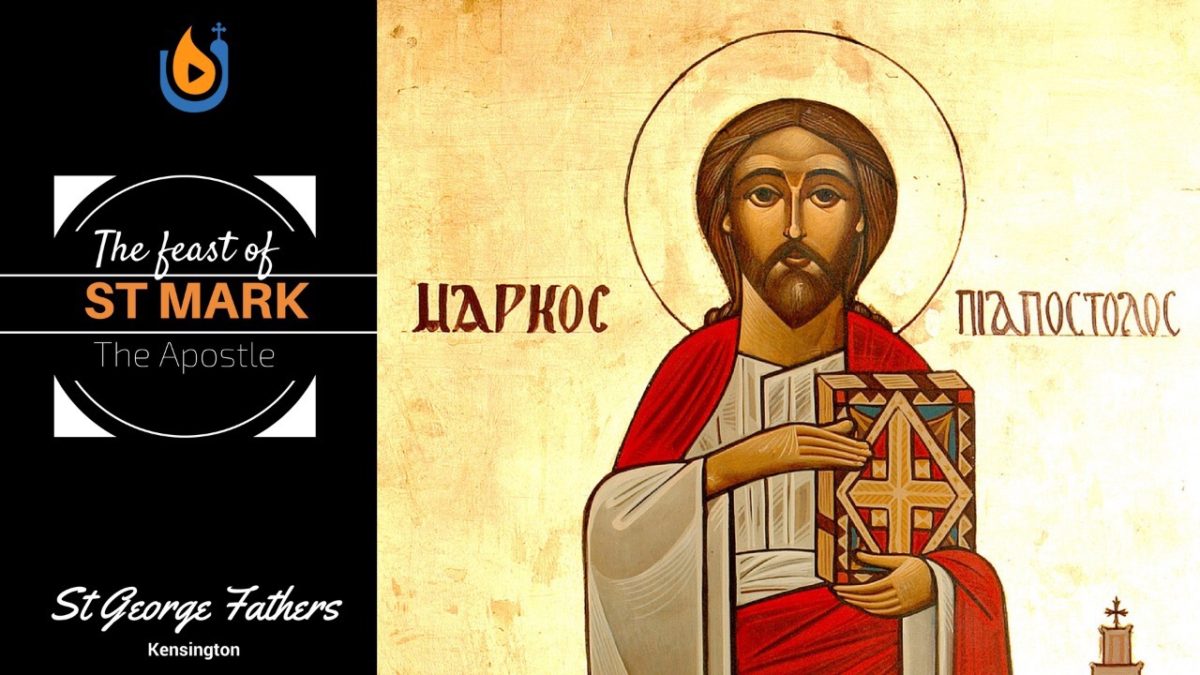
The Feast of St Mark the Apostle

The Feast of St Mark the Apostle

On Monday, 8th May 2017, the Church will celebrate the Feast of its founder and Father, St. Mark the Apostle.  John Mark was a native of the North African country of Libya.  He was one of the 70 Apostles (Luke 1:10) and travelled with St. Paul and his cousin St. Barnabas to Antioch.  He then returned to Jerusalem and later accompanied his cousin to Cyprus.

Picture1

We are immensely indebted to the great Apostle and Evangelist St. Mark for the following reasons:

1.       St. Mark – Author of the Gospel

The first and shortest Gospel was written by St. Mark between 55-60AD.  The message of St. Mark Gospel is captured in a single verse, “For even the Son of Man did not come to be served, but to serve, and to give His life a ransom for many” (Mark 10:45).  Chapter by chapter the Gospel unfolds the dual focus of Christ’s life: service and sacrifice.
St. Mark portrays Christ as a Servant on the move, preaching, teaching and healing; moving towards the goal of offering Himself a sacrifice for all mankind.  Directed towards the Romans, the Gospel of St. Mark omits the Aramaic words and uses Latin terms in their place (Mark 4:21; 6:27 and 15:15).

2.       St. Mark – Founder of the Church of Alexandria

Filled with the Holy Spirit and enthusiasm St. Mark headed to his Alexandria in approximately 45AD, where he founded the Coptic Orthodox Church, the Mother Church of Africa.  As his sandal broke and he went to a cobbler to have it mended.  He met Anianus, who accidently pierced his hands crying, “O Theos” (O the One God).  St. Mark rejoiced at his utterance and healed his wounds.  Subsequently St. Mark baptized him and ordained him Bishop and thereafter he became the 2nd Patriarch of Alexandria (68 AD to 83 AD).

The seeds sown by St. Mark flourished and within 20 years the flock increased and Christianity spread rapidly across Egypt.  The Church of Alexandria gave the world the greatest gift, Monasticism in the persons of St. Anthony, St. Paul, St. Shenouda, St. Pakhomious, St. Macarious who transformed the dryness of the Desert into a living paradise.  It has also produced distinguished theologians such as St. Athanasius (259-373), St. Cyril (376-444), St. Peter Seal of Martyrs, Origan, Panteaus and Pope Shenouda III.

3.       St. Mark – Writer of the Liturgy

St. Mark wrote the first liturgy which is used by the Church to this day.  This liturgy is distinctive in that it has several Litanies inserted within.  For the first 400 years of the Church it was the only liturgy used, well before the Church began using the liturgy of St. Bassilious or St. Gregory.  St. Cyril I (the Pillar of Faith, 24th Patriarch of Alexandria) modified it and thereafter it earned his name.  When St. Athanasius, 20th Pope of Alexandria ordained Abba Fromentius as the first Ethiopian Patriarch, he gave him a copy of the liturgy.

4.       St. Mark – Established School of Alexandria

In order to combat the secular institutions in Alexandria, St. Mark established the first Theological College in the world, the School of Alexandria.  St. Mark appointed Justus as its Dean (later Justus became the 6th Patriarch of Alexandria).  Among them include Patriarch Clement, Origen, Didymus the Blind and Dionysious.  As the fame of this School was so great, Emperor Theodosious issued a decree stating that whoever ran away from it would be considered a pagan.  Most of the eminent Church leaders were either Deans, teachers or students of the School of Alexandria.  In it the first Curriculum of Christian Theology was formed and the allegorical method of Biblical exegesis was devised.

5.       St. Mark – A Martyr for Christ

St. Mark laboured greatly and suffered for Christ and His Church.  In May 68 AD, St. Mark was seized and dragged with a rope around his neck in the streets then incarcerated for the night.  That night the Lord Christ appeared to him and said, “Peace be with you My beloved Mark”.  This strengthened St. Mark greatly.  Thereafter he earned the title The Beholder of the Lord.  The following morning, the same ordeal was repeated until he died a martyr for the sake of God whom he had so faithfully served from a young age.

The Spirit of Martyrdom permeated the entire Church, producing innumerable martyrs and confessors and thereafter deciding to commence its calendar with the era of the martyrs, calling it in the Year of the Martyrs.

6.       St. Mark – A Blessed House

St. Mark’s house received considerable heavenly blessings.  Christ the Lord instituted the Sacrament of the Eucharist (Matthew 26) there Christ ordained the Apostles in the Upper Room (John 20:21-23), the Holy Spirit descended upon the Apostles whilst they were with one accord (Acts 2:1-10).

The home of St. Mark became the first Church in the world where St. Peter, after being released from jail, went where members of the Church were praying together (Acts 2:12).

The life, works, mission and achievements of St. Mark is a tremendous inspiration for us to serve Christ and labour for His children and Church.

St. Paul attests to St. Mark’s distinguished ministry saying, “Bring Mark to me, he is useful in the ministry” (2 Timothy 4:11).

Please remember us in your prayers.
In Christ,
St George Church

Kensington, Sydney 

I Rescued the Fatherless

I Rescued The Fatherless

by: Virgin Mary Youth

“I will not leave you orphans; I will come to you…” John 14:18

“I rescued the poor who cried for help, and the fatherless who had none to assist them.” – Job 29:12

There are a couple of areas in the Holy Bible where our Lord Jesus Christ mentions widows and orphans, and how He has a special place in His heart for them and our duty to care for them also.

When you’re reading the Holy Bible sometimes you come across a verse which pulls on the heart strings depending on your mood and what you’re currently going through. These types of verses always hit home for me having had someone close to me pass away when I was younger.

I guess what hurt and bothered me the most was that God took away one of the closest people to me.

“Why would God do that? Does He really love me?”

Questions like this always lurked in my mind which created a barrier between myself and God.

However, I learnt something really valuable – When God takes something away, He also gives you something greater.

 It always reminds me of those superheroes like Daredevil where Matt Murdock is blind but he has this super-hearing, which can basically paint a picture of his surroundings in his mind.

For me, it was that I lost a loved one, but for someone else it could be a relationship that went downhill, a job that fell through, or never getting into a particular degree. It’s hard! It’s always hard! But the fact that we have a loving God that we can talk to, and sometimes even get frustrated with, is something that’s so comforting.

“From the end of the earth I will cry to You, When my heart is overwhelmed; Lead me to the rock that is higher than I.” Psalm 61:2

This is one of my favourite psalms because it’s so comforting! King David always knows what to say! That rock that is “higher than I” is God. He’s the one we should be relying on. But sometimes when we are in the middle of our troubles, He’s the last person we want to talk to. Despite this, because of God’s great love, He gradually and subtly appears in the picture so that we can come to our senses and speak to Him.

I only got off the pity train when I told Him how I felt; when I was honest with Him. Only at that point did things change. My whole mindset changed when I told Him what was going on with me and why I was upset. It’s so cliché but from then onward it felt like a heavy weight was lifted off my shoulders.

“Do not be anxious about anything, but in every situation, by prayer and petition, with thanksgiving, present your requests to God.” Philippians 4:6

“Come to me, all you who are weary and burdened, and I will give you rest.” Matthew 11:28

God allowed my dad to pass away but He gave me a priest who became an earthly father. He gave me a mother who He knew would be the best mother and father. He gave me friends who would always be there for me. He gave me a church that I could always go to for a moment of silence and serenity. Most importantly, He gave me Himself so that I would have the best Heavenly Father

We always worry about the future to the point where we don’t enjoy the present. Just enjoy the now and let God sort out tomorrow.

“Therefore do not worry about tomorrow, for tomorrow will worry about itself. Each day has enough trouble of its own.” Matthew 6:34

I learnt so much from that stage in my life but the three things that stood out to me the most were:

1. To turn all my worries, burdens and frustrations into prayers to Him
2. Just live in the moment and forget about all the worries of the futur
3. God will never leave us when we are going through something tough, no matter how alone and helpless we may feel.

Admit it… Isn’t church just sheer boredom?

Admit it… Isn’t church just sheer boredom?

By: Bishoy Sharobim

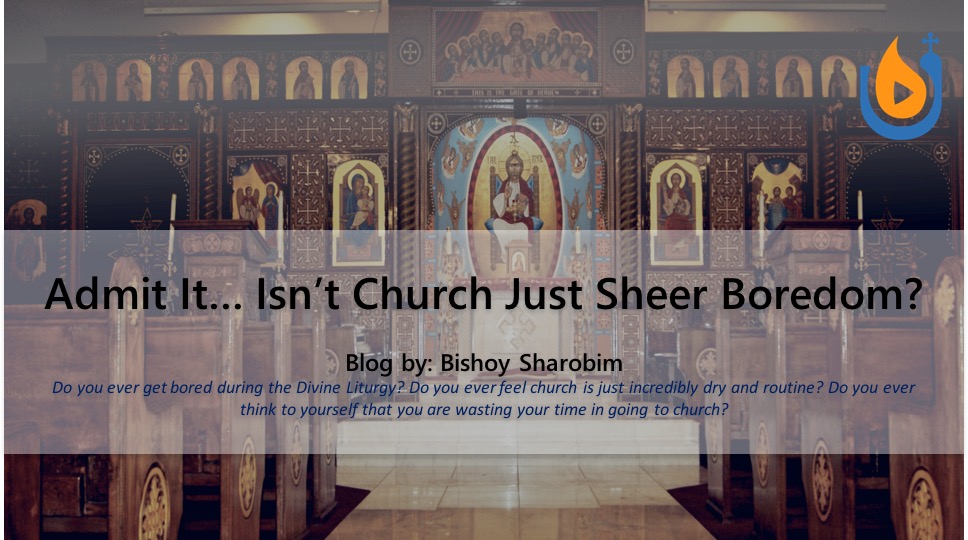
Do you ever get bored during the Divine Liturgy? Do you ever feel church is just incredibly dry and routine? Do you ever think to yourself that you are wasting your time in going to church? Or that it is extremely useless and yields no profit to your life whatsoever? Come on, please admit you’ve had thoughts along these lines before.

Maybe you ponder to yourself, “Oh, I could be at home studying for my exams, or I could be catching up on lectures and tutorials” and those aren’t even sinful alternatives, right? I mean by all means, shoot for the stars in terms of your studies and career. I really admire seeing hard working people and if you didn’t know, two great modern day saints that inspire and are dearly loved by Copts,  Fr PishoyKamel and Pope Shenouda III,  were known to have been extraordinary successful in their studies.

So the question remains: why do we attend masses frequently when the benefit is less than the cost?

A holy Russian bishop once wrote to an abbess of a convent the following: “The Inward Temple. There is no need to weep much over the destruction of a church; after all, each of us, according to God’s mercy, has or should have his own church—the heart; go in there and pray, as much as you have strength and time. If this church is not well made and is abandoned (without inward prayer), then the visible church will be of little benefit.”

I ask you to please kindly try to read that quote a few times and let it sink in. I believe this quote holds profoundly important spiritual guidance. The part I want to highlight is: If this church [that is our hearts] is not well made through inward prayer then the visible church will be of little benefit.… then the visible church will be of little benefit? What could this line possibly mean?  Does it actually imply that attending church is utterly useless to me, if I don’t master the art of prayer or at the very least make some sort of significant progress in my prayer life (Let’s ignore any technicality around the words “inward prayer” for now). Oh my goodness! What a very revolutionary piece of wisdom? Oh my. This quote can finally explain so many years of extremely mundane and dry church attendance and help us finally figure out just exactly what is going on.

Doesn’t this make sense my brother and sisters? Take for example a university student. Perhaps this student is very diligent in attending the lectures for his course and rarely misses any. However, this particular student becomes quite busy at home and cannot seem to make the effort nor the time to study at home. What do you think? Do you think such a student will be successful in his studies? He attends the lectures – an integral component of succeeding in one’s university studies, right? Isn’t that enough for him to do well and perhaps even reach a stage where he enjoys the subject itself (because when we become successful in things we much more tend to enjoy them)?

No! It is highly doubted that the student will ever succeed in that subject. Moreover, he will probably hate the lectures and become frustrated in attending them because he would fail terribly to comprehend what is going on in. Additionally, there is no mental connection between his brain and the study of the particular subject.

We do the exact same thing spiritually. Yes, we attend the liturgies regularly, perhaps even twice or more a week. However, will we benefit if we don’t pray and don’t fulfil our element of struggle and striving at home? Will we feel joy in the liturgy, or rather frustration and boredom? No, we definitely will not receive any of these things which our most treasured church offers us. Instead, we will regard the liturgy in the same way as the slothful and indolent university student who hates his work, is repulsed and frustrated by it and wants to cease attending lectures. And all of this is simply because he didn’t put in the effort and time at home.

So my brothers and sisters, we are exceedingly blessed beyond our imagination to be born into the glorious Coptic Orthodox church, where there is no greater joy than in following the teachings of the church handed down to us by our saintly forefathers. Come, let us deeply internalise the importance of prayer in the spiritual life, and having done this, then we will bear stronger arms in applying ourselves diligently and consistently to the all-important work of prayer. And finally, we will cry out with ecstasy alongside the psalmist saying “How lovely is your tabernacle, O LORD of hosts! My soul longs, yes, even faints for the courts of the LORD” (Psalm 84:1-2).

O our beautiful Lord Jesus Christ, grant us such happiness that is found in the Orthodox Church!

Evidence for the Resurrection

Evidence for the Resurrection

By: St Mark Youth 

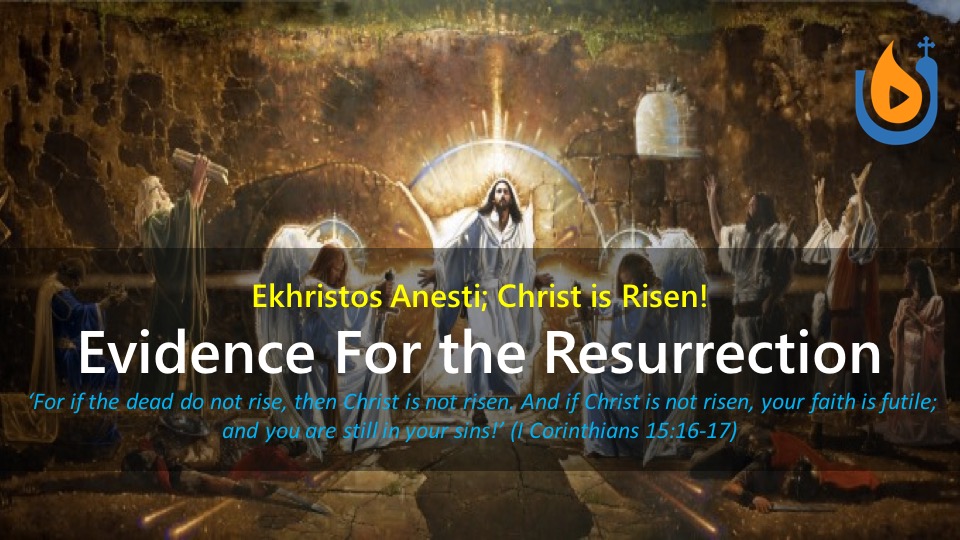
‘For if the dead do not rise, then Christ is not risen. And if Christ is not risen, your faith is futile; and you are still in your sins!’ (I Corinthians 15:16-17)

 The resurrection of Jesus Christ is the cornerstone of the Christian faith without which the whole building falls. It seems hard to imagine that such a supernatural event could stand the scrutiny of scores of historians and philosophers unless there was some proof for its occurrence. This proof is put forward by William Lane Craig, through four objective facts:

Fact 1: After His crucifixion, Jesus was honourably buried by Joseph of Arimathea in a tomb. As a member of the Jewish Sanhedrin, well known by many of the Jews and evidently Pontius Pilate himself, he is unlikely to be a Christian invention. This, along with the fact that the chief priests posted guards on Jesus’ tomb, shows that the location of the body of Jesus was known, prior to its disappearance on Easter Sunday.

Fact 2: On the Sunday after the crucifixion, Jesus’ tomb was found empty by a group of His women followers. The discovery of the tomb by women (whose testimony in 1st century Israel was regarded so untrustworthy that it would not even be admitted into a Jewish court) is further proof to the truth of the whole story. For if the resurrection was a fabrication then its authors would not have used women as the first discoverers, rather men in hope of convincing the Jews. Also, the early Jewish allegation that the disciples had stolen the body of Jesus (Matthew 28:13) proves that the body was in fact missing from the tomb on Sunday morning to which the Jewish leadership had no better explanation.

Fact 3: On multiple occasions and under various circumstances different individuals and groups of individuals experienced appearances of Jesus risen from the dead. The appearance narratives in the Gospels provide multiple, independent attestations of the appearances which are then summarised by Paul in I Corinthians 15:5-8.

Fact 4: The disciples suddenly and sincerely came to the believe that Jesus was risen from the dead despite their having every predisposition to the contrary. The disciples were in a catastrophic state following Jesus’ death; not only was their Lord dead but He had been crucified and thus by Jewish law is considered accursed by God (Deuteronomy 21:22-23). What would drive this group of mostly uneducated, scared men and women to then suddenly and openly proclaim that He is risen from the dead and preach to the whole world? Not only that, but to accept torture and even death for their preaching. Could it be seeing and talking to the very Man they buried with their own hands?! Certainly yes.

But more importantly than this mere historical evidence for the resurrection of Jesus Christ, is our personal proof that ‘God raised Him from the dead’ (Acts 13:30); which is our own experience of the Risen Lord and His work in our individual lives. Alfred Ackley, in his Easter Hymn, writes:

‘You ask me how I know He lives? He lives within my heart.’

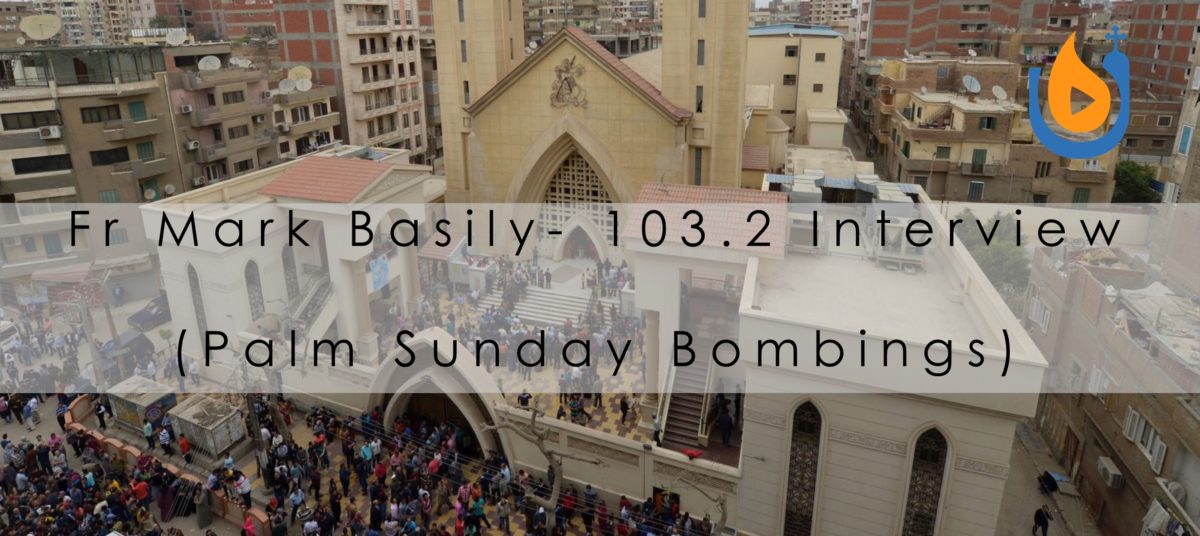
Fr Mark Basily – 103.2 Interview (Palm Sunday Bombings)

Blog Originally Posted on Hope 103.2 website. View the original at:
http://hope1032.com.au/stories/life/news/2017/please-pray-egypts-christians-attackers-says-coptic-priest/#.WOyH7W8VxRE.facebook

Listen: Father Mark Basili from St Marks Coptic Church in Arncliffe, Sydney, reflects on centuries of persecution of Coptic Christians.

Australia’s Egyptian Christians have rallied to prayer for their brothers and sisters in faith, after the ISIS attacks on two churches in Egypt on Sunday.

As news of the attacks came through, Father Mark Basili from St Marks Coptic Church in Arncliffe, Sydney, spoke to Open House presenter Stephen O’Doherty.

He called for prayers for both Egyptian believers, and for the attackers themselves, after the shocking bomb attacks in Alexandra and Tanta that claimed at least 45 lives.

“We ask all the Christians to share with us in prayer and we also pray for the attackers, that God would have mercy on them and also touch their hearts,” he said. “As Christians we’re called to love everybody, even those who persecute us.

Father Mark, who has been in touch with clergy friends in Egypt since the attacks, said the attacks were clearly timed to hurt the largest number of Christians possible as they gathered to celebrate Palm Sunday, an annual tradition for many Christians.

“Palm Sunday is the celebration of the Lord’s entry into Jerusalem, and for the Coptic Orthodox Church it’s one of the most significant feasts and probably the most crowded day in the whole church calendar,” Father Mark said.

“It’s devastating to begin this beautiful period of Easter in this kind of way. It definitely would have been one of the most crowded days of the whole year in church.”

The attack follows a suicide bombing in December last year on St Peter and St Paul church at St Mark’s Cathedral in Cairo, which killed 24 people; as well as the murder of 21 Egyptian Christians by Islamists on a beach in Libya in 2015.

Father Mark explained that Egyptian Christians are sadly familiar with persecution. In fact on the Open Doors ‘World Watch List’, a ranking of the 50 nations where Christians are treated the worst, Egypt ranks at number 21.

“The Coptic Church has always been an attacked minority,” Father Mark said. “Christians are living in fear and persecution, all for their love for Christ and just wanting to worship Jesus.”

The Church That Predates the Bible

The Coptic Church is one of the most ancient of the Christian faith. It was established the first century AD by St Mark the apostle, the author of one of the Biblical gospel texts. He travelled to Alexandria in Egypt and from there Christianity spread all across Egypt.

Both the Coptic Church and the Greek Orthodox Church of Alexandria are believed to be descended from that early church plant in Alexandria.

“It’s a very ancient, special and beautiful church,” said Father Mark, who is himself named after Mark the Apostle. “But it’s definitely stained with the blood of the martyrs throughout the centuries.”

Australia has large Coptic congregations in both Sydney and Melbourne, as well two Bishops, a monastery, dozens of churches and thousands of parishioners.

“It’s a very active church with a lot of young people, very devout, and probably the reason for that is the strength that comes from being persecuted in Egypt,” Father Mark explained. “When you are persecuted for Christ’s sake it does strengthen your faith, make you closer and more dependent on God. You can see that ripple effect in the parishioners and the way their faith is deeply rooted, in the way they worship.”

Catholic Archbishop’s Personal Connection to Egypt

In response to the Palm Sunday bombings, Sydney’s Catholic Archbishop Anthony Fisher has also joined in the call to prayer, inspired not only by his faith but his personal connection to Egypt.

“My own grandmother was born in the then-peaceful city of Alexandria, after her family fled persecution elsewhere,” he said in a statement. “As we gather in parishes across Australia this week to commemorate the Lord’s Passion, let us be thankful and never take for granted that we are able to do so in safety; and let us remember in our pryaers who are dying for their faith in Christ.”

Australia’s Coptic congregations are looking forward to a visit by the Coptic Pope Tawadros II in September this year.

Sacrament of Unction

Sacrament of Unction

By St Mark’s Youth

Join us as we contemplate on the Unction of the Sick! Read the following Bible passages as you come across them below, to supplement the blog!
Mark 6
James 5
Luke 10
Psalm 23
Joel 2

The Sacrament of the Unction of the Sick is one of the holy Seven Sacraments of the church (do you know the others?). The sacrament allows the sick who are faithful, to be healed from psychological and physical diseases.  The priest anoints the person with the holy oil from which they obtain the grace of remedy/healing from God.

We read in Mark 6, Christ travelling through Nazareth performing miracles of healing. There is something peculiar though… “Now he could do no mighty works there, except that He laid His hands on a few sick people and health them. And he marvelled because of their unbelief” (Mk 6:5-6). This was Christ’s hometown, and there was something preventing him from performing many miracles there.

St John Cassian reflects on this; “If the faith of those who bring them or of the sick is lacking, it may prevent those who possess the gift of healing from exercising it.” Christ was shocked because of the lack of faith of the people in this hometown!

Origen goes further to take something more beautiful out of this: “Mark presents the all-surpassing value of God’s divine power, even in those who do not believe” – God’s power is stronger than our lack of faith! He continues, “Mark did not deny that grace works even more powerfully among those who have faith. He does not flatly say that Christ could do no mighty work there at all, and stop at that point… but he added that he laid his hands on a few sick folk. The power in him overcame their unbelief.”.

What does this mean for us, and our lack of faith? The Unction of the Sick seems quite abstract… can we gain psychological and physical healing from a simple prayer and anointing with oil? Of course with faith of a mustard seed, we can move mountains – and furthermore, God can overcome our lack of faith (as above)! Let us pray to God to strengthen the holes in our faith, so that His grace may work more powerfully in us.

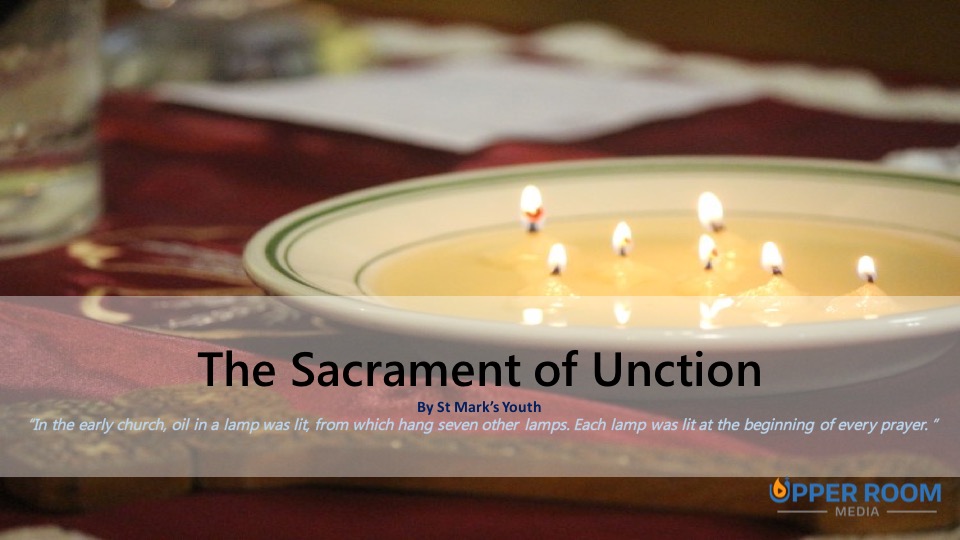
You may have heard of these prayers before as ‘Kandeel Prayers’, where the priests visit your house and light cotton wicks in a bowl of oil. This is indeed, the Sacrament of the Unction of the Sick. In the early Church, Christians used to perform this prayer – it was known as the Sacrament of Lamps.

In the early church, oil in a lamp was lit, from which hang seven other lamps. Each lamp was lit at the beginning of every prayer.  This rite now occurs with seven wicks, made from cotton wool, which sit in a plate of oil. The number seven signifies the seven spirits of God, which are mentioned in the Book of Revelation (Rvltn 3:1).  The Spirit of God dwells and sanctifies the oil in order to heal those anointed by it. The wicks are placed in the sign of the cross, in the plate of oil.

Indeed we see the Biblical mentions of this sacrament, in our reading of James 5:13 “Is anyone among you sick ? Let him call for the elders of the church , and let them pray over him, anointing him with oil in the name of the Lord”. Lent is a time where the Church recommends families to invite parish priests into their homes, and partake of this blessed sacrament!

Here we must remember the definition of a sacrament – these are the workings of God and His grace, through His creation. The priest is the one who prays, but it is God who heals, for the sacrament is not a person’s work but the work of God.

The act of God healing through the prayers of others is seen in our reading of Luke 10:8-9 “Whatever city you enter, and they receive you, heal the sick who are there, and say to them, The Kingdom of God has come near to you.” The disciples, similar to modern day priests, enact this sacrament through God’s grace.

Psalm 23 reminds us that the Lord provides healing. This Sacrament has a beautiful value and benefit in our Orthodox church. Let us pray for faith, for our hearts to be opened and experience a direct encounter with the Grace of God.

Glory be to His holy name forever, Amen.

The Resurrection of the Dead

The Resurrection of the Dead

For reference while reading this blog, join and contemplate on the following readings:
1 Corinthians 15-16
Matthew 24
1 Thessalonians 4-5
2 Thessalonians 2
2 Peter 3

The Resurrection is at the centre of our faith and St Paul makes this clear in 1 Corinthians 15, when he states that if Christ is not risen from the dead, then we, as Christians, are the most pitiable of people because our faith is empty. However, fear not, St Paul confirms that Christ truly has risen, through the testimony of his life, where he preaches Christ’s Resurrection to his martyrdom!

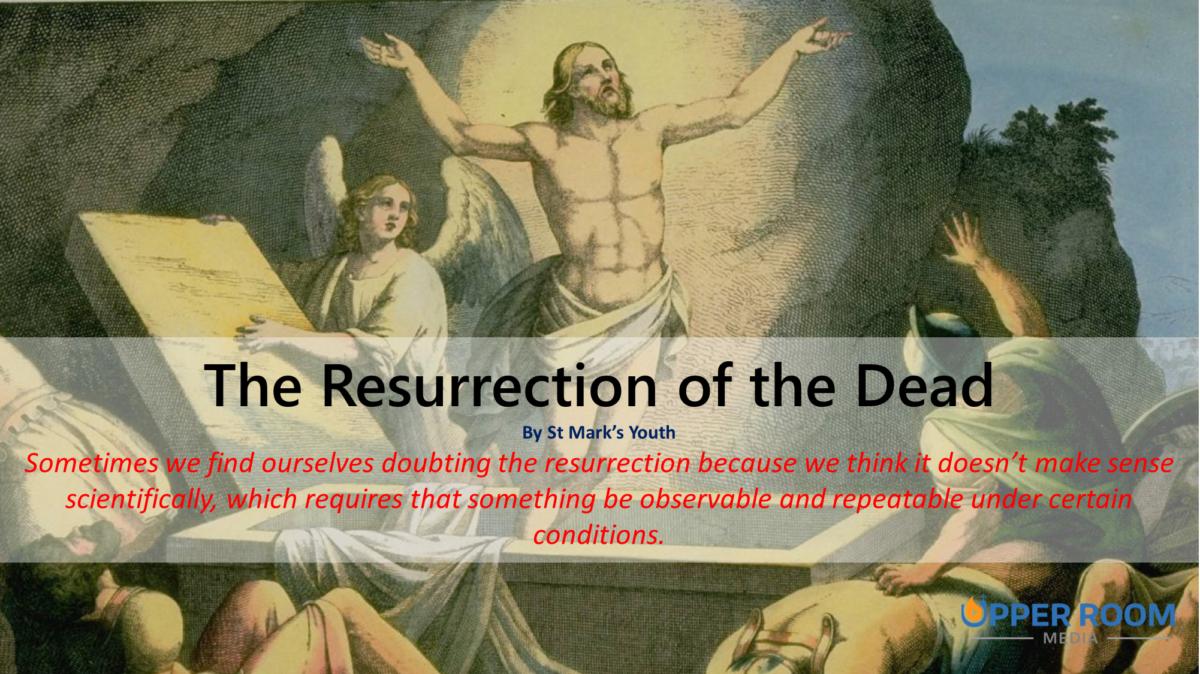
Sometimes we find ourselves doubting the resurrection because we think it doesn’t make sense scientifically, which requires that something be observable and repeatable under certain conditions. But one thing we have to realise is that the resurrection is not meant to be looked at scientifically, but it is to be looked at as a historical event. And one of the biggest pieces of evidence that this historical event really occurred is the witness of the Apostles after Christ’s resurrection. These normal people could have gone back to their everyday lives, and accepted that they were fooled in the three years of Christ’s ministry. Instead they dedicated their whole lives to spreading the message of Christ and His Resurrection. Would they dedicate their lives to a lie? Some may argue they just did it because it made them fill their time, kept them united or made them famous. Sure, that would have lasted for a while. But when they were threatened with and were at the point of death, for any sane person, that would have been the final straw. Nobody would die for a lie! And yet we see all of the Apostles, except for John the Beloved, being martyred for the sake of Christ. And if you think they did it because of peer pressure or because they were together and everyone was doing, then think again! St Mark was martyred in Egypt, St Paul in Italy and St Thomas in India, and so they weren’t there supporting each other at their toughest moment and it would have been easy for them to admit that they were preaching a lie so that they could save their lives. And yet they didn’t! And they didn’t because they were sure of what they had seen and what they had heard, and they knew that Christ had truly risen from the dead! So the question still stands, why would so many of them die for a lie? And if you can’t find an answer then this is just one piece of evidence to convince you that Christ truly is risen!

The rest of the readings mentioned tell us how to respond to the Resurrection of Christ. The gist of it is that we should always live with the Resurrection at the forefront of our mind, living out what we say in the Creed where “we look for the Resurrection of the dead and the life of the world to come.”  The chapters tell us to be ready for His coming, since we know neither the day nor hour, but that we should not wait in fear, but in joy and comfort, as we know that Jesus will come to save those who believe. This waiting time should also be used as an opportunity to “put on the breastplate of faith and love, and as a helmet the hope of salvation.” (1 Thessalonians 5:8) and to “grow in the grace and knowledge of our Lord and Saviour Jesus Christ.” (2 Peter 3:18) And the best way to do this is in the Church, and by living her life of prayer, repentance, and by participating in her Sacraments.

Fr. Alexander Schmemann: Reflections on Pope Shenouda III

Fr. Alexander Schmemann: Reflections on Pope Shenouda III

Saturday, February 11, 1978

Immersion yesterday and today in a totally unknown (to me) world of Coptic Christianity. Right away I must express my main impression: it is edifying and it is alive. I remember my trip to the Middle East in 1971 and my impression of something outlived, nominal, dying, chained to the past—the existence of a non-existent world. Lifeless Hierarchs. Fear. Lies. Corruption.

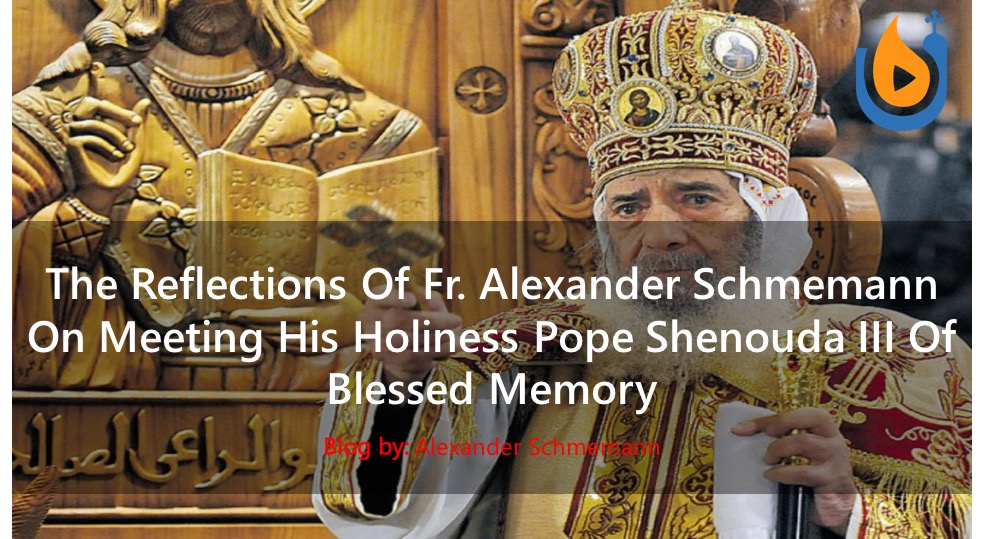
And then, last year in Los Angeles, I met His Holiness Pope Shenouda III, the Patriarch of the Coptic Church. Right away—an impression of genuine life, spiritual openness. And now, inCairo, I am meeting the very Coptic reality. There are about seven million Copts in Egypt! And this church, despite persecutions (Byzantine, Arab, Turkish), despite the surroundingsea of Islam, despite its isolation and loneliness, and the whole spiritual and political chaos of the Middle East, is revived and alive!

In the morning, a long reception at the Patriarchs residence. Right away, we talk about the essential—the Church, ways to unify, mission, Africa, youth.

In the evening, I witnessed something truly amazing. In the packed cathedral, seven thousand people listen—as they do every Friday—to the Patriarch. In front of him, on a little table, hundreds of little pieces of paper with questions. He chooses five or six and answers them so simply, and at the same time so deeply (about the meaning of “Lord have mercy”; about the death of a mother—“where is she now?”; about a fifteen-year-old girl—“should she go to a monastery now?”; about somebody who promised to work in the church school if he passed his exam and has not kept his promise, etc.). Then he lectures about the temptations of Christ in the desert, and again—genuine, lively, pastoral, nurturing. Where in the Orthodox world can one see and experience this, a patriarch with the people, in a live dialogue?

But then today I had an extraordinary day: a visit in the desert to three monasteries with an uninterrupted tradition from Anthony the Great, Makarios, etc. In one of them is the sarcophagus of Ephrem of Syria. And the most amazing, of course, is how very much alive it all is: Real monks! In my whole life, I have seen only imitations, only playing at monastic life, false, stylized; and mostly unrestrained idle talk about monasticism and spirituality. And here are they, in a real desert. A real, heroic feat.

So many young monks. No advertisements, no brochures about spirituality. Nobody knows anything about them and they do not mind it. I am simply stunned. I have a thousand questions, and I will have to gradually start sorting it all out. Right now, this trip to the desert remains in my memory as something radiant.

_____

Editor’s Note: The Rev. Alexander Schmemann was a leading Russian Orthodox theologian influential in U.S. church life in the cause of religious freedom in the Soviet Union and in the world-wide ecumenical movement. He was an adjunct professor at Columbia and New York universities and at Union and General theological seminaries in New York City. He was also dean of St. Vladimir’s Seminary in Crestwood, N.Y.