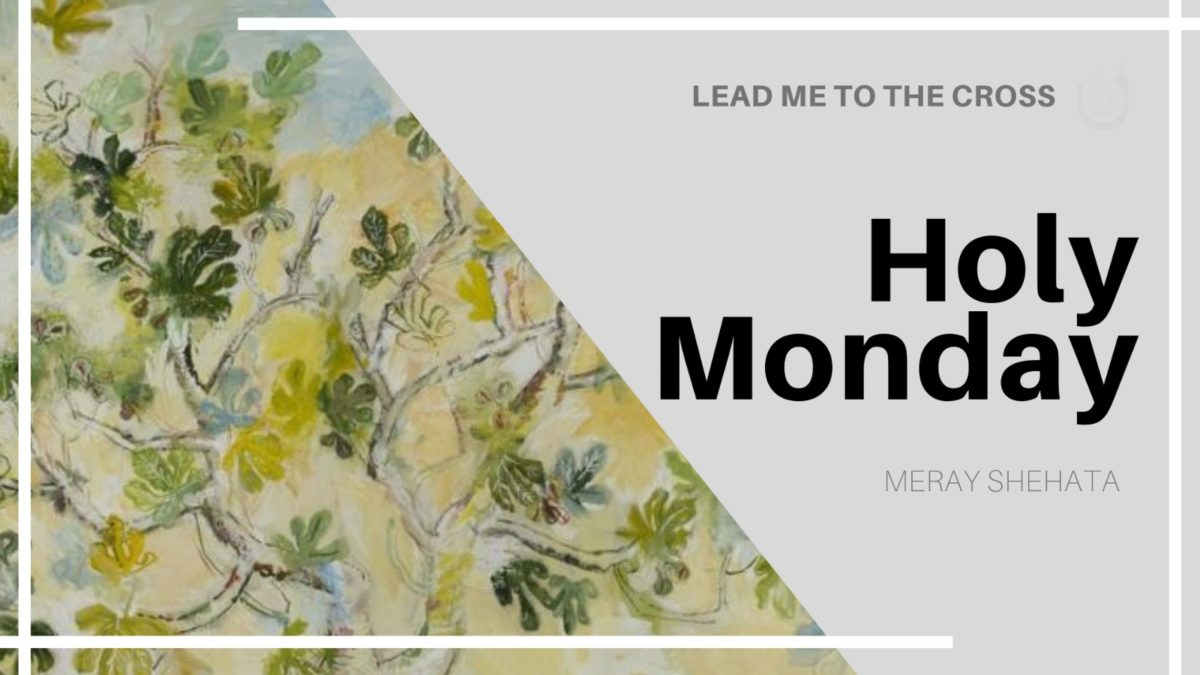
Holy Monday

Lead me to the Cross

Holy Monday

by Meray Shehata


Where are my fruits?

Think of the fig tree. One of God’s creations planted as a seed as all the other trees were, cared for and given water. Jesus expected great things from this plant as He gave it the perfect environment to thrive and flourish.  Now when it came time for Jesus to reap the fruits of the tree and found none, He cursed the plant.

The lesson for us is that we are not living a life that is our own. Each day, each hour and each second of our lives have been gifted to us. As with the fig tree, which has been granted so much time to bear fruit, each one of our breaths is counted.

Our God is a merciful, just and kind God. He waits at the door of your heart seeking to enter and provide you with your heart’s desire, He waits to come in and give you salvation. In return, He has one request. Repentance. If the plantation of your heart is fruitless then what good is it then to be cut down?

Seek the Lord while He may be found,
Call upon Him while He is near.

Isaiah 55:6

As we are living on borrowed time, it’s important to remember that everything ends except for the Lord. He is patient and gives us enough time to change and bear fruit. Even more, God is just, He knows the complexity of your character. How comforting is it to know that, “The Lord is not slack concerning His promise, as some count slackness, but is longsuffering toward us, not willing that any should perish but that all should come to repentance” (2 Peter 3:9)

Let’s look at the tree from another angle. The fig tree was a beautiful tree. “And seeing from afar a fig tree having leaves” Jesus being hungry went to inspect it as this wasn’t the season for the fruit. So not only was the tree not meant to have fruit, but it was lavishly displaying its leaves when other trees had nothing to show but bare branches.

Our lives can also appear abundant. Maybe our leaves portray us as; having the perfect career, an impeccable church servant or a flawless family. Others can be deceived by the extravagant leaves we parade; we may even fall into the trap and see our self falsely. What about God? Will He be deceived by the show we flaunt? Or, will He look deeper to find fruit?

“Examine yourselves as to whether you are in the faith. Test yourselves. Do you not know yourselves, that Jesus Christ is in you?—unless indeed you are disqualified”

2 Corinthian 13:5

As with the fig tree who bears leaves and no fruit, we cannot become half-hearted Christians. The cursing of the fig tree was symbolic of the cursing of the nominal Christian. The alleged believer who is unrepentant and faithless is undeserving of the kingdom of God. Which is why our actions, thought and feeling should reflect our citizenship in Heaven.

“Enter by the narrow gate; for wide is the gate and broad is the way that leads to destruction, and there are many who go in by it. Because narrow is the gate and difficult is the way which leads to life, and there are few who find it.”

Matthew 7: 13-15

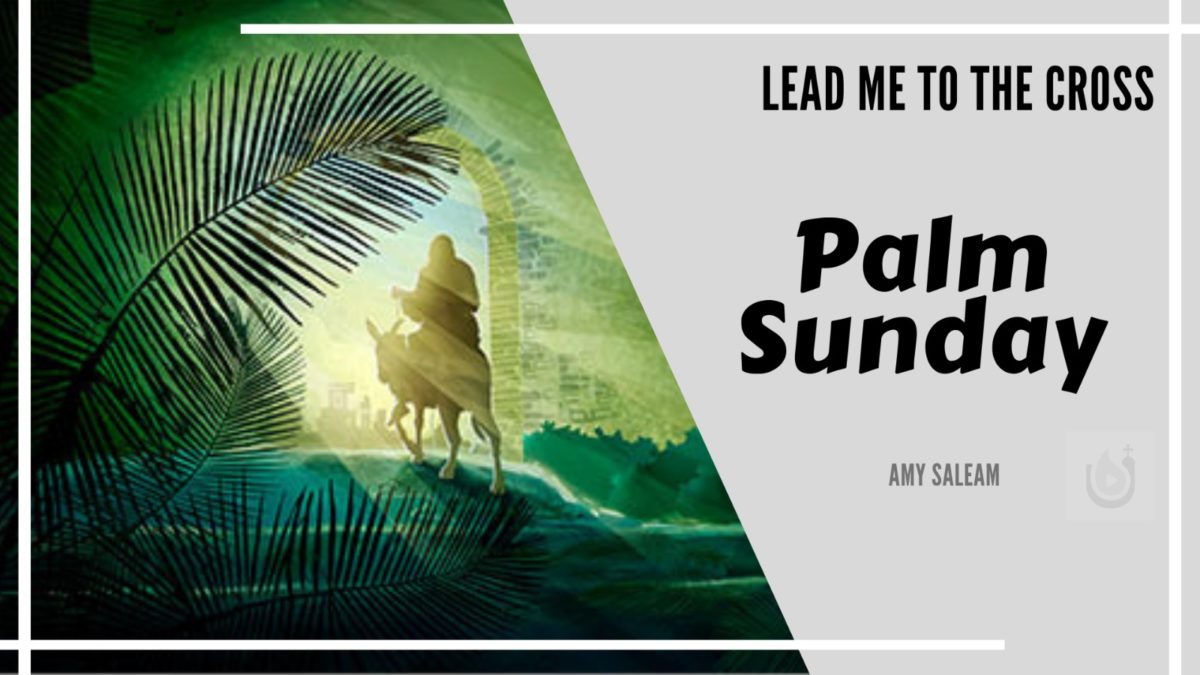
Palm Sunday

Lead me to the Cross

Palm Sunday

by Amy Saleam


 Here we are, the first day of Holy Week – Palm Sunday. Palm branches have claimed the name of today but they are merely what make it unique. The Gospels paint a picture of a crowd lined along the road as Jesus entered Jerusalem. Riding on the beast of burden, a path of palm trees and worn clothing formed a carpet of endearment before Him. “Hosanna… blessed is He who comes in the name of the Lord,” He was praised. When we look at stories in the Bible that recount the life of Christ, there is always a message deeper than what appears on the surface. So what is today really about?

No beautiful horse, no guards for protection, no army around Him – no grand gestures. Despite who Christ is, all His Glory and Greatness, He chooses to enter the city with complete humility, seated on an animal who contradicts all things royal. The humility demonstrated by Christ on Palm Sunday poses the perfect snapshot of who Christ is, and who we are to be, so that our lives may be shadows of Him.

Christ leads the example of humility by choosing to humble himself without need to be humbled by another. Just as he chose to enter with humility, days later, he also chose death on our behalf. Not because He was forced to, not because He owes it to us, but because of His love for us. Allowing Himself to be placed at the forefront of humiliation and pain, He nailed our sins to the cross. And so you see, the triumph of Christ does not lay in the praise of the people on Palm Sunday, but through His passion towards us that would be soon demonstrated.

Can Pride and Humility Co-exist?

“How could he speak to me like that?”

 “Why does she think it is okay to ignore me?”

“How could he say that to me?”

Undoubtedly, these thoughts have crossed your mind; I can be the first to put my hand up to this. These are what we call ‘finger pointing’ thoughts and are a product of pride. When you spend your day focusing on “me” – how you feel, replaying a hurtful interaction, or even just focusing solely on ticking off your to-do-list for the day, you occupy your mind with thoughts of, “I” rather than thoughts of Him. We end off our self-consumed day with a one-minute prayer as though we are doing God a favour in our “busy” lifestyle by remembering Him, mid yawn. The danger of this is that it provides perfect opportunity for pride to make itself a comfortable home within us. Just as light and darkness cannot simultaneously occupy the same room; humility and pride cannot live in the same heart.

When self-absorbing thoughts become our daily practice, our vision of Christ becomes blurred and His voice harder to hear. So, if we are to reflect the humility of Christ, we need to let go of ourselves and fill our lives with Him through prayer, Scripture and fellowship. When we do this, we learn that a humble response towards others rejects the shame that follows a proud reaction, and rather it embodies wisdom – a wisdom that comes from knowing Christ.

“By humility and the fear of the Lord, are riches and honour and life”

Proverbs 22:4.(NKJV)

The Bible tells us that when we embody Christ’s humility, we are given life and nourishment. So when we are humiliated and hurt by others, let us be reminded that a meek heart and humble response is a reflection of Christ and honours God. If we are to know Christ, we are to personify humility. The more you are filled with Him the sooner pride will know it has no place in you.

The True Victory

“The way to Christ is first through humility, second through humility, and third through humility. If humility does not precede and accompany and follow every good work we do, if it is not before us to focus on, if it is not beside us to lean upon, if it is not behind us to fence us in, pride will wrench from our hand any good deed we do at the very moment we do it”

– St Augustine

Upon His entrance into Jerusalem, the crowds shouted “Hosanna,” meaning ‘save us.’ They were desperate to be saved from the Roman rule over them, ignorant to the fact that the true saving they needed was the one of their heart – but Christ was well aware.

We are very much like the Israelites on Palm Sunday. We come before the Lord and ask Him to fix our problems and change our circumstances, forgetting that perhaps it is the condition of our heart that requires edification. Before we point the finger at the other person or question why certain things had to happen to us, let us go to God in prayer that he may humble and change our heart.

A humble heart gives us a Christ centered perspective of our situations. Through this, we are then able to truly forgive and extend grace to others, even if we are placed in the most unwanted of situations. As Saint Augustine perfectly puts it, if humility does not take precedence over all that we do, our efforts will be fruitless and the true saving of ourselves overshadowed. Perhaps I dare to say that the core of many of our problems and even our external concerns is because we overlook the real issue within us. You see, Palm Sunday demonstrates that beyond the circumstances that we may deem unbearable, and problems that we desire be removed, Christ came for a greater purpose than to save us from inconveniences – but came to purify our hearts and give us life through Him. He did not enter Jerusalem to conquer the Romans, but to conquer much more than that.

It’s not too late

“Of all the afflictions that burden the human race, there is not one, whether spiritual or bodily, that cannot be healed by the Holy Scriptures”

– St John Chrysostom

As we approach the end of Lent and begin the Holy Pascha today, let us be reminded of the beauty of this season. In a few days time we celebrate not only the resurrection of Christ, but also the resurrection of our renewed self. This was something beautiful that I was reminded of by one of our Church Fathers recently. And so as we spend this week reflecting on the lead up to Easter Sunday, let us encourage one another to die to ourselves and celebrate not only His resurrection, but ours also. Although none of us can say we are without blemish, let us confide in the fact that we can leave it all at the cross and have a fresh start. Just as Christ was welcomed into Jerusalem, may we welcome Him into our lives.

Not just on Palm Sunday but every day this Holy Week, may we look to His word and reflect on Scripture, pray fervently, repent wholeheartedly and return to Our First Love.

Lord, consider our laments and hear our cries for help as we come before you. Protect us from thoughts that pierce through our hearts and break us down. Help us reflect Your humility through actions that honour You. Show us that when we wait, you bring light to the darkness. Show us that when we trust, you take over and fill us with Your peace. Help us take refuge in You as the only one that can fill and satisfy our hearts.

Glory be to God, forever. Amen.
Despair (Barriers to Repentance)

Barriers to Repentance 4/7

Despair

by Shery Abdelmalak


 The modern world is marked by advancements in technology, in social media, in education, in health – in all that we know. We have subsequently become increasingly self-sufficient. We know that we need God, but really, how often do you feel that you will not make it through the day without His immediate intervention? When you wake up in the morning – do you pray that God gets you out of bed? Do you pray and honestly believe that you will not achieve even the smallest of tasks without His help?

When you open the door to your room, you know you will find a bed, a wardrobe, all your things in their rightful spots. All your needs before your eyes. There are some places where this is not always guaranteed. Where you do not know what you will find when you open the door – if there even is a door. The certainly that we have in this life can often prevent us from seeking His help at every step. If you thought the floor you walk on could collapse at your next step then the dependence factor would increase profoundly.

Self-dependence, when applied to our spiritual lives, is a major source of despair. Youhanna El Daragy says: ‘The devils, before the fall say to you that God is kind and merciful, but after the fall they say that He is the Just Judge and they will frighten you to lose hope in the forgiveness of God and not repent’. Our self-dependence is what allows the devil to target despair to trap us deeper into sin and separate us further from Christ.

Despair can be defined as the complete loss or absence of hope. How this can apply to Christians in the New Testament is the real bemusement. Christ died for our sins, rose and ascended to the heavens. He conquered death through His death so that we could spend eternity with Him. Yet we despair because of sin? Your sins have been wiped away. But we prefer to wipe them away ourselves, that is way of self dependence.

Our self-sufficiency shadows the promises of faith as we try to overcome sin by our own efforts. Christianity in earlier years was a process of falling and getting back up again. You will fall but when you do, you will stand again. While we are not perfect, and will never attain perfection, we stand; we strive to imitate the One who is perfect. There was no over inflation of ego to hold someone down in the despair of sin. In modern times, falling is still guaranteed, but getting up again is dependent upon the despair that follows the sin.

The greatest source of despair is in repeated, habitual sins. That one sin that we cannot overcome no matter how hard we fight – the one that makes us realise we maybe we do need Him, not before the cycle of despair that is. We can call this a “tunnel vision” sin. Tunnel vision can be defined as, the tendency to focus exclusively on a sole object. If we think of horses at the races, racehorse trainers equip their horses with blinders to keep them focused on the finishing line and to prevent them from being distracted by the crowds and other surroundings. Now imagine a horse with misplaced blinders – blinders that cause the horse to look down to the ground instead of up to the finishing line. This horse is not going to go very far. It can only see two insignificant steps ahead of it. It is missing the entire race.

In a tunnel vision sin, we lose sight of all else, weaknesses and strengths alike. We need to stop looking down and start looking up. Look up to how God sees you – “I am dark but lovely” (Song of Songs 1:5)

HH Pope Shenouda III comments on this verse saying, “Iam dark is a uniquely peculiar and extraordinary phrase. It is uttered by the humble, unassuming, and contrite soul that is readily prepared to confess its sins and shortcomings.” Although tainted by sin, we were still created in His image and in His likeness. We have the potential to be vessels for honour, sanctified and useful for the Master, prepared for every good work (2 Timothy 2:21).

A humble, unassuming and contrite soul is what we should strive for. A soul as such easily finds repentance. They are harsh on their own sins yet filled with mercy in their dealings with others. The beauty of the soul is in its ability to declare its deficiencies without any feelings of humiliation or degradation. The soul is what it is. We accept this with full focus on God, who He is and His work in us.

When we look at the three qualities HH Pope Shenouda III lists for the soul, we clearly see these as the requirements necessary to overcome despair and repent honestly and joyfully. Humble. Unassuming. Contrite. A soul as such is empty of itself and accepts their flaws. In this admission of weakness, Christ is given the ability to cleanse the soul of its weakness and fill it with all perfect strength.

Repentance is best when it is performed quickly and with no hesitation. This eliminates the stage of despair altogether. To overcome despair is to overcome one’s ego. Boast with Saint Paul of your infirmities. Trust like David that when He washes you, you will be whiter than snow. For in this, His strength will be made perfect in you, the joy of His salvation will be restored and His Spirit will uphold you.

What causes us to despair most is what God looks upon most favourably – a broken and a contrite heart (Psalm 51:17). God the Most High opposes the proud but exalts the humble (James 4:6). By grace we have been saved through faith, not by our own doing, but through the grace of God (Ephesians 2:8-9). To look upon sin with despair is to deny the Holy Spirit of His work within us.

“The human soul cannot be victorious or successful in life unless it leans on her beloved, our Lord… Blessed and happy is the human soul that leans on her beloved, on the Lord and none but Him.”

– HH Pope Shenouda III

May we overcome despair through humility and dependence on the Saviour of our souls. Glory be to God forever, Amen.

Why are you here?

Why are you here?

by Bethany Kaldas


 ‘Let your light so shine before men, that they may see your good works and glorify your Father in heaven.’

~ Matthew 5:16

Before you start reading this, I want you to look around. Take note of where you are, who you are with, and how you got there. Keeping all that in mind, I want you to ask yourself, ‘Why am I here?’

People spend a lot of time contemplating the meaning of life. Don’t get me wrong, I’m one of them—and if you’re claiming not to be then I suspect you need your humanity revoked. But asking that huge, impersonal question of ‘Why are we (as in, all things that exist) here?’ has often proven to be a case of biting off a bit more than we can chew. Just a bit. And this has generated a lot of existential angst in those who find themselves pondering the meaning of all that is.

When faced with questions too big to swallow, it can help to ask smaller questions first. When I urged you to ask yourself why you are here, I did not want you to contemplate the meaning of your personal existence. Even this is a question possibly too big to be grappled with at the moment. I meant quite literally, why are you right here, right now?

I’m sure you can generate a wealth of obvious answers to those questions. If you’re reading this on the train, for instance, you’re here because you have somewhere to go. You’re surrounded by the people around you because they too have somewhere to go, but otherwise have no connection to you. I think I can safely say that (unless something extremely strange is happening in your life), you are fairly confident in the reason for why you are literally here, be it by choice or by chance. It is not a question we tend to give much thought to.

But is it possible that the key to that big, ultimate question of why we are here is rooted in the simple, mundane question of why you are here, in the most basic sense? Is it possible that there’s more to why you are where you are, with the people you are with (or alone, for that matter), than mere coincidence?

Let’s talk about a Biblical story we should all be familiar with: the Samaritan woman (John 4:1-40). This is a seemingly random encounter with enormous consequences. And it does seem quite random. The Samaritan woman had been gathering water (specifically at an hour when she assumed she would meet no-one) and Jesus had been on His way to Judea and was only passing through Samaria.

If you had asked the woman at the well, ‘Why are you here?’, I can imagine she probably would have said something about needing water before telling you to leave her alone. She had no idea the true purpose God was working through her apparently ordinary daily chore. In that one seemingly insignificant moment, everything changed. She saw the Saviour. She helped countless others to see Him too. And even to this day, her story aids us in meeting Him in our lives.

…But that’s different to your life, right? After all, the whole reason that moment held such magnitude was because she had met Christand not just anyoneat that well. If you’re wondering what this really has to do with you, I think Fr Alexander Schmemann expresses it perfectly in his book, Great Lent: Journey to Pascha:

‘Christian love is the “possible impossibility” to see Christ in another man, whoever he is, and whom God, in His eternal and mysterious plan, has decided to introduce into my life, be it only for a few moments, not as an occasion for a “good deed” or an exercise in philanthropy, but as the beginning of an eternal companionship in God Himself.’

When you consider this, can you ever believe that any encounter you have is truly random? That any moment you experience is merely a transition from one more important event to another? That anyone or anything in your life, anything that the world has told you is insignificant and unworthy of attention, is really without purpose

C. S. Lewis addresses this also when he speaks of friendship in The Four Loves:

‘But, for a Christian, there are, strictly speaking no chances. A secret master of ceremonies has been at work. Christ, who said to the disciples, “Ye have not chosen me, but I have chosen you,” can truly say to every group of Christian friends, “Ye have not chosen one another but I have chosen you for one another.” The friendship is not a reward for our discriminating and good taste in finding one another out. It is the instrument by which God reveals to each of us the beauties of others.’

There is nobody and nothing in your life who is there purely by chance, not in God’s eyes. Christ does not encounter people by accident—He always does so with purpose. And when you encounter someone in your life—anyone, whether they’re a total stranger or someone you’ve known your whole life—you are meeting Christ. And they are meeting Him too—in you.

So I want you to take a moment. Look around you again. Consider where you are, who you are with, and how you got there.

Why are you here? You are here to show Christ to the world. And maybe the answer to that simple, basic question holds the key to that massive, ultimate question. If you are here to show Christ to the world, maybe the world is here to show Christ to you.

‘Then the righteous will answer Him, saying, ‘Lord, when did we see You hungry and feed You, or thirsty and give You drink? When did we see You a stranger and take You in, or naked and clothe You? Or when did we see You sick, or in prison, and come to You?’ And the King will answer and say to them, ‘Assuredly, I say to you, inasmuch as you did it to one of the least of these My brethren, you did it to Me.’’

~ Matthew 25:37-40

Slavery of the Mind (Barriers to Repentance)

Barriers to Repentance 4/7

Slavery of the Mind

by Shery Abdelmalak


 The human mind can be seen as a complex thing. By it, we move, live and have our being. Sound familiar? That description belongs to the Creator, not the creation. When I think of all the times I was stressed or upset or didn’t know what my next step was – it was because a negated God’s role in my life. I was doing so well on my own, but that does not last.

One of the devil’s greatest tricks to separate us from repentance is through the mind. It was the mind and human reasoning that convinced Adam and Eve to eat of the fruit of knowledge of good and evil that ultimately led to the fall of mankind.

Like most sin, sins of the mind start slow, small distractions during the mass, during prayer – an inability to concentrate. At this point, you will not feel separated from the Father and thus, will not feel the need to fight seemingly innocent thoughts. The very battle you fight to focus on God in prayer while life is going well will be the reason you hold your peace when times get tough, and they always do. Over time, the trust you place in yourself grows and although you might not notice, your priorities are shifted and He is no longer your main aim. The same life that has built up your ego has now knocked you down and you are left to pick up the pieces. The entrapment of the mind is a slow yet seemingly endless cycle of abuse, as you fall further away from Christ and His ability to deliver you from all evil. The doubt, the shame and all the tricks in between that the devil plays have convinced you that He will never take you back.

How could you forget how much He loves you? You’re His masterpiece. His finest work of art. One of His favourites. He has blessed you with so much yet these blessings seem hard to see through the storm. God’s biggest blessings come from our biggest mistakes. You don’t see it now but you will when it is all over. Alleviating your pain is not His aim. He wants to bless you, and to bless you abundantly. You are His child.

He is always anticipating your return. Don’t look to overcome your sin before you return to Him. Stop trying to reason your way out. If you think for long enough maybe you’ll find a solution, but you will more than likely fall further into confusion and shame. Look up, look to Him. Look at all He is. Stop looking back on your sin and look to who He can make you. You will never understand how He forgives but this is not for your understanding. Thomas Kempis says, “The humble person, though he suffer confusion, is yet tolerably well in peace; for that he rests on God, and not on the world.”God gave you a living and reasoning soul for His glory, but when it is misused, confusion takes hold and peace is lost.

While in a state of confusion and sadness, a common misconception of repentance is that it will only enhance these ill-feelings. This could not be further from the truth. If you are looking at your mistakes with self-pity, with sorrow, with guilt, with shame – this is not repentance. This is a fall further into slavery.

If we take the parable of the two debtors (Luke 7:41-43) and tweak it to show a debtor that was entrapped in guilt and shame, we can see how unlike repentance this path really is. In the parable, he left thankful, knowing that although he could not repay his debt, his slate had been wiped clean. To approach repentance with guilt and shame would be the equivalent of the debtor returning to the creditor just to apologise once more for his failure to repay his debt…

Creditor, “are you here to repay me?”

Debtor, “No, I’m just here to tell you how sorry I am that I can’t repay you, again”

“It’s okay, it’s already forgiven”

“No but you don’t understand. I’m really sorry”

This would lead to a frustrated creditor and a self-pitying and shameful debtor. We, as debtors, need to overcome the tricks of the devil and accept the beauty of God’s gift of grace to us that is salvation. 

This can be so difficult to see if you are in state of slavery of the mind where confusion is paramount and problems seem endless. You are finally realising your sins and your weakness but do not be disheartened. You can never separate the creation from the Creator. Those weaknesses that cause you to fall into sin can be strengths when turned over to the Creator. Do not insult His creation but trying to redeem yourself on your own. As Mother Teresa says, “If you are discouraged, it is a sign of pride because it shows you trust in your own power. Your self-sufficiency, your selfishness, and your intellectual pride will inhibit His coming to live in your heart because God cannot fill what is already full. It is as simple as that.”

Empty yourself of the thoughts that control you and be clothed with His blessings. HH Pope Shenouda III says the thoughts that control us are like flies. Shoo them away. Not every thought that comes to mind deserves contemplation. A thought turns into a feeling that turns into an action. If you knew the end result of a simple thought, it is unlikely that you would allow yourself to dwell on it. This however, comes with discipline and may become a life long struggle of faith.

Pray until you can’t pray anymore. Wrestle God in prayer like Jacob until the thoughts flee from you. Pray until you can recite the psalms in your sleep, like HH Pope Kyrillos VI. Pray with your whole body through prostrations so that you deny your entire being over to the mighty Hands of God. Pray to stir the unutterable groaning of the Holy Spirit to intercede for you and pull you out of the storm you are in. Glory be to our Almighty Creator forevermore.

How to Control Your Thoughts

How to Control Your Thoughtsby Fr Anthony Messeh

Reposted from http://www.franthony.com/blog/how-to-control-your-thoughts 

Fr Anthony Messeh is an American Coptic Orthodox Christian living in Arlington, VA. The aim of his blog is to spread the message of a real, relevant and rewarding God.


That title is a bit misleading (but it sure is catchy isn’t it?).  You can’t actually “control” your thoughts – at least not in the same way that you can control other things, like a blender or a remote control car or a group of dancing robots.

It would be great if you could, but you can’t.  You can’t control every thought that comes into your head.  Thoughts will creep in that you have no control over.  For example:

Insecure thoughts:  “I’m not good enough and ______ probably thinks I’m annoying.”

Fearful thoughts: “I’ll never be able to fix this or get to that point in my career, marriage, etc.”

Negative thoughts: “My life is so difficult and everything is working against me.”

Impure thoughts: (no explanation needed for this one)

Dealing with thoughts like these isn’t easy.  It can be debilitating at times.  It feels like you’re in round 4 of a 15-round sumo wrestling match with this guy.  No matter what you do, the thoughts just keep coming and coming and coming…

Is there a solution?  Is there anything we can do?  Or are we destined to be slaves to our thoughts forever?

Jesus said, “And you shall know the truth, and the truth shall make you free.” John 8:32

The solution to your thought problem is often the exact opposite of what you might think.  The solution isn’t to REMOVE those pesky old thoughts, but rather to REPLACE them.

Imagine you have a 1,000 gallon tank of water.  Imagine that it’s full to the brim and you want to empty the water of it.  How would you do it?

You have two options:

Option A: try to pick up the pool and dump the water out (aka, the dumb way)

Option B: throw a rock in (aka, the smart/I-obviously-listen-to-Fr.-Anthony way)

What would happen if you tried the first option – to pick it up and dump the water out?  YOU WILL FAIL.  You will fail and you will be exhausted as well.  That’s because trying to REMOVE the water doesn’t work.

But what would happen if you tried the second option – throw a rock in?  A little water would splash out.  And if you threw another rock in?  A little more would splash out.  And what would happen if you continued to throw rocks in there – one a day every day for 10 years?

ALL THE WATER WOULD BE GONE!

The same is true for your thoughts.  Stop trying to remove your old thoughts and instead seek to replace them.  How?

Below are four ways (or rocks) that you can use to replace those negative thought patterns.

1) TALK IT OUT

As long as your thoughts remain hidden inside your head, they have power over you.  But once you let them out, they somehow become a lot easier to deal with.

2)  READ A LOT!

Reading is the fastest way to put new thoughts in your head.  For me personally, there is no more important habit than this.  I believe that reading will bring more fruit into life – when done consistently – than just about any other spiritual practice.  It certainly has for me.

3)  PRAY, BUT NOT A LOT

There’s a good way to pray about your thought problem – “Lord, I surrender my thoughts to You and ask Your Holy Spirit to guide my thoughts this day.”

And then there’s a not-so-good way to pray:  “please God help me to stop remembering my mistakes and thinking that I’m a bad person.  I know I made mistakes but please help me to stop remembering them all the time – especially that one mistake that was just so awful.  Please please please help me stop thinking about that mistake and how awful I am…”

Prayer is good, but obsessive prayer is not good.  The kind of prayer you need is the kind that a) is THANKFUL, b) is TRUSTING, and c) PRAISING.

4)  JUST SAY NO!

Learn to reject thoughts that you KNOW are not true and from the devil.  JUST SAY NO!  Say what Jesus said when His disciple Peter introduced a thought that He didn’t want/need to hear, “GET BEHIND ME SATAN!  You are an offense to Me, for you are not mindful of the things of God, but the things of men.” (Matthew 16:23)

Trust me, if you struggle with your thought life, you are not alone.  It is something that everyone struggles with to some degree.  Believe me, there’s help for you.  You don’t need to live as a slave to your thoughts forever.  But you must be committed to taking small steps every single day and being patient as those small steps add up to major changes in your way of thinking.

See more from Fr Anthony Messeh at http://www.franthony.com/

Forgiving God (Barriers to Repentance)

Barriers to Repentance 3/7

Forgiving God

by Shery Abdelmalak


Forgive God does not need to be said in theory. In practice, in a life full of tribulation and faith that is not yet fully formed, blame is misplaced. We would all love to say, like Job, “Naked I came from the womb and naked I shall return, blessed be the name of the Lord” (Job 1:21).

Job, you lost your children, your livelihood, blessed be who?

While we should be aiming to bless His Name through tribulation the way Job did, sometimes we can’t find the strength to even stand, let alone praise God. As Christians, we are gifted with the knowledge of faith. No matter what we go through, we are assured of His grace and that good will come out of the seemingly hopeless. Giving glory to God when things go right is easy, what becomes difficult is giving Him glory when things are not so good. What should be glory turns into blame, into resentment, into despair.

It is His fault that your plans did not go the way you wanted. It is His fault that He’s going to give you more than you could ever imagine, but for now, you can only see two steps ahead of you. If you knew what His plans were, if you knew the reason why you are in the tribulation you are in now, you would be on your knees in awe and amazement of the undeserving Love He has bestowed upon you.

While the end result is what we strive for, during the thick of tribulations, where can we draw faith from? This is when it gets difficult to stand and pray when the One that could get you out of tribulation at the click of His fingers, doesn’t. When you can’t see what He sees. When you are not capable of understanding of what He can do. When you think He has forgotten you. When you doubt that maybe you’re not His favourite anymore. Maybe He’s busy. Maybe He doesn’t love you anymore. As absurd as these all sound, these are the things that get in the way of repentance.

Job’s wife spoke as any one of us would when she told Job to forsake the God that had left him with nothing. As much as Job’s wife is ridiculed for what she said, we need to be sure we are not saying the exact same thing when troubles come our way. God didn’t fulfil our plans? On to plan B. There is an elevation of faith and of spiritual maturity when we put our desires aside for nothing more than to be united with our Lord. There is beauty in seeking Christ for who He is and not what He can offer. We remember Job, not his wife, who remains nameless. We remember Job as he was filled with faith and patiently endured tribulation. You have a choice; to chase a life like Job that is credited to him for faith or at best, be forgotten, like his wife.

What is pivotal to the story of Job is the moment he questioned God. To this, God responded to him in a whirlwind of anger and rebuked him for questioning that His love could ever fail. For the emotional outburst that was Job’s wife’s moment when she lacked faith, Job responded gently. The same way God gently responds to our lack of faith. We were never called to follow Him blindly. In peaceful silence, He waits for us to return to Him. He waits for us to stop focusing on ourselves and focus back on what truly matters – a life with Him.

If God does not respond to you in a whirlwind like He did to Job, know that your faith is not yet fully formed. How else can He show you His love? When you are going through tribulation, know that He is reaching out to you. This is not the time for you to let go. Cling to Him for surely He is the only One holding you together.

Job had lost everything, he was condemned as a sinner by his own friends and felt that the God whom he served had also forsaken him. For the moment that Job looked to himself instead of looking up to God, he fell into deep despair. He started to believe that God owed him something. If we are ever struggling to forgive God it is because we have fallen into the same trap – looking to ourselves instead of looking up to Him. There is purpose to your pain. If you can’t see it, look harder, look up to Him and He will reveal Himself to you. How can we ever question Him when we don’t even know how wisdom enters the mind, or who has given understanding to the heart? (Job 38:34).

Repentance is key to ensuring the virtues and lessons God has instilled in the tribulation you are in are fought and won. In true repentance, we stop looking to ourselves. We let go of the entrapment of our minds and look to Him. We look to His perfection and spread the love we are filled with to those around us. To think that some kind of reconciliation between you and God is necessary because He has wronged you makes no sense. You are not living a life to fulfil your own desires. You are living for Him. Focus on Him and His children and you will never be shaken by tribulation. Where were you when God made the heavens? Who are you to question His plans? A faith formed through trusting God when everything feels like it is going wrong is what makes questions like these fade away to nothing.

He is doing what is best for you, all that is left for you to do, is to thank Him, repent and make sure that no lesson is gone to waste. Let us pray for a faith that only grows and is not shaken by the tribulations of this world. Glory be to God forever, Amen.

Searching for Hope

Searching for Hope

by Fr Anthony Messeh

Reposted from http://www.franthony.com/blog/searching-for-hope

Fr Anthony Messeh is an American Coptic Orthodox Christian living in Arlington, VA. The aim of his blog is to spread the message of a real, relevant and rewarding God.


HOPE.  What is it?  Where do I find it?  How do I get it?  And if I do get it, how do I keep it?  Why does THAT guy seem to have so much of it and I have so little of it?  Is there really such a thing as hope in my situation?

Of course we all know the “right” answers to these questions.  It’s easy to rattle off some Bible verses and spew out a few stories and then declare “so just hope in God.”  But do we really believe that?  Do you really believe that?

The honest answer for me?  Yes and no.  At times, yes.  And at other times, no.  There are those times when life seems to be going well – not perfect, but at least moving in the right direction.  Economy is up, career is progressing, and relationships are stable.  Life is good.  At times like that, it’s easy to talk about hope and tell others about hope as well.  Hope is ours.

But those “good” times seem to occur much less frequently than the “bad” times don’t they?  The economy seems to be down more than it’s up.  My career has more bumps than I expected.  And my relationships (or lack thereof) seem to be a constant source of stress and anxiety in my life.  Where’s hope then?

Please don’t give me (or yourself) the “right” answer that we learned back in Sunday school.  Don’t just tell me that we have to trust and believe and everything will be ok.  Do you even believe that?  I will be honest and say that I struggle with that at times.

Where is hope when you are standing at a grave with a mother who just buried her son? 

Where is hope when you see a family with no money in their account, bills are piled up to the ceiling and then you hear that the dad just got laid off?

Where is hope when you’re lonely and God knows you’re lonely but doesn’t seem to be doing anything about it?

In the past, I’ve written about some of more abstracts element of hope, so today I want to focus on the practical components.  I don’t want to DEFINE hope; I want to DESCRIBE it.  Hope is too big to be defined, but it can be described – in both words and pictures.

1. Hope is a choice

The level of hope you experience in life is totally and completely up to you.  No one and no circumstances can affect that.  Let me draw you a picture.

trainImagine a parallel set of train tracks that extends as far as the eye can see.  Those tracks represent the experiences that we all go through in life – one is the painful experiences and the other is the joyful experiences.  Every day we experience some pain and some joy as we walk down the road of life.

Now imagine looking out toward the horizon – look out as far as your eye can see.  What will happen?  What will you see?  Can you still see two separate tracks?  NOPE.  You’ll only be able to see one.  The two tracks appear to become one track only.

That is hope.  Hope is not looking down, but looking ahead.  If you look down at either one of those two tracks, you’ll be in trouble.  Focusing on the joyful track only will lead to denying reality.  Focusing on the painful track only will lead to depression.  We don’t need to look down; we need to look ahead.  That is hope.

Hope says that no matter what happens today, God is working all things together for good to those who love Him.  Hope says that even though today you may see “good” and “bad”, there will come a day where you will see that BOTH of those tracks were needed to get you to where God wants you to be.

That is hope – not that everything is ok, but that God is working all things in order to make it ok one day.  That is why I say that hope is a choice.  No one can force you to look up and by the same token, no one can stop you from doing so either.

2. Hope is a person

There’s a beautiful prayer we say in the Orthodox church and we use it just before we read from the gospel.  The prayer says: “for You are the life of us all, the salvation of us all, the HOPE OF US ALL, the healing of us all and the resurrection of us all.”

God is our hope.  We don’t hope in the miracles of God or the grace of God or the mercies of God.  WE HOPE IN GOD HIMSELF.

Said another way, hope is not based on the presence of your circumstances; hope is based on the presence of your God.  Don’t tell me how bad your situation is; tell me whether or not God is in it with you or not.  If He is, there’s hope.  If He’s not, there’s no hope.  Simple.

Let me draw you another picture.  Imagine sitting in a pit – with the mud and mire all around – and then seeing a hand reaching down from above.  That hand of is the Hand of God reaching down to rescue you and lift you up.

Now what’s hope?  Hope is how tightly you grasp that hand.  Some choose to hold lightly and therefore have little hope.  Some cling with all their might and therefore have a lot more hope.  The force and desperation and urgency with which you cling to that Hand – that’s hope.  And again, no one can affect that except you.

“Why, my soul, are you downcast?  Why so disturbed within me?  Put your hope in God, for I will yet praise him, my Savior and my God.”  Psalm 42:5

They say that hope is the oxygen of the soul.  I couldn’t agree more.  Even though we don’t necessarily know what it is, we all know we need it.  And now we know that it’s in our control to go get it.

Hurt is inevitable, but despair is optional.  We cannot avoid hurt, but we can avoid hope.

See more from Fr Anthony Messeh at http://www.franthony.com

Forgiving Yourself (Barriers to Repentance)

Barriers to Repentance 2/7

Forgiving Yourself

by Shery Abdelmalak


God instructed us to forgive one another, but the forgiveness we have to offer others is largely dependent on the forgiveness we have for ourselves. He told us to love our neighbours as ourselves (Mark 12:21). But what if we don’t love ourselves? What if we’re held back by shame and guilt for the sins of our past? If we approach sin with regret, guilt and shame, these are all we have to offer to those whom we love most.

The world teaches us to approach a problem with possible solutions. This is very simple when applied to sin. You do a sin. You know it was wrong. You try to fix it. This is not how God asked us to approach sin. You may be able to overcome a sin on your own a few times but eventually you’ll get worn down. You’ll soon realised that the higher you reach, the further you’ll fall.

As morbid as this sounds, God teaches us to approach sin in a way the world will never understand. When you are resigned to sin and you come to Him in prayer, you may fall again but there is a comfort in knowing He is always there to pick you up – a comfort in knowing that He is not just a fall back but the very core of your strength. St Paul says, “I will rather boast in my infirmities, that the power of Christ may rest upon me”(2 Cor. 12:9). If we can truly give the glory to Him, we know that our flaws and mistakes will work for good for those who love Him and are called according to His purpose (Romans 8:28).

Even by worldly logic, fighting sin on your own doesn’t make sense. Saint Moses the Black was one of the strongest men on Earth. The devil tried to physically fight him and so naturally, he fought back. He fought back, and was knocked down. The devil is stronger than the elites of this world. We need to shift our logic and stop trying to fight sin unarmed. There needs to be an understanding of where we truly stand in this world. If the only One stronger than the devil is God and He is able to crush Satan under your feet, how could you try to fight without Him?

Elder Mattaous says, “If someone is described as ‘humble,’ this is not, in my opinion, a characteristic of human nature, for how can dust be humble?Dust was taken from the ground, so if someone looks at dust, would he consider it to be pearls or precious stones?”

If you truly see yourself as dust, there would be no shame or guilt for sin. A curse of the modern era is oversupply. We no longer need to pray for our daily bread- it’s a given. Our lack of need extends to our lack of ability to see our own sins and even more to overcome them. We are largely self-sufficient, and so for anything we lack, we turn to ourselves before we turn to Christ.

In repentance, we turn over our weakness to Christ to be moulded as the Potter moulds a clay vessel. A clay vessel need not worry about the lumps and bumps that take a little while longer to be smoothed out, for in the hands of the Potter, all will be perfected according to His Image in due time.

“But indeed, O man, who are you to reply against God? Will the thing formed say to him who formed it, “Why have you made me like this?” (Romans 9:20). He has made no mistake. Your sins are for your ultimate edification and renewal in His image. They are not for you to fix, but to recognise your need for a Saviour who will deliver from all evil and the death of sin.

Sometimes we like the idea of repentance because we think that is how God forgives us; that we need to apologise before He can forgive or that a great display of prayer and almsgiving is what sways God to forgive us. While it may help you feel better about sins of the past, a broken and a contrite heart is all He desires. Before you were even formed in your mother’s womb, God sent His Son to die on the Cross in anticipation of the sins of the world. The father of the prodigal son did not wait begrudgingly for his son’s return. No, he ran out to greet him for he who was dead was alive again, he who was lost was now found (Luke 15:32). We need to realise that after we sin, God is not angry at us, the guilt you feel comes from knowing that you should’ve done of better. God doesn’t care that you fell, He just wants to you to get back up and renew your love for Him once more.

After His resurrection, Jesus asked Peter three times if He loved him in remembrance of the three times Peter publicly denied Him. For every time that Peter denied Him, he renewed his love for Him. Peter was overly zealous and believed in his own self. Through his repentance his zeal was renewed into godly zeal and an unshakable faith that would go on to convert the nations. Christ was imploring Peter to renew his love for him – all was forgiven but reconciliation had to be made. Peter had to put aside his guilt and shame and remember the One whom he loved more than the entrapment of sins past.

Let us pray that with every fall, we recognise and learn from our mistakes through repentance, and we are transformed according to His Love. Glory be to God, forever. Amen.
I Will Give You Rest

I Will Give You Rest
By Fr David Shehata

“In You I will find rest”. Jesus says, “Come to Me all you who labour and are heavy burdened, and I will give you rest”. And He continues and says “come to Me… I will teach you and you will learn from Me… My yoke is easy and my burden is light”. These words are very comforting from the Lord, and the reason for this is that it comes from Jesus Himself, one who has authority and the willingness to help. This provides us a lot of comfort and rest. St Apollinaris, one of the early Church Fathers, posed a very profound question saying, “How is it that Jesus sometimes will say ‘my burden is light and my yoke is very easy’, but at other times, He’ll say ‘the path that leads to righteousness is very narrow and very difficult’?” Fortunately, St Apollinaris also answers this dilemma… those people who may be careless in their spiritual life… people who do not prioritise the Lord, or a Christian way of living, walk a very narrow path, one that seems very burdensome and difficult. And yet, for those of us who are zealous and do want to prioritise the Lord and live a Christian life, the task’s and instructions given to us by the Lord become easy and a pleasure to follow… become very light with Him.
Everyone carries a burden, whether it be work or family related. Make no mistake, despite the exclusively happy facades of people we may see on social media, we all have problems that burden us. Yet how is it, that some people walk through these problems, through life, being perfectly ok, while other people are destroyed by these difficulties? Truly, the common thread that runs through the people who get through their problems, and move from success to success, is this element of hope and faith in the Lord. The element of faith in this particular verse. When Jesus says to us, “Come to Me ALL..”, there’s no prerequisites. It’s not only come to Me if you think your worthy, or pray this many hours a day, or only if you come to Church for this amount of time… not at all. “Come to Me ALL, you who are burdened”.There’s a few stories that this reminds me of. One time Fr Thomas Hopko, a really beautiful man, said a story once, of a little girl with her father. Her father had given her a present… a necklace. And she loved it. It was a diamond necklace, fake of course, just made of plastic, but it looked gold… and so she loved this necklace. She thought it was so pretty and beautiful. And her dad used to put her to sleep. One time, as he was putting her to sleep he said to her, “Please give me this necklace” and she refused. So he said, “that’s ok, no worries”. Then the next night he was putting her to bed, and he asked again “can you give me that necklace?”, but she still replied, “no dad, I really love it… I don’t want to part ways with it”. So he said again, “that’s ok”. The third day he asked her and she started crying, she said “you know that I love this necklace, why are you asking me to get rid of it? Why you asking me to give it away? I really love it”. And so he said to her, “Don’t cry, I don’t want you to cry. Just give it to me when your ready, and I have something better for you”. She said, “but there’s nothing that could possibly be better that this”. He replied, “that’s ok, when you’re ready”. This kept going on for days and days and weeks. Until one day, as he was putting her to sleep, he asked, “can I have the necklace?” With tears in her she gave it to him. He said, “why are you crying”, and she responded, “you know why I’m crying, I really love it”. He said, “well maybe you won’t be crying anymore after you see what I have prepared for you”. She still said, “there could be nothing better than this necklace”. So out of his pocket, it was there the whole time, he pulled a jewerelly box. Inside, there was a real gold necklace, the real deal. And he gave it to her and said, “I had this ready for you all along”. In a way, it makes us realise that many times we’re going through burdens and problems, and it feels like we are the ones who need to fix the problem… we are the ones that need to solve it. And I feel, that these are the times we have to let go and tell the Lord, “You are the one who is going to fix this problem, it’s Your burden, not mine”. Fr Thomas Hopko once said that when we’re praying to God, we tell Him, “Lord we are weak, we’re rubbish… but we are Your rubbish. We are weak, but You are the one Who can draw out the strength in our weakness”.