Journey of Resilience

Journey of Resilience

Adapted from a sermon by HG Bishop Angaelos


There are many elements of our ‘journey’ during passion week. Most are inspiring and uplifting, for this is a wonderful journey to be with our Lord. It is a time of joy, growth, power and faith. It is a time to witness and a time to serve. 

Tonight, we see another element of this journey – a journey of perseverance. A journey of resilience and focus, where we come to understand the direction this journey is heading in… 

We see the obstacles that the Lord must face in the space of a few hours. He is betrayed by one of his disciples and abandoned by all his disciples. He was arrested, rejected, captured unjustly, tried, and had false witness borne against him. And of course, he was subject to extreme insult and injury. Yet our Lord, the incarnate word, continued in His mission. 

It is a beautiful journey, but it is a journey to an end. It’s end that doesn’t come easily. For our Lord suffered this to give us a completely countercultural message. He went against every norm and He did it with power, strength, grace and love, with a divine perseverance and endurance that inspires us. 

On our personal journeys, we may face some or all of these obstacles. For most people, that’s the end of it. We get angry, upset, disappointed or disillusioned. We often forget that there are people who have been offended by these obstructions and have left the church. Maybe it’s because they didn’t have resilience or strength – but what we need to consider is what we are doing about it. How are we, in our journeys, inspiring them to return? How are we trying to fix the betrayal, the denial, the rejection and marginalisation? 

I can’t imagine going into a life-threatening situation, where my life depended on your witness, and one of you, after all these years, suddenly says, “I don’t know him”. Not once, not twice, but three times. What effect would that have on me or you? 

What effect would it have on me if I thought I was speaking the truth, and quite blatantly saw someone bearing false witness? How would I react or feel? 

We put ourselves in the place of our Lord in this situation, maybe we can put ourselves in the place of those who have been mocked, abandoned, marginalised, persecuted and denied. And then we can try to see how we can heal that. 

We often focus on the message that we need to be resilient. Which is true. But we also need to care for those who may have been less resilient, whether through intention or negligence, whether through their fault of ours. For the journey of our Lord, in flesh, to the cross and beyond the cross was a journey for us. He walked every mile for us. 

If we come out of this week with anything, let it be that we remember to walk in the footsteps of our Lord beyond this week. Now we have a constant reminder, but on Saturday, the black drapes are gone, the hymnology’s changed, the readings are different to suit the new season.

Does that stop us from journeying in his footsteps? Does it stop us from remembering that His journey was for those who were outcast and living in darkness and the shadow of death? He didn’t discriminate based on whether we were intentional or negligent, but he came for all. 

It’s easy for us to focus on the cross this week and it’s important, but the cross should be something we carry with us always in our hearts throughout our Christian journey. We carry it, we persevere, but we know that it is the Lord who carries the cross with us, and sometimes for us as well. 

It’s easy for us to lose steam and become bored of these same issues. But thankfully, this is not how God looks at us. Every day He deals with the same issues, same insecurities and inadequacies and sinfulness, but he is resilient and persistent. We are able to journey regardless, courageous and confident that we are not alone. 

In tonight’s setting, He was completely alone. Being brought before a counsel, He was tried and sentenced with all those He had known, mentored, taught, supported and healed all gone. There was not an adulteress or leper or even disciple in sight. No one. 

Yet for us, our situation is never so dire because there is always someone there for us. Even if we don’t feel it or believe it, we are there for one another. The Church is there. The body of Christ is there. Your confession father is there. Your spiritual guide is there. Your companion is there. Your servant is there. This is a journey that we take together, and we are never completely alone. 

Satan often tells us that we are completely alone. Yet we are not, and we are confident in that.

So as we journey tonight, and as we continue in the knowledge that beyond the cross there is a resurrection, we are confident that our God is with us. We are confident that we are never alone. The Lord says to us that in our patience, we will possess our souls. He tells us to be brave. Not to worry. He tells us that He will never leave nor abandon us. These aren’t empty words – they are divine promises.

Our God is a God of fulfilled promises. 

We persevere because we know what the end is. Beyond this life, there is a life to come, and that is what we are aiming for. But we don’t want to go there alone – we need to remember all those who may be feeling exactly the same as we are. Those who are deceived into feeling that they are alone. 

This is where it is important for us to not only see God’s actions in our lives, but how He desires our actions to be in the lives of others. We do not deceive, we do not abandon, we do not betray, we do not bear false witness, we do not perform acts of injustice, because if they hurt the Lord, they will hurt us. If they hurt us, they will surely hurt everyone else. 

It is a blessed journey, but one that needs focus, resilience and the confidence that it is a journey alongside our Lord, Who takes us beyond the cross and resurrection into the life that He has promised us. 
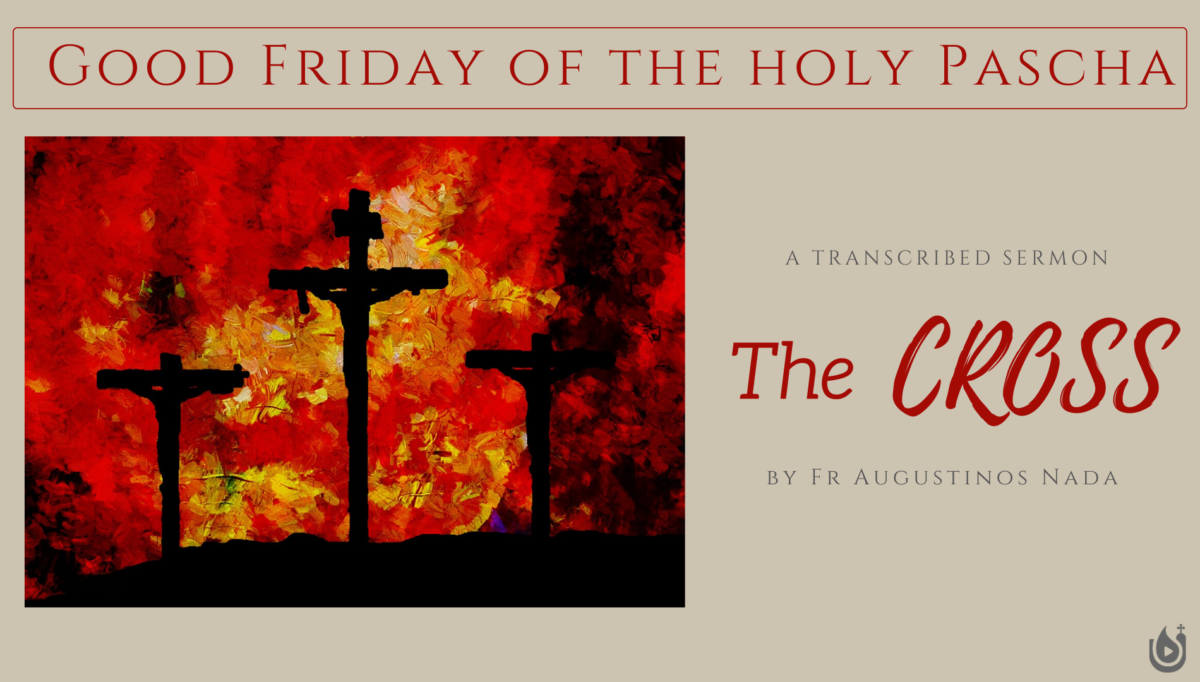
The Cross

The Cross

Adapted from a sermon by Fr Augustinos Nada


Crucifixion started in about 600 BC by the Babylonians who were crucifying people on trees. The person would be nailed to the tree and their body would be left for the animals and birds to prey on. Very barbaric!

The Romans modified this method of punishment and became experts in crucifying people. The word excruciating comes from a Latin word which means crucifixion, and it describes the severe pain which is exactly what the Lord endured. A very severe pain both on the cross and leading to the cross. In icons, you notice that a lot of the crosses are very high and tall, but in reality, some of the scholars say that Roman crosses were not that high, only about two meters or so. This allowed for anyone to approach the person on the cross to slap, spit, curse or abuse them. It was quite humiliating, in addition to the pain.

Christ was crucified outside Jerusalem as the Jews believed that if anyone was to die, especially criminals, they should not to be executed or put to death in Jerusalem, in their holy city, because that was regarded as defiling the land. They wanted Christ to be crucified in accordance to the law in Deuteronomy that said anyone who hangs on a tree is, “cursed by God” (Deut. 21:22-23). The Lord was crucified outside the city and on a place called Golgotha. Some traditions say that this is the place where Adam was buried and this is quite ironic. The second Adam, the one who lifts the curse from us and opens the doors of Paradise outdoes the consequence of the first Adam’s actions.

The greatest miracle witnessed on the Cross was the acceptance of the right hand thief, who acknowledged and accepted the true faith. In itself, this is the greatest miracle. The Lord rose many people and performed countless miracles, including Lazarus, but all those died again. The situation with the right hand thief was the raising of the spiritually dead person who was granted everlasting life. Even while on the Cross, the Lord was still giving and performing miracles.

More still, there was darkness all over the land from the sixth hour (Matt 27:45). In 55 AD, a Jewish historian recorded that there was some kind of eclipse during the year of the Lord Jesus Christ although it was later confirmed that there was no eclipse, as this was not the time for it. Something clearly dramatic happened at this time that had the appearance of the darkness of an eclipse but was beyond what Science could explain. This is why the church switches off the lights from the sixth hour to commemorate this unusual darkness at the time Christ gave up His soul.

“And about the ninth hour Jesus cried out with a loud voice, saying, “Eli, Eli, lama sabachthani?” that is, “My God, My God, why have You forsaken Me?” (Matthew 27:46). A lot of people think that He is praying to the Lord because He is in agony. He was in fact directing us to Psalm 22. Psalm 22 describes the Lord’s crucifixion and all the things that happened to Him in those hours. When the Lord says, “My God, my God, why have you forsaken Me,” He was simply directing them to the Psalm. In those days, psalms were not numbered and so, the people would know the psalm by its opening line.

The Lord also said “I thirst.” In response to this, they gave Him sour wine, which is very old wine. The aim of this was to lessen the pain, as an analgesic but instead, the Lord refused it. The reason for this was because Christ didn’t want to soften the blow. He wanted to feel the full extent of the pain. He wanted to feel the pain and the suffering for the salvation of humankind. He was not forced to die, He went to the Cross willingly and accepted every bit of suffering for our sakes.

In the Gospel of St John, it says that the Lord bowed His head, and gave up His soul (John 19:30). Normally, at death, a person will die and then bow their head. Christ did the opposite. It was almost a display of honour to the Father as He gave up His soul. Christ was in full control throughout all His suffering. The Lord was so unique and so wise in all these happenings. If the Jews still could not see this, the veil of the Temple was torn, a declaration that the self-righteous Jews were not worthy of the Holiest of Holies.

The splitting of the veil of the Temple was a prophecy about the destruction of the Temple while Christ opened the Holies of Holy for all mankind to enter into the joy of the Lord. This allows Christians to come and partake of the Holies of Holy. It is no longer only the Jews that were God’s chosen people but all people.

We are so privileged to be Christian! We are so honoured to be Christians; to know and understand what the Lord did for our sake. To see how much suffering and how much pain He experienced, the nails, the scourging, the humiliation, that was on the Cross and all this was for our salvation.

✝️ Full Sermon ✝️

Not One Bone Broken

Not One Bone Broken

By Shery Abdelmalak


The climax of the greatest love story ever told with the ultimate sacrifice of the most perfect Bridegroom. Every moment of human history came down to this one fateful day. The final covenant between God and His creation, a promise of salvation and freedom for the faithful.

Every little detail on this day had profound meaning and a tremendous cost. Nothing was by accident, all the prophecies led to this final moment of the Lord’s crucifixion. Our God, the author of Love, orchestrated every little detail to show us His Love truly knows no bounds. While there were moments that seemed unnecessarily harsh, these were glimpses into His everlasting love. For it was in His affliction that we hear His call, “I am my beloved’s, And my beloved is mine” (Song of Solomon 6:3). 

The Jews were relentless, but they stopped short in one instance. When they went to break the legs of the crucified, they found that Jesus had breathed His last and there was no need. Some early church fathers have contemplated the question, why the legs? Why not the head, for a swift death? Breaking the legs caused the greatest pain, while speeding up death slightly. They wanted them to die faster, but not without pain. They needed the bodies to be taken down before the Passover so that the stench of the dead bodies did not defile the atmosphere. God-forbid they appeared to be an unclean nation. They were completely blinded to reality and fixated on an honourable appearance, and so, our Bridegroom still had more ways of showing His love to soften even the hardest hearts.

To their surprise, Christ had died already. Could it be that this was a sacrificial death? Could He really be the Saviour they had waited for? We know He died out of free will, out of love. This was His choice to grant us freedom. By His death, He overcame death so that it could no longer have dominion over us. Through His victory in love, He gave up His Spirit at a time He chose, at the fulfilment of all the prophecies, and not at the expected time.  

The Jews knew their prophecies and maybe it was in this moment that they recalled the sacrifice the Israelites offered in remembrance of their freedom from the Egyptians. The one sacrifice that the Lord commanded, “nor shall you break one of its bones” (Ex 12:46), was Christ the sacrifice of freedom; 

He guards all his bones; Not one of them is broken. – Ps. 34:20

If Christ had endured the height of suffering already, why stop at the breaking of bones? Beyond the prophecies, there is more the Bridegroom has to offer to you and I, His bride. We are the bones of Christ. We may endure suffering, but we do not break away from Him. We remain in Christ and by His stripes we are healed (Is. 53:5). For it was in the crucifixion that we were freed from the death of sin and united with Christ for eternity, so how could any one of His bones be broken?

We may leave Christ, but Christ will never leave us. There were so many signs, calling out to the hardest of hearts. When we look upon the hidden brokenness of the heart, the pain almost physical yet unseen. The brokenness we experience, caused by our own accord or otherwise, represents a detachment from the Bridegroom. 

When a bone is broken, modern medicine teaches us that it will never be as strong as it was before. If you repeatedly break the same bone, extra precautions are taken to prevent future breakages. To protect a heart that has been broken, we harden its surroundings, we don’t let people in, just in case it breaks in the same way it broke before – just in case that the next time it breaks, it is beyond repair. 

Don’t show love. Don’t show weakness. Don’t show any sign of humanity that can lead to being hurt.  

‘There is no safe investment. To love at all is to be vulnerable. Love anything, and your heart will certainly be wrung and possibly be broken. If you want to make sure of keeping it intact, you must give your heart to no one, not even to an animal. Wrap it carefully round with hobbies and little luxuries; avoid all entanglements; lock it up safe in the casket or coffin of your selfishness. But in that casket – safe, dark, motionless, airless – it will change. It will not be broken; it will become unbreakable, impenetrable, irredeemable. The alternative to tragedy, or at least to the risk of tragedy, is damnation. The only place outside Heaven where you can be perfectly safe from all the dangers and perturbations of love is Hell.’

C.S. Lewis

That is option one. 

Option two, the option that Christ gives us on the Cross – choose love. Choose love that breaks. When a broken heart is given to God, He heals it so that it is stronger than it ever was before. 

“I am dark, but lovely” (Song of Solomon 1:5). I may be tainted by mistakes, sin, brokenness, but this does not cause God to love me any less. On the contrary, He calls for the one lost sheep among the hundred. For every mistake I make and the subsequent hurt I feel, He heals my heart, He makes me capable of loving more than I ever could before. He helps me fight the reflex to harden against things that hurt me. To harden against pain is to choose a bandaid over the healing Hands of God. He can only heal wounds that are given to Him as they are, as wretched as they may be. May we always remember that on Good Friday, Christ endured all suffering but did not allow His bones to be broken, He did not allow His children to be broken away from Him. There is no hurt too great that He cannot repair.

Our brokenness is a calling to love, to be reunited with Christ in repentance. When we come back to Christ in repentance, we are not just healed, but renewed. Let it break, let it be renewed, for this is the purpose of His Crucifixion. On the day of Resurrection, we are renewed. We put to death all that leaves us feeling broken and we prepare to be risen in Christ. 

“A broken and a contrite heart, these O God, You will not despise.” Ps 51:17

A Sweet Soothing Aroma

A Sweet Soothing Aroma

Adapted from a sermon by Fr Augustinos Nada


Imagine the worst, ghastly smelling thing you have ever smelt. Many of us will think of fesekeeh, in line with the Easter Monday tradition, or milk that has gone bad, or any kind of food that is left out for too long.

Can you imagine if we can then harness this smell into the sweetest swelling aroma? It doesn’t seem possible, but that is what God does for us. He took the stench of our sin and turned into a sweet-smelling aroma.

In Exodus, Leviticus and Numbers, we read of the law of atonement. God spoke to Moses and said that to expel the odour of sin, to offer a burnt sacrifice. Anyone who had sinned would offer up a livestock animal, sheep or bird that was without blemish; a symbol of Christ. This animal was then brought to the door of the temple. The person would confess their sins with their hands on the head of the animal and then they would slaughter it, blood would come forth and this was the form of atonement. The priest would take it to the altar, that would become a sweet soothing aroma to the Lord.

And the priest shall burn it on the altar for a sweet aroma to the Lord. So the priest shall make atonement for him, and it shall be forgiven him (Leviticus 4:31).

Throughout these books of the Old Testament, the sweet aroma of the sacrifice is mentioned 25 times. Could you imagine the rot of sin being transferred through repentance into a sweet aroma to the Lord? Imagine the Lord enjoying the smell of aroma. That is the power of our repentance when we return to the Lord. The fowl smelling of sin – pornography, lies, anger, adultery, disputes, cheating, drugs, alcohol, smoking – is all turned into a sweet incense before the Lord in repentance.

Beyond repentance, we see the sweet aroma in one Person, and that is our Lord, Jesus Christ Himself. The Lord sent His sweet aroma to us in His Son. The ultimate sacrifice was His blood on the Cross. He carried our sins in His body to give us atonement as a sweet aroma. No longer do we sacrifice animals because we have the ultimate sacrifice in Christ.  

2 And walk in love, as Christ also has loved us and given Himself for us, an offering and a sacrifice to God for a sweet-smelling aroma (Ephesians 5:2).

How can we be the sweet aroma to the Lord? The way we live. If we are Christ-like in our conduct, in righteousness, in honest repentance, we become the sweet aroma to the Lord.

For we are to God the fragrance of Christ among those who are being saved and among those who are perishing. (2 Cor. 2:15)

We are the fragrance of God if we imitate Christ and live in His footsteps. Thursday Eve describes two kinds of aromas. The bad smell in the betrayal of Judas for 30 pieces of silver. This was a symbol of man’s sin and the stench that followed the rot of sin. The second was an aroma of love and repentance from the woman that poured the expensive fragrant oil. The sinner woman who did not say one word but the Lord understood her tears of repentance. She anointed Him and prepared His body for burial (Matthew 26:12).

What we know about expensive fragrances is how strong the smell is, the aroma will stick for days. The sinner woman anointed Jesus so that the aroma was beautiful even unto the Cross. Christ was crucified just before the Passover, at a time when they wanted the bodies taken down quickly for burial. There was no time to prepare the spices and anoint His body, He was quickly rushed to the tomb. He went to the Cross and rose with the same sweet smelling aroma from the sinner woman’s repentance.

What can we offer to the Lord?

Our sins and habits when turned to sincere and honest repentance is the sweetest aroma to our Lord. The Lord will carry this to the Cross. The doors of our church are closed now. The churches will, of course, be open again. But this is an important reminder that one day the heavenly church will be closed. These events are a re-enactment of the Second Coming. He said the doors will be shut and there will be people left outside. We have a glimpse of that feeling now with the churches doors closed. It’s not a good feeling, but imagine being left out of the doors of heaven. One day, the doors of heaven will be closed, but they will not be re-opened. In those days, there will be wailing and gnashing of teeth (Matthew 13:42). They will knock on the doors and Christ will respond, I do not know you (Matthew 7:23).

But today, we have a second chance. Let us offer sincere and honest repentance. Then we will have the beauty of being in the presence of God in His peace. We will have answered prayer, and growth in virtue.

Every Good Friday, we find the most expensive perfumes donated to the church for the icons. Instead of giving this to the church, let us leave it to prepare for the church in our homes. The first homily of Monday morning says, “Every person who was baptised in the name of the Father, the Son and the Holy Spirit has an angel responsible for him till their death, and to convey and raise their deeds to God.” – St Shenouda the Archimandrite.

The Lord has sent an angel to listen to our prayers and supports us. If the church is the house of angels, and our homes our now the church then what appears to be a family of four is actually a church of eight if we consider the angels, not to mention the saints and the heavenly hosts. This is the beauty of our home churches.

Let us practice finding a sweet aroma to give our home churches as a reminder of the sweet-smelling aroma that the Lord delights in when we repent. Let it be a constant reminder of repentance that turns the rottenness of sin into an aroma.

🌹Full Sermon 🌹

Is This the End of the World?

Is this the End of the World?

Adapted from a sermon by Fr Mark Basily


There are a lot of questions on our minds, especially as we look around and we see what is taking place around the world. A pandemic that has crippled the Globe. We see numerous deaths, churches closed, streets empty, communities in isolation. This raises so many questions. One question that most people will ask, whether Christian or not, religious or not;

Could this be the end of the world?

In Holy Week, we are following our Lord’s actions and teaching. The week begins with Christ’s triumphant entry into Jerusalem on Palm Sunday. He cleanses the Temple and curses the fig tree. There is a gap of time before the betrayal of Wednesday. Monday and Tuesday almost seem like filler days. What is taking place is a significant part of our Lord’s teaching in those two days.

The readings of Wednesday Eve provide a sample of what Christ spoke and taught. The three synoptic gospels (Matthew, Mark and Luke) dedicate a large portion of their gospels to the teaching on these two days. A key theme was the end of all things. The church refers to this as the Eschatology – the study of the last things.

Christ in His final week spoke significantly about the last things. Matthew has 6 chapters dedicated (Matthew 21-26) to the last things; the second coming, the final judgement and heaven and hell. 

We see a glimpse of this in the readings of Wednesday Eve. We read the parable of the wedding, where all were invited but someone came without a wedding garment and they were cast into hell, revealing the theme of heaven and hell (Matthew 22:1-14). It continues, you must be ready, because two people will be in the field, one will be taken, one is left. Two women grinding at the mill, one is taken, one is left (Matthew 24:40-42). Death can occur at any time. We also have the theme of the Second Coming. The Second Coming is like a thief in the night, it can come at any time so we must always be ready (Matthew 24:43). We also have the theme of judgement with the five wise and five foolish virgins, five were taken in while five were excluded (Matthew 25).

Eschatology is widely considered by scholars to be one of the most difficult areas of study. The confusion is typically surrounding the tense that Christ uses – past, present or future. He speaks about the end of things like they are present, here and now. Surely the kingdom of God has come upon you (Matthew 12:28) – as if the kingdom is now here. It is present.

Elsewhere, when asked when the kingdom of God will come, Christ responded, The kingdom of God does not come with observation; 21 nor will they say, ‘See here!’ or ‘See there!’ For indeed, the kingdom of God is within you” (Luke 17:21). We are given the impression that it is all here now.

Then, there is a future tense that Christ also uses. “So it will be at the end of the age. The angels will come forth, separate the wicked from among the just” (Matthew 13:49). Here, the kingdom appears in future tense. In the Lord’s prayer we say, “Your kingdom come,” implying that the Kingdom is not here but is coming. So, is the Kingdom coming, or is it presently within us?

“Assuredly, I say to you, there are some standing here who shall not taste death till they see the Son of Man coming in His kingdom” (Matthew 16:28). Another confusion is that it is not present, or future, but will be in their lifetime.

How do we make sense of this all? When Christ speaks of the end of all thing, He speaks of four aspects that are weaved together;

  1. The end of the temple – the destruction of the temple in 70 AD. Jerusalem was destroyed.
  2. The True Temple – meaning Christ, His own death and end on earth.

Both allude to the end of the earth. For Jews, no Temple meant the end of the world. For God, the Creator of the Universe to die, the world cannot go on. But there are two more personal ends.

  1. The end of our own lives at our death
  2. The end of the world

What we see taking place is a paradox where the end is already here, but not yet. The church speaks in that language – the already and the not yet. The end has begun at the death of Christ, the end has begun by the destruction of the temple, the end is happening as people are dying and the end is waiting to be fulfilled at the end of the entire world. With the birth, death and resurrection of Christ, He has inaugurated the end of the world. The end has begun.

If the end has begun, it changes how we view Heaven, Judgment and the Second Coming of Christ. It is no longer part of the unforeseeable future. It is here and now.  It can change the way we see heaven and hell, judgement, our own death and how we live.

If the end has already begun then judgement has begun. I am not waiting to be judged. I begin judging myself now in the presence of Christ. If I begin judging myself now so that when the final judgment day comes, I pass judgement. I begin judging myself now with repentance.

In the last days, there will no judge or jury; just Christ and me. A true repentance overcomes judgement. The end has begun. I stand with Him now to judge myself while I am alive. If the end has begun, then the Second Coming is not in the unknown future, it is here and now. I can prepare myself for the second coming now.

During the Pascha, the church is watching from home. Even five of the seven priests follow on from home. We use this time to prepare for the second coming of Christ. The second coming is unlikely to occur while we are in church. Let us stay out of the church to prepare for that moment. We can prepare ourselves to that extent. The end has begun; it is already here. The first Christians lived in that way; as if the end would happen in their lifetime.

If the end has begun, it changes the way I live my life. It changes my view of heaven. Heaven is no longer a place in the future. The Kingdom is here and now and I can live heaven on earth.  When you go to heaven or hell, what will you see? You won’t see anything distinct. Nothing will be different. It will just be the same as where you are.

“Earth, I think, will not be found by anyone to be in the end a very distinct place. I think earth, if chosen instead of Heaven, will turn out to have been, all along, only a region in Hell: and earth, if put second to Heaven, to have been from the beginning a part of Heaven itself.”

C.S. Lewis, The Great Divorce

When we are in heaven, we will look back and realise, we were living heaven all along. Nothing will change. I need to begin my heavenly life here and now, in the already. The age to come will be a continuation. Heaven and the Kingdom is here and now to be realised here and now.

So, is this the end of the world? Yes. It is the end of world. The end of the world began at the death of Christ. We are living judgment, preparing for the second coming and living Heaven on earth. This is our hope.

In the Creed, we end in a joyful tune, “And we look for the resurrection of the dead and the life of the world to come, Amen.” It’s joy. This is what it all about. We can’t wait for the resurrection, but we start here and now.

✨ Full Sermon ✨

Repentance and Mercy

Repentance and Mercy

Adapted from a sermon by Aidan Mclachlan


“To fall in love with God is the greatest romance, to seek Him, the greatest adventure to find him. The greatest human achievement”.

St Augustine

The two main events of Thursday Eve are the betrayal by Judas and the anointing of the feet by the spikenard woman. Two remarkably different people who approached the Lord in very different ways.

Each time we read the gospels and come to the calling of the twelve disciples, we come to Judas. He is described as the one “who also betrayed Him”. All too quickly we assume that the sin of Judas was betrayal. But we ask ourselves, did any of the other disciples betray Christ? The answer would be a resounding, yes! St Peter, who denied Christ three times certainly betrayed Him and yet he remained the rock on which Christ builds His church. In fact, we have all sinned and sin is no less than spurning God’s trust and love for us. It is in short, a betrayal. Is there then no hope for us?

I think we find the true sin of Judas not in betrayal but in despair, and from this despair, his failure to repent. But was Judas not repentant? Didn’t he try to return the silver coins? Judas, so absorbed in the world, tried to overcome his crime on his own without seeking God, or His mercy. What he felt most guilty of, was his role in killing Christ and there was no way that he could reverse this and bring Christ from the dead.

But God could. By this time, Judas’ despair overwhelmed him, and his guilt had consumed him. He was nothing but a vessel of wretched misery and anguish. With no hope on Earth, he ended his life and with it, his hope in heaven as well. If only Judas had suffered a little longer. If only he had endured. If only he had waited a few more days for Christ’s glorious resurrection. He failed to see Christ as God, and that He could kill his despair, before it killed him.

Now if we turn to the second key character, the spikenard woman. We find in the Gospel of Matthew and Mark, a story of a woman who was a friend of Jesus. She anoints Christ’s head, not his feet, in the town of Bethany just before His passion. A different story is presented in Luke; a story of a sinner woman who anoints Christ’s feet and dries them with her hair, with no association with Christ’s passion. Most likely, these are two different events. One performed by a sinner woman, and the other by a friend. One clearly an act of repentance and one seemingly an act of affection.

In the Gospel of John, we find Christ at Bethany just before His passion, similar to Matthew and Mark’s gospels. Yet the woman washes Christ’s feet like the sinner woman in Luke’s Gospel. What is the point of seemingly fusing the two stories, and the two women? This is to show the transformative power of repentance. St John keeps the action of a sinner woman in washing His feet, but the timing in the Gospel narrative of the other woman, a friend of Christ. This Indicates that through her repentance, she went from being a sinner woman to being a friend of God.

The Greek word metanoia is commonly understood as repentance but it is so much more than that. It is a change – a transformation! The spikenard woman becomes an example to us for proper penitence, weeping at Christ’s feet, having both her sins and her Lord before her eyes. The spikenard woman is also a revelation of God’s love that though we fail, though we betray Him, though we put nails in His hand, and a spear in His side, He will overcome our weaknesses and transform us to something greater, a friend of His. Finally we can marvel at God’s love and mercy, just as she did. This is true repentance, born from true love, true faith, true hope, and given to the one that is the fulfilment of love, faith and hope.

If we compare the repentance of the spikenard woman to Judas, we find that she had trust in the salvation of the Lord that Judas did not. Unlike Judas’ attempt at repentance, this woman did not aim for a worldly goal. She was rightly criticised by the apostles for not selling that oil and giving the money to the poor, because it made little sense to the world. Yet out of love, she gave up what was likely her most expensive possession. She wept and begged and pleaded for mercy. This is true repentance.

How can we discover this heart felt repentance? With wonder! We can see that God in all this greatness can overcome any obstacle, even despair. With this wonder, we can behold all that God has made and done for us and so grow in love like the spikenard woman. With this wonder, we can honestly say like the apostle, “if God is for us, who can be against us” (Romans 8:31). How is it that God became Man? How is it that God could suffer? How is it that God could rise again from the dead? How is it that God could make the corruptible incorruptible?

We are blessed not to have logical explanations for many of these questions because if we had them, we may suddenly lose our sense of wonder in favour of something much less marvellous. We discover this wonder from the world around us when we discover that the world is transparent. Through it, we see the beauty and the light of God. The English word cosmetic meaning beauty, comes from the Greek word cosmos, meaning universe. The world becomes an icon of God and we see through it. We cannot be like Judas, who saw the world as an end in itself, because this road leads to despair. We must instead see the world, its beauty and the Lord Almighty in their height of greatness, and not reduced to it.

May we all seek and discover the wonder of the Lord this Holy Week, and for the rest of our days.

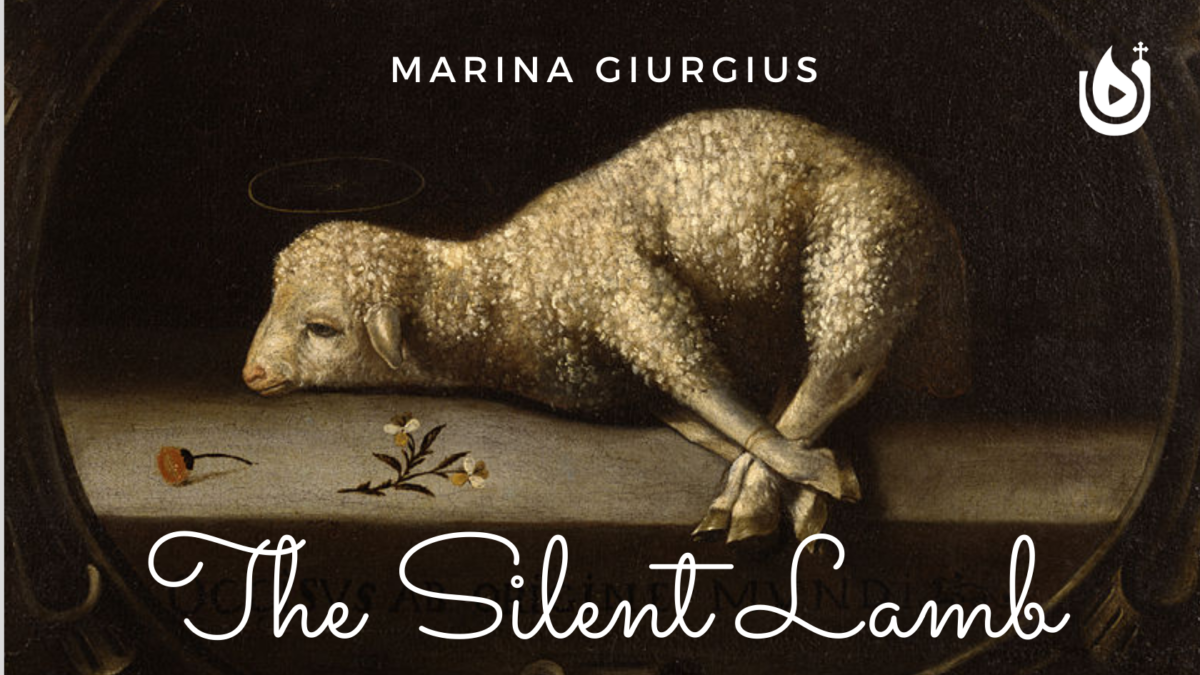
The Silent Lamb

The Silent Lamb

by Marina Giurgius


‘Like a lamb that is led to the slaughter, and like a sheep that before its shearers is silent, so he opened not his mouth.’

Isaiah 53:7

A solider completely silent in the midst of war. Not a single war cry or victory scream. That same solider later forgives his enemy on the battlefield, in the midst of his agony. You and I can both agree that this all sounds somewhat unrealistic, unbelievable perhaps?  Well this solider was Christ and his battlefield was Golgotha. Does that make it any more comprehendible? As we journey into Holy Week, let’s try to make sense of it.

Every aspect of death on the Cross had a ghastliness about it. It was the most agonising of Roman capital punishments and to make it crueller it was not a direct road either. Christ first underwent a patronising trial, excruciating torture and a mockery and all whilst remaining silent. He did not speak during these events and spoke only 7 things on the Cross, all of which were not for his own profit.

Lord, what stopped You from crying out to defend Yourself against the affliction? What satisfied Your heart so much, that it was worth the suffering?

It is not you and I alone questioning His silence. Many at the time and to this day may say that Christ was silent as a means of escaping His tribulation however, it is in fact the complete opposite. It was simply a still submission to the will of His Father and a depiction of His great love for mankind as ‘Love does not seek its own’ (1 Corinthians 13:5).  Just as He left to go to the wilderness, the abyss of silence it was rather a spiritual battlefield than a means of an escape. His silence is perhaps one of the most overlooked lessons on forgiveness given from the Cross. His silence was not fear, but sacrifice.

When we speak many words it only satisfies our hollow weaknesses within us but serves little purpose to our soul belonging to God. It is a challenging task to ask someone to accept an injustice without getting caught up in a confrontation or an argument. Is this not what Christ did on the Cross when He paid the price for our sins in silence? The most difficult of tasks is to not speak in the midst of chaos “A soft answer turns away wrath, but a harsh word stirs up anger” (Proverbs 15:1).  This is the first step to forgiveness as we begin to silence our anger and resentment with silence itself.

The word ‘give’ makes up the word FORGIVE and so it is no surprise that this is moreover at its centrality. The Silent Lamb broke His silence only to give. He gave his enemies and persecutors forgiveness. He gave the Right-Hand Thief the keys to paradise and eternal life. He gave the solider who speared his side a kindness that later made him a great saint. He gave His blessed mother a son and carer. He gave his Father a ransom paid in full and He gave humanity redemption and salvation from an eternal inferno. He gave only to receive a gift of humiliation, grief, suffering and pain embellished with a crown of thorns. 

The first words of Christ at the Cross:

“Father, forgive them for they do not know what they do” (Luke 23:34)

St John, the Mother of Christ and the three Mary’s are all at the foot of the cross and before speaking to them, Christ breaks his silence with a request of forgiveness for his enemies. He prays for his enemies before He addresses His own Mother and His own anguish. Not only was it a simple request of forgiveness on behalf of His enemies but a firm shield of defence and an exemption of their ignorance. How comforting is it to know that Christ is our chief advocate before the throne of God, for there is no earthly defender that can compare to such. Christ continually provides us with the benefit of the doubt for our sins, excusing our sins but how often do we do this with others?  St John Chrysostom explains that waiting for your enemy to come to you seeking forgiveness is vain and a heavenly reward will only come to those who make peace with their enemy on the same day despite criticism. Setting an excuse for your enemy will allow you to forgive before they ask and is an ultimate expression of love, the core lesson from the cross.

Even the pain of the Cross did not amount to the pain He felt one night earlier in the garden of Gethsemane. Upon Christ’s great anguish kneeling before the Father with sweat dripping from his holy temple in the form of blood, He requests,‘Father, if you are willing, take this cup from me; yet not my will, but yours be done’ (Luke 22:42). We can be comforted knowing we have been promised condition-less forgiveness without needing to ask,“If you are willing, forgive me”.

St Anthony the Great says “If we remember our sins, God forgives them but if we forget our sins, God remembers them.”  It is with a continual remembrance of our sins that it becomes impossible for us to say our own sins are lesser than those committed against us and this too will help us forgive.

Our ultimate role-model Jesus Christ even on the Cross in the peak of His torment did not cease to guide and inspire us to forgive. So here are the four things taken from the Cross that we can use to forgive.

  1. Spend time with God in silence
  2. Make excuses for people that you feel may have wronged you
  3. Give whenever you can to the best of your ability
  4. Always remember your own shortcomings and sins 

Because of sinfulness, man lost the crown of perfection that God had granted him in the Garden of Eden, and instead crafted at Golgotha a new crown made of thorns, of that very earth that God cursed when man fell.  Forgiveness is the love that compelled our creator to bear this crown and cross whilst silencing its suffering on our behalf.

Glory be to God forever.

A Love Like No Other

A Love like No Other

By Marianne Wilson

“But God demonstrates His own love toward us, in that while we were still sinners, Christ died for us.”

Romans 5:8

The scene opens to a hill, high up and with a view of the entire wall of Jerusalem. It really is the perfect location for a marriage. A place where all can see the most sacred, holy, intimate and beautiful relationship known to man about to unfold. The Bridegroom laying His life down for His bride, promising His unfailing love. As the view becomes clearer though, I become acutely aware of something extremely unusual; shocking even.

This marriage is different.

Markedly different.

Rather than holding His bride’s hands; the Bridegroom’s arms are outstretched.

Rather than being clothed in the finest robes; He is naked.

And rather than standing; He is hung.

Confused, I look around to find the bride but she is nowhere to be seen. Concerned, I turn back and head towards the city, my pace slowing only for me to catch my breath. I search the streets, frantically asking everyone if they have seen the bride- certain that there has been a mistake.

Most ignore me, some ward me away angrily while others stare at me blankly, completely oblivious to what I am talking about. The sky turns from blue to a dark eerie grey, the rain begins to beat down cutting through me like knives and the lightning explodes lighting up the evening sky. The streets quickly become silent and barren. Soaked, freezing and helpless I am convinced that all hope is lost. As I tread along, head down, feet barely lifting up off the ground, I notice something out of the corner of my eye, something that catches my attention. It is a man, he looks familiar. As I move closer I realise that he is a friend of the Bridegroom. But he is kneeling oddly in a hidden corner, seemingly unaware of the raging storm around him. As I approach I notice that he is shaking, ‘weeping bitterly’ and mumbling words I cannot make out. Embarrassed but desperate, I move closer and almost whisper the question I had spent the last hour asking.

Wearily he raises his head. Even in the darkness I can see his bloodshot eyes and dampened face. With a shaky voice and trembling hand he directs me to an alleyway just a mile down the road. Filled with a new sense of optimism I quicken my pace, the rain no longer bothering me and the cold almost unnoticeable.

Arriving, I look down the pitch black alleyway and notice the poorly concealed shadows lurking in the darkness, the smell of cheap perfume and the sound of coins tinkling.

Immediately. I know where I am.

Frightened of what I might see, I turn, ready to run; positive the man had made a mistake.

But then I see her.

I see the bride.

Rather than holding her Bridegroom’s hands; she is wrapped around the waist of a strange man.

Rather than a pure white dress, she wears an article; stained with the stench of sin.

And rather than a virgin bride she is a soiled dove.

Enraged, confused and hurt I turn and run. Not even stopping to catch my breath. I stumble up the hill, desperate. Desperate to get to the Bridegroom in time. He needed to know. He needed to know the truth about His bride. Even from a distance I can hear His laboured breathing. I drag my feet, every part of my body aching.

Finally, I make it, its not too late. I look at Him, hanging, beaten, bruised and bleeding. Desperate, so desperate, I tell Him the truth. The truth about His bride. I tell Him she’s not worth it. That she loves another man. That she may never return to Him. That the price was too high. That all this was a mistake. That I, was the bride.

But it doesn’t phase Him, not at all! Rather, with a knowing smile and a sweetness in His eyes, He looks at me with a love unfathomable. A love unfailing, intimate and unrelenting. A love so full of mercy and forgiveness it pierces through my very soul. A love reserved only for a Bridegroom and His bride.

And softly, oh so softly, between bruised lips, utters three simple words- “It is finished!”

And bowing His head, He gave up His spirit.

“And it shall be, in that day, Says the Lord, That you will call Me ‘My Husband,’ And no longer call Me ‘My Master’… I will betroth you to Me forever; Yes, I will betroth you to Me In righteousness and justice, In lovingkindness and mercy;I will betroth you to Me in faithfulness, And you shall know the Lord.”

Hosea 2:14-20

Do I qualify for the Kingdom of Heaven?

Do I qualify for the Kingdom of Heaven?

Adapted from a sermon by Fr Antonios Kaldas

If we look at Tuesday Morning of Pascha, the last Gospel introduces the theme of two different kinds of people who relate to God. We hear Jesus talking about the end of the world and He asks, “Who will be on my left and who will be on my right.”

The criteria Jesus gave for who will be on His left and who will be on His right says, “I was hungry, and you fed Me, I was sick, and you visited me, I was naked, and you clothed Me” (Matthew 25:36).

The gospel tells us it’s hard to judge who will be where. When we look at those who Jesus speaks to at the end of the world, do you think it would be easy to tell who fed the hungry, who visited the sick and who clothed the naked and who didn’t? When you look around yourself and look at other people in your day to day life, do you know who feeds the hungry? Do you know who has visited the sick? Do you know who has clothed the naked? Chances are, those that do, aren’t walking around boasting about it. We simply, do not know.

The Gospels of Wednesday help us to try and understand how a person qualifies to be at the right hand of Jesus. Not so that we can look at the people around us and say, “you’re going to heaven,” it is so we can look at ourselves and determine if we qualify for the Kingdom of Heaven. The first hour of the Gospels is about the marriage banquet, here there are two types of people, those are invited to the wedding feast and refuse and those who rejoice to attend the wedding feast of Christ.

The second Gospel was the coming of Christ, here we see two types of people again. Two men in the field, one to be taken and one to be left. “Watch their fall because you do not know what hour the Lord is coming” – which one of them qualifies for heaven?

The third Gospel speaks of the two groups of virgins. The five foolish virgins on the left – they weren’t ready and the five wise virgins – they were ready. The fourth Gospel then talks about the hypocrisy of the scribes and pharisees.

“Woe to you, scribes and Pharisees, hypocrites! For you build the tombs of the prophets and decorate the monuments of the righteous, 30 saying, ‘If we had lived in the days of our fathers, we would not have taken part with them in shedding the blood of the prophets.’ 31 Thus you witness against yourselves.” (Matthew 23:29-31)

These are the people who think they’re going to heaven.

I give God my 5 minutes of prayer, I pay my tithes. What do I have in my life that is important enough for me to rush my prayer? What is more important than giving God my attention when I speak to him? Our prayers tell us something about our relationship with God, our prayers in itself give us a glimpse of which group we fall into.

There are people who believe that God created us to love Him and there are people that believe we create God to love us. The first group says, I exist for God. God is the one who made me, without God I would not exist, He wants me to experience the Joy of love. Therefore, all I do is for God and anybody else. Then there is the other group where, they make up a god in their image and their likeness. He is a god that is kind and merciful and doesn’t mind the sins I am committing. They never feel they have any problems. The problem is, they haven’t met the real God.

We have to be awfully careful to not create our ‘fantasy’ god. The god who will give me everything I want. A god who must make my life very successful. We can’t lead our real God into what we want Him to do.

In the famous words of C.S Lewis, “He is not a tame lion.” We must not think he will come and lick our hands; He has a mind of His own. We are His servants, that is why we say “thy will be done” when we pray Our Father. There are no footnotes at the bottom of Our Father saying, “but let my will be Your will. Please Lord want what I want. Please Lord give me what I want.”

We must deal with the real God, not this fantasy god.

Judas, created a fantasy god. He created a fantasy Jesus. Judas didn’t like it when he had to face the real Jesus, the real Jesus, didn’t approve of his greediness. Ask yourself this question, “Are my thoughts, my motivations, my actions, my words motivated by care for myself or are they motivated by genuine and sincere care for God and my neighbour?”

In recent times, the Church has been tainted with Western ideas. We think of our relationship with God ultimately as standing before a judge. A judge in a “legal” sense where He has a law, He has witnesses of what we’ve done. If we’ve broken the law, we take our punishment. If we haven’t, we will meet Him in heaven.

The Orthodox view has a different emphasis. Those who are going to go to Heaven are those who live in Heaven on earth. It’s not going to be a matter of getting there and having your accounts checked. If we start to live in Heaven on earth, when we get to meet Jesus and ask “Lord, can I please go to heaven,” His answer will be “No, because you’re already in heaven”.

What does it mean to live in Heaven on earth? It is to live united with God while we’re here on earth. Heaven is not defined by a location or characteristic, it is defined by the presence of God.

We can create our own hell on earth by turning away from God. By turning into ourselves and not to God, we turn away from Our God who is everywhere. God has said to us, your soul and your heart is free, God does not force Himself upon us or into our heart. This is why in oneself; we can turn away from God. We become selfish and self-centred. The person who lives in hell on earth, goes up and stands in front of Christ and says “no, I don’t want to be with you. I prefer myself.” And Christ would say “okay, I won’t force you.”

So, as it turns out, it is not God who decides where we go. We choose ourselves. This is the free choice God has given to every one of us. The choices we make in our lives, makes us who we are in the end.

Let us ask ourselves:

Who am I? What kind of person am I? Who is the real person I am that nobody sees? Have I met with the real God, or am I dealing with my fantasy god?

“Then the King will say to those on His right hand, ‘Come, you blessed of My Father, inherit the kingdom prepared for you from the foundation of the world”

Matthew 25:34

💎 Full Sermon 💎

A Warning to the Fruitless

A Warning to the Fruitless

Adapted from a sermon by Fr Yacoub Magdy


In Holy Week, we live hour by hour so we remember exactly what the Lord did in His final week.

On Monday, we remember the day that the Lord was in Bethany. He woke up and was hungry. From afar, He saw a fig tree that appeared to be full of fruit because of the amount of beautiful leaves that were on it. As He approached the tree, He noticed that were no fruits. The tree falsely appeared to be full of fruit but it was merely an appearance of goodness.

The Lord then cursed the tree. For three years, He was with the disciples pouring blessings of healing – raising the dead, curing the sick, giving sight to the blind, cleansing lepers and expelling demons – but to the fig tree, He cursed. The next day as He was passing by the same tree with His disciples, Peter remembers what the Lord says and exclaims, “Rabbi, look! The fig tree which You cursed has withered away!” (Mark 11:21).  For the first time, something living had died at the hands of our Lord.

This was an important event that opens our eyes to the nature of our Lord. The Lord is telling us that the worst sin is hypocrisy. Its underlying sin is arrogance but hypocrisy is the manifestation.

Hypocrisy is to pretend you are good when are not, to hold an inner life that is vastly different to your outward appearance. To appear holy, to appear blessed, but when the Lord looks to your heart, it is withering away like the fig tree with no fruits.

He speaks firmly to the Pharisees and the Scribes to draw their attention, to overcome their pride and hypocrisy. What is the issue of pride?

Pride repels repentance. The hypocrite cannot see their need to repent. They are satisfied with their outward appearance. It is a disease that can manifest upon those living in the church for many years. Their pride sustains them and they carry on living with no cause to repent.

As St Macarius was passing away, there were two monks with him who asked him to give them lessons to live by. His advice was to live your life as a beginner. This is how you remain protected from pride. As we grow, in service, in knowledge, we think we are doing better and we leave ourselves exposed to attacks of pride. The label of “beginner” protects us.

St Yostus implemented this same principle all his life, so that others would not see his goodness and there was not even a hint of hypocrisy within him. One night he knocked on the door of another monk. The other monk awoke from sleep in haste to see what was wrong. St Yostus asked him what time it was. The other monk responded, “Father, you wake me in the middle of the night to ask me what time it is? It is after midnight, what difference does the time make?” He turned around angry, and as he was about to get into bed, he saw scorpions on his bed. St Yostus protected him from the scorpions by asking a silly question so that he would not receive any credit. He preferred to appeared crazy before others than have them think of him as a saint.

This is how the saints protected themselves. The ones that were focused on the opinion of God over the opinions of people. They did what they needed to do protect themselves from the sin of hypocrisy.

As St Moses the Black grew in repentance and spirituality, he was given the gifts of healing and prophecy. Word spread throughout surrounding countries and people began to travel to the desert to ask for his prayers. Some overseas travellers found a tall, dark monk in the desert as they were traveling to the monastery to see St Moses. They asked him if he knew St Moses and the monk responded, “why would you travel all this way to see him? The stories you hear are false, do not waste your time, he is no saint.” They continued walking to the monastery disturbed by what they heard. When they arrived at the monastery, they asked about the monk they had encountered. When asked to describe his appearance, the monks of the monastery were quickly able to identify that the monk they had seen in the desert was, in fact, St Moses. He didn’t like to be described as a saint, he wanted God to reveal what was within his heart.

St Seraphim of Sarov was a Russian hermit and is very well known till today. He was falsely accused of wrong doing. There was a court case before the Russian Synod of bishops and he was asked to defend himself. His disciples implored him to answer but he opened not his mouth, he insisted upon this. The Synod had no choice but to excommunicate him. He left joyful and continued in prayer and fasting. Many miracles were performed while he was in excommunication. This was extremely embarrassing for the Synod that had found him guilty. His excommunication was reverted and he was canonised a saint after his passing.

The saints hid their sainthood to prevent them from falling into hypocrisy. While we are not at the level of the saints to show we are bad but we must protect ourselves too. We must not try to convince people that we are good. If we do good, this does need to be broadcasted. Many times, the church is given huge gifts or donations and no one knows where they came from.

As a safeguard;

  • Never speak in a way that glorifies yourself
  • Never speak of yourself in a way that will cause others to conclude that you are good or a high achiever
  • Always give thanks to God.

How will we be saved if we accept glory of earth?

2 Therefore, when you do a charitable deed, do not sound a trumpet before you as the hypocrites do in the synagogues and in the streets, that they may have glory from men. Assuredly, I say to you, they have their reward. 3 But when you do a charitable deed, do not let your left hand know what your right hand is doing, 4 that your charitable deed may be in secret; and your Father who sees in secret will Himself reward you openly. – Matthew 6:2-4.

Do not be angry. Turn accusation into correction. Apologise often, even if you didn’t do anything wrong. Blame yourself, and you will live happy.

🍎 Full sermon 🍎