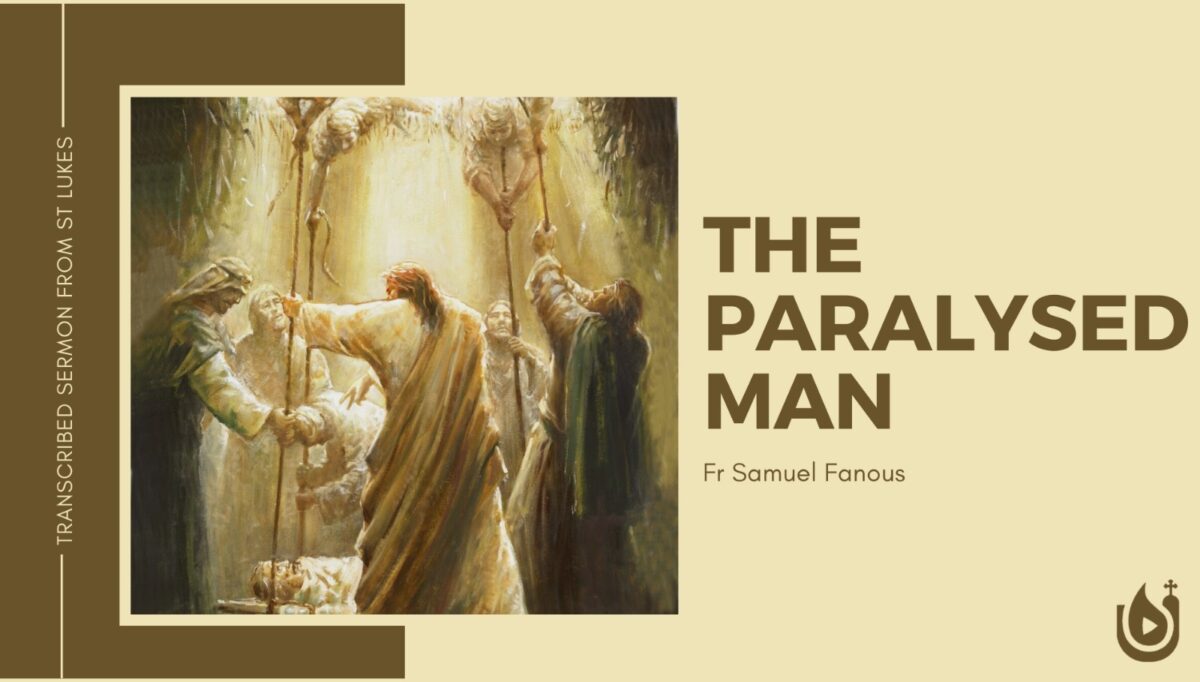
The Paralytic Man

St Luke’s transcribed sermons- Fr Samuel Fanous

There are some beautiful readings today, and if you look through them there is a common theme that runs through all of them. That theme is healing.

If you look at the Pauline it says;

“eye has not seen, nor ear heard, nor has entered into the heart of man the things which God has prepared for those who love Him.”

So, you can’t even begin to imagine what God has prepared for you. Then if we go to the Catholicon;

“by which have been given to us exceedingly great and precious promises, that through these you may be partakers of the divine nature having escaped corruption that is in the world through lust.”

This is one of the most famous passages in the whole Bible because St peter teaches us something very profound in this passage; the true incarnation of Jesus Christ through Him coming as fully God and touching humanity in the way He did and uniting it to Himself, He has touched all flesh so that we become like God. God became man, so man could become God. So, this is what Christ offers us through healing our flesh, through touching it and making it holy and divine. Hence why this is one of the most famous passages in the Bible.

If we go to the acts, we hear of St Paul healing a cripple from Lystra. They thought that he was a God because of this healing. As we also hear of St Moses the Strong in the Synaxarion, which is one of the most beautiful stories of repentance we have in the whole church. A man who was so far gone and yet he became one of the greatest saints that we have in the church.

Finally, in the Gospel we have Christ healing the paralytic man, and if you have a look at the order, He doesn’t heal him then forgives his sins. He forgives his sins then He heals him. And the question is, what is the greatest miracle in the Gospels?

He raises Lazarus from the dead after 4 days and He made eyes for a blind man. But is this really what He came to do?

Lazarus rose and then died later on in life. The blind man saw but became blind again when he died and saw nothing. So, is this really what He came to do?

All of these miracles don’t achieve any lasting service in and of themselves, because the healing that he achieves is temporary.

Matthew Henry, one of the great biblical commentators says;

“The only reason Christ did miracles, was to show what He could really do.”

The miracles were just a little taste tester to show what he could really do. The miracles don’t mean anything in and of themselves because of how many people saw his miracles and walked away and kept going on about their lives.

What Christ is teaching us today is the real miracle, which is the forgiveness of sins. The real miracle is the healing of the soul, not the body. The healing of the soul has eternal ramifications, and it is so much harder to do than the healing of the body. That’s why Christ questions, “what’s easier to say?”

It is much easier to heal someone than to forgive their sins. Now in modern medicine, you come, and we have miracle drugs because they cure many diseases and fix problems that we never had before. That’s what medicine can achieve, but what medicine can never achieve is the change of heart, the change of person, helping someone to overcome a particular sin. So, when Christ came, He did not come for miracles, He came to say, “look, you have a physical disease and I will heal it for you. Just to show you. Imagine what I could do with your spiritual disease. For us its standard, I repent, and the sin is gone. This is what we have been taught in Church, but if you look, it wasn’t always the case. In the old testament, if you sinned; let’s say you killed someone, there’s no forgiveness. The punishment is death. It is only through Christ that that changes. Now everything is forgivable, everything is healable. This is why the Pharisees were shocked, they said; “who can forgive sins but God alone?” And God doesn’t refute them, because He forgives the sins to show that “I am God.”

So, all of these readings today show us the process from sickness to health is an incredibly joyful process, not something sad. We often think that repentance is something sad, we should cry and lament, which might be the first part of it. But the reality of repentance is exceeding joy, to that that ‘I was sick and now I am healed’.

From now on in your life, you have to remember that there is nothing that can separate you from God except yourself. The only person standing between you and God is yourself. Many people sin and then they think that is the end of the line for them; ‘Now I am a sinful person; how can God accept me …’

And that is what you call despair, which is the worst thing that you can do in life. Many people think that despair is humility, but it is the opposite. It is pride. When you think of yourself as so good, that you can’t imagine how you have fallen so much, you think that you are better than that, but none of us are better than that. At our best states, we are still the biggest sinners before God, comparatively speaking. But when I think, ‘wow look at what I’ve done, how could I have done this?’ You think your better than what you are, but if you saw realistically you realise that when you sin it is what you are without God’s grace. So, we must remember that nothing can separate us from God’s grace. St Paul says;

“For I am persuaded that neither death nor life, neither angels nor principalities, nor power, nor things present, nor things to come, not height, nor depth, nor any other created thing should be able to separate us from the love of God, which is in Christ Jesus our Lord.”

But there is a catch; and that catch is ourselves. If you do not repent and not feel as though you have sin in your life, or you feel as though you are not worthy before God and you feel that you are ok, you can never have this relationship, it’s impossible. It is you putting yourself a big barrier between you and God, and not allowing God to enter. For us, repentance starts with an acknowledgment of the sin and is completed in the act of confession and achieving healing. Many people feel as though the church made confession up, but if you look at the old testament people would take 2 goats and bring them to the altar and cast lots for them. One of them is God’s lot. And the goat which the Lord’s lot is cast, that goat is slaughtered. The Lord’s one is slaughtered, and the goat that didn’t get killed is set free into the wilderness. Before they set it free, the priest lays his hand on the goat and he confesses the sins of himself and of the whole Jewish people, and that goat goes free while the Lord’s goat is slain. And so, when you come to have confession it is the exact same process; when the priest lays his hand on your head and you’ve confessed your sins you go free as the scapegoat, you’re the one who escaped. But the Lord, the Lamb himself, Jesus Christ, is sacrificed for your sake. Confession is a sacrament in which there is a hidden mystery, in which something happens that you don’t see with your eyes. This is a very beautiful thing that we have to remember, this is the miracle that God gives us in healing. The physical miracles in your life are nothing compared to this healing that can happen to us.

The worst cases as a doctor to see is when somebody comes in with mental health problems. The first thing you ask is a question that tells you what their insight it, do they have insight into their disease, and if they have good insight it is excellent. We can fix it as they will comply with treatment and do what needs to be done because they know that they need it. If you have no insight it becomes infinitely more difficult to treat, if the person has no insight of their mental health problems they won’t comply and thus we can’t treat them. And so, the number 1 marker of whether a person can be healed is whether they have insight into their disease. Sometimes, we walked around like this, with zero insight into what we are. Zero insight into how sinful we are and how much we need God; ‘I’m fine, I’m a good person. I don’t fight, I don’t kill, I don’t do anything, what do I need God for?’ And that is the hardest thing to cure. St Moses the strong, big sinner, no problem, he knows he’s a big sinner. But most of us going about life ordinarily thinking everything is ok, that is a big problem because we don’t recognise what we need and don’t have. This is the hardest job for any priest and even Jesus Christ Himself who came and could not convince the Pharisees that they needed Him.

So, I think for us, God is offering healing for us and if you seek Him as a Physician, He will be given to you. But you must never feel or think that you don’t need it, or that you are too good for God. The moment you do that you are making yourself out to be God.

Glory be to God forever.

How Great is your Faith?

How Great is your Faith

Adapted from a sermon by Fr David Shehata


Passage Luke 5:17-26

The Paralytic Man is read in the gospel of Luke 5, but also in Matthew 9 and Mark 2. It is very commonly confused with the miracle recorded in the gospel of John which recounts a paralytic man that was 38 years old and sat by the pool of Bathsaida. This is usually because Jesus says to both, “rise, take up your bed and walk.”

There are key differences between the two. They are definitely not the same person and when we look at the differences, there are a multitude of benefits that reveal how Christ treated them according to the depth of their faith.

Jesus was in a house in the gospel of Luke and the man was brought to Him, while in John, Jesus sought out the paralytic man. The man in Luke had friends around him while the man by the pool of Bethsaida had no one.

It can come across as insensitive that the Lord – who is all-loving, all-powerful, all compassionate – would allow this man and his friends to go through so much trouble to reach Him. St Mark recounts the extent of the difficulty they had when he writes, “many gathered together, so that there was no longer room to receive them, not even near the door” (Mark 2:2).

He emphasises a house that would have had so many people that they were flooded out the door. There was no room, so the four men looked upon this situation and decided to enter through the roof; “And when they could not come near Him because of the crowd, they uncovered the roof where He was” – Luke 2:4.

If we pause at this verse and put ourselves in this situation. If I was one of the four men in this situation or the paralytic man himself who had come to see Jesus in faith because I have heard of what He has done for others, how do I react to the obstacles in my path?

This applies to every time we want to spend time with God, but find an obstacle along the way. I am making my way to church, I have planned ahead and booked a spot because of the current Covid restrictions. I find rain, storm, cold… what next? Do I wait for the next mass?

Or I come to pray at night at my designated prayer spot but just before I get there, I find the room is cold and I remember the warmth of my bed… what next? This is a question we ask ourselves. What would I do in this situation; when Christ is so close but there is an obstacle in my way?

Do I presume that it’s just not God’s will for me to go to church on that day? There is nothing wrong with waiting, Jesus will still be around when I eventually pray the next day, or the day after that. There are so many ways to justify turning back at the first obstacle we see.

But in Mark, the four friends saw that they could not enter through the door so they created their own entry point through the roof. It seems irrational and beyond the logic of society to enter through a closed roof instead of an open door.

It is not the faith of one alone in this situation but the combined faith of the five men. They had to carry the man to the roof, they had to uncover some of the tiles so that they could lower him into the house. The greatness and difficulty of this task was exemplary of the greatness and unwavering faith of these five men.

The understanding of Jews at the time was that in major disease or illness was the result of sin. Either their own sin or that of their parents, just like in the gospel of John when the disciples asked Christ in front of the man without any fear of whether he would hear them or not, “Who sinned, this man or his parents?” This is an insight into the culture at the time. The paralytic man was seen as a sinner, deserving of his punishment of paralysis.

The life of a paralytic would have been extremely difficult, they had no social security, were unable to work and moreover, they were blamed for the state they were in. No one had compassion on them and they were likely to grow irritable and resent society. This man showed willingness to become a public spectacle, to be judged and condemned as a sinner, for a chance to reach Christ and be healed. This was all irrelevant to him compared to what he was about to gain. His gain in this process was far greater than any criticism and social stigma. This is a lesson in faith we can all learn from.

How many times do I sacrifice time with God for momentary praise or pleasure? How many times do I, in my own life, say that I will speak to God later?

When the Lord sees the faith of the paralytic man and his friends, He says, “your sins are forgiven.” This is so powerful and gives us insight into the nature of Christ. The Lord prioritises the man’s sins over his paralysis. This was the more important of the two in the eyes of the Lord. Heavenly healing lasts for eternity, while healing of the flesh is irrelevant to the hereafter.

Perhaps we can learn to prioritise similarly; to work harder on the forgiveness of my sins, to work harder in speaking to my father of confession, to work harder in partaking of the sacraments and finding time alone with God.

God wants to approach Him similarly as Fr Yacoub Magdy points out – “the trust of the beggar, compels the giver.” We learn to approach the Lord in unworthiness, in helplessness and that compels God to come to our rescue, for He is our only hope.

We cannot say we have finished breathing for the day, so we can not say that we have finished praying for the day. Prayer is a continual and ongoing relationship with the Lord. The four men approached the Lord and encountered an obstacle but they kept striving to reach Christ by any means possible. They persevered with greater effort so that they would see the Lord and have the life changing encounter that they hoped for.

One reason why the Lord ensured on that day that He would be so far out of reach was to highlight the extent of their faith on that day to benefit those that witnessed the miracle and even to us, 2000 years later.

The question we then ask ourselves is how much effort do I make to meet the Lord? Is it beneficial to me? I need to keep asking, I need to keep seeking, I need to keep knocking, until I encounter the Lord, whatever it takes.

“Do not be foolish in the requests you make to God, otherwise you will insult God through your ignorance. Act wisely in prayer, so that you may become worthy of glorious things. Ask for things that are honorable from Him Who will not hold back, so that you may receive honor from Him as a result of the wise choice your free will had made. Solomon asked for wisdom (3 Kg 3:8-14) – and along with it he also received the earthly kingdom, for he knew how to ask wisely of the heavenly King, that is, for things that are important.”

St Isaac the Syrian

We have the King of Heaven and Earth before us and He is willing to give us all that we ask for. Ask, and ask for big things. Don’t ask for meaningless things that you would never put before a king. Even if you don’t receive immediately, keep praying for your begging will compel the Hand of God to give.

Put off Worldly Lust, Put on Spiritual Nourishment

The New Man Part 2: Put off Worldly Lust, Put on Spiritual Nourishment

By Ereeny Mikhail


I want you to think to a time you bought your favourite treat. A box of Favourites chocolates. A dozen of Krispy Kreme donuts. A container of cookies. You bought it at the end of the week after you’ve spent the week eating healthy and exercising. You tell yourself I will only have one. Then you have one, enjoy it and carry on with your day. But then you see the rest of the treats sitting there…you eye it…think about it…then you have one more. And once you start, you can’t stop.

How do you feel after it? Guilty? Angry with yourself? Upset? Or maybe you feel happy? Joyful? Satisfied?

Our initial aim is self-control but when the temptation presents itself, we often act on impulse, desire and lust. You may ask yourself; why don’t I have self-control? Why are others able to control themselves with certain things while I cannot?

Let me reassure you, there is an explanation to all this. There are different parts to the brain which control for these responses. The frontal lobe, specifically the prefrontal cortex, controls for resisting temptation. It is actually responsible for something described by scientists as “executive function”. In simpler terms, “executive function” refers to judgment/decision making, focusing, planning, coordinating, social control and emotional control. Individuals who have less activity in this part of the brain may struggle with impulse control problems, lack of self-control, trouble learning from past experiences amongst others. Of course, each individual is affected differently depending on the level of activity. There are multiple other sectors of the brain which ultimately play a role in our fleshly lusts such as the limbic system which supports different functions including our emotions. Our hormones are also responsible for feelings of joy and happiness which results in people seeking certain fleshly lusts. Essentially, multiple factors play a role in temptation. These all interact in ways that we still do not fully understand.

Does that mean we give up? When my brain is wired like this, is there a point? If my brain tells me to fulfil the lusts of my body, should I do it?

St Paul tells us in Ephesians 4:20-24: “But you have not so learned Christ, if indeed you have heard Him and have been taught by Him, as the truth is in Jesus: that you put off, concerning your former conduct, the old man which grows corrupt according to the deceitful lusts, and be renewed in the spirit of your mind, and that you put on the new man which was created according to God, in true righteousness and holiness.” He specifically says to ‘be renewed in the spirit of your mind.’ St Jerome reflects on this and says:

“We are not being renewed in our thinking process apart from the renewal of our spirits. Nor are we renewed in our spirits without thinking.”

We can only renew our spirits when we renew our mind and vice versa. How can we renew our mind if we are wired as such? Again, let me reassure you, the mind controls the brain, which is the single most malleable organ in the entire body. As it says in 2 Timothy 1:7, “For God has not given us a spirit of fear, but of power and of love and of a sound mind.” God has given us a sound mind which we can train.

I am reminded of the story of the World War II veteran, Louis Zamperini, who later became a Christian evangelist. His biography “Unbroken: A World War II Story of Survival, Resilience, and Redemption,” is the exact example of the flexibility of the mind. At the beginning of his story, he and two others survive a plane crash which leaves them stranded at sea for 47 days. Zamperini and one other plane crash survivor, Phil, live through the extreme circumstances. The third plane crash survivor, Mac, on the other hand, who does not believe he will survive, is the one that dies. All three individuals were put under the horrible circumstances with the same supplies. However, Mac dies because he believed he would die. After the 47 days, they are caught by the Japanese and become prisoners of war. They are faced with extremely harsh and violent conditions but still continue to survive. Zamperini, specifically, is violently targeted by the Japanese corporal, Mutsuhiro Watanabe. Watanabe often hurt Zamperini, leaving him weak and hungry. On a day, when Zamperini’s body was not able to continue working at the camp, Watanabe punishes him by telling him to carry a heavy beam above his head. Watanabe asks the guard to shoot Zamperini if he drops it. Zamperini, put his mind to it, lifts the beam and held the beam above his head for an impossible 37 minutes. Through his weakness, he controlled his mind to believe he could do it and he did. If the mind is focused on something, it can achieve it. No matter the circumstance, no matter the temptation, no matter the spiritual warfare, the ‘sound mind’ Christ has given us can do anything. Thus, we must exercise our mind to overcome our fleshly lusts.

As I mentioned, both the mind and the spirit work hand in hand, not one before the other. St Paul in Galatians 5:16-17 tells us, “Walk in the spirit, and you shall not fulfil the lust of the flesh. For the flesh lusts against the Spirit, and the Spirit against the flesh; and these are contrary to one another, so that you do not do the things that you wish.” The mind can be trained by ‘walk[ing] in the spirit’. And, if we train our mind, then our spirit is also lifted. By doing this, we overcome the lusts of the flesh.

I think the first hurdle to train our mind and spirit, should really be answering the almighty; WHY? Why should I overcome the lusts of the flesh? St John Chrysostom reflects on this and says;

“Pleasures often are destructive. They end up being not really pleasures but bitterness and deceit and pretense, like a theatrical illusion.”

Our lusts are but masked happiness which lead to eternal condemnation. We must not live in lust, because we don’t know when our last day may be. We often tell ourselves, its ok if I overindulge today, I will be better tomorrow. By we must deny ourselves because “…you do not know what will happen tomorrow. For what is your life? It is even a vapor that appears for a little time and then vanishes away.” (James 4:14) Likewise, “His spirit departs, he returns to his earth; in that very day his plans perish.” (Psalm 146:4)

A priest once described to me the notion of something called a “beloved sin.” He said it was a sin that a certain individual always finds themselves returning to, a sin they sometimes think they have no control over, a sin they might even enjoy. Let’s return to the donut, the cookie, the chocolate…I asked a question…How do you feel after it? You might feel guilt, upset, or angry. Or you might feel happy, joyful, and satisfied. Our favourite treat is like our ‘beloved sin’, our fleshly lust. We may be burdened by our fleshly lust, we may feel we have no control over our fleshly lust, we might even enjoy fulfilling our fleshly lust. But because our life is but a ‘vapour’, we must put on spiritual nourishment. “If anyone desires to come after Me, let him deny himself, and take up his cross and follow Me. For whoever desires to save his life will lose it, but whoever loses his life for My sake will find it. For what profit is it to a man if he gains the whole world, and loses his own soul?” (Matthew 16:24-26) We must endure and deny our burden, that is our fleshly lust, whether that be money, sexual desire, gluttony, or other sins… because as St Peter says in 1 Peter 2:11 it is a “…war against the soul.”

Most importantly, we are reminded of God’s love. That love is the single, most epic love of all time. No other love can compare. If our body, mind and spirit recognise this love, then all impulse drive in our mind, all emotions in our systems, and all hormones which are associated with temporary fleshly lust, will then desire that eternal love because it is the only way to feel full for longer. Like in the story of the Samaritan woman, “Whoever drinks of this water will thirst again, but whoever drinks of the water that I shall give him will never thirst. But the water that I shall give him will become in him a fountain of water springing into everlasting life.” (John 4:13-14)

Now that I have answered the almighty WHY, we know that our fleshly lusts may be a burden, an ‘illusion’ of happiness and to overcome it we are reminded of Christs love and must take up our cross. How do we practically take up our cross? The contemplations of the Saints guide us.

“But the Word of God kills in such a way as to make the dead one come alive. He then seeks the Lord whom he did not know before his death. He does not corrupt but kills the old man…As the outer man decays the inner man is renewed.”

St Jerome

“When you control your body, the spirit will do its job and the might of the body will be controlled by fasting.”

Pope Kyrillos VI

“Ignore the needs of the body when you stand for prayer. Even if you are bitten by a fly or an insect, do not be bothered by it so as not to lose the great benefit of prayer.”

St Evagrius

Through fasting, prayer and the word of God, we put off our fleshly lusts. We put on spiritual nourishment. We become one with God.

“Let us see how the saints reached heaven. They did not have an easy life but had to struggle in patience and great long suffering. The Scriptures gave us the commandments, and the saints left us their experience regarding the path leading to the Kingdom. Let us see how much they loved God. Let us contemplate their lives. We will realize that they lived in humility and meekness, in hard work, in struggle, in love for God and others, in vigilance and prayer, in addition to their manual work.”

Tamav Ereeny

Our Father

Our Father

Adapted from a sermon by Fr Daniel Fanous


In the Gospel, there are various accounts where Jesus teaches us how to pray. Often, we may find ourselves asking ourselves, “How do we pray?”. Thus, it is important for us to listen closely to the words which Christ provides us with within the Gospels. He says,

“When you pray, say Our Father,” (Luke 11:2)

He doesn’t give us prerequisites or strict instruction. We probably don’t notice how unusual that language is since we are so used to it. We hear it because we recite this prayer almost if not daily. During Christ’s time, to call God ‘Father’ was unusual.

In the Jewish praise, you will often hear them say, Lord God, creator of Heaven, and that’s how it would begin it. Very rarely would you see somebody called God, ‘Father.’ People were often excommunicated for claiming to call God ‘Father’, due to the audacity to act as though they were a son or daughter of God.

Not only does Christ urge us to call God Our Father, but He himself also uses the title when He prays.

It is unusual. Not only is He claiming to be the Son of God, but he also invites us to partake in this sonship, urging us to approach God as our Father too.

One of the early Church Fathers in early fifth or fourth century Alexandria says,

“He gives His own glory to us.”

He raises slaves to the dignity of freedom. He rescues us from the state of slavery, giving us by His grace what we did not possess by nature, and permits us to call God our Father as being admitted to the ranks of sons and daughters.

Can any of us say that we are truly free. But rather, we are all enslaved to something. All of us are beneath where we should be. All of us find that we do not have freedom or certain control, whether it will be given to anger, words that we cannot stop saying, cigarettes, alcohol shopping, whatever it may be, we’re all enslaved to something attention. However, Christ elevates us back to where we were supposed to be, sons and daughters.

Therefore, since we are all children of God, thus we must also be brothers and sisters to one another. We are all part of the same family raised under our Father’s wing. As He will care for us, so should we take care of our fellow brother or sister.

On Anger

On Anger

By Fr Antonios Kaldas

Original post by Fr Antonios Kaldas blog site


How often do you change your mind about something? I mean, really change your mind? A few years ago I had the privilege of co-authoring a book on Orthodox Christian Marriage with Ireni Attia, and one of the things we discussed was anger. My initial attitude was that anger has no place in a truly healthy, happy relationship. But working with a professional like Ireni, helped me to realise that anger is a very normal human emotion that is neither good or bad in itself. It is how you use it that matters. The more I thought about it, the more I realised she is right: psychologically, biblically, and philosophically.

It is a basic psychological principle that suppressing or burying real feelings inside us is never good. The fact is, I get angry, and to pretend otherwise can only cause harm to my own mental health, and to my relationships. Such a denial is unsustainable in the long term. 

Biblically, I was astonished that I never picked up on this before. Our modern sensitivities tend to downplay the anger inherent in Christ’s driving moneychangers from the temple:

Then Jesus went into the temple of God and drove out all those who bought and sold in the temple, and overturned the tables of the money changers and the seats of those who sold doves. And He said to them, “It is written, ‘My house shall be called a house of prayer,’ but you have made it a ‘den of thieves.’” (Matthew 21:12–13).

 I simply cannot imagine Jesus gently strolling up to the moneychanging table, smiling and passing a few polite pleasantries, and then taking permission: “Would you mind terribly if I turned your table over now, sir?” This was an act of anger, and He left no one in doubt about that. Surely, then, if the Word of God Incarnate, the Perfect Man, could rightfully be angry, it must also be possible for us to be rightfully angry. What is it then, that distinguishes the good use of anger from the bad? St Paul gives this advice: “Be angry, and do not sin”: do not let the sun go down on your wrath (Ephesians 4:26).

 Is that not odd advice from a preacher of the Gospel of divine unconditional love? Can it ever be loving to be angry with someone? It turns out that St Paul is quoting Psalm 4:4, word for word from the Septuagint Greek translation of the Old Testament most familiar to Jesus and His disciples

 The first word, orgizesthe, is a passive construction—roughly, it means to be provoked to passion or anger. So the first thing to note here is that the Psalm (and St Paul) are acknowledging that there are things in this world for which the right response is anger. I can think of a few: the poverty and hunger of millions while a tiny number of rich people keep everything for themselves; the oppression and exploitation of the weak by the strong; the injustice of thousands of innocent people dying at the hand of a state simply because they are too poor to afford expensive lawyers who can navigate a complex legal system; lies being peddled as truth for selfish purposes … the list could go on. If such things don’t get you at least a little hot under the collar, the question to ask is why not?

The last word in that quote, hamartanete, comes from the root word commonly used for the concept of sin in the Bible. Hamartia is missing the mark, failing to be what you were meant to be. Anger may be justified, but if misused, it makes you tremble so much that your aim goes astray and you miss your target. If the target is to right wrongs, unbridled or misdirected anger can make you the cause of even worse wrongs. If you are going to be angry, then, do not let your anger make you miss the mark.

How do we miss the mark? When is anger a sin?
Simply: whenever it contradicts the Gospel of love.

There is a difference between getting angry at someone who has slighted me and plotting my revenge upon him on the one hand, and getting angry at world poverty and being moved to action to do something about it. The first is motivated by self-love, the second, by love of others. The first leads to acts of violence that hurt others, the second to acts of charity that save others. The first breeds hatred, the second breeds gratitude. It is the first—this “wrath of man” untempered by divine love—that “does not produce the righteousness of God” (James 1:20).

In brief, then, ‘good’ anger arises from ‘good’ motivations, is properly justified, and leads to ‘good’ actions and outcomes, while the reverse is true of ‘bad’ anger. Bad anger is a failure of love, but good anger is the appropriate expression of love. The proper purpose of anger is to move us to act against evil, whether in ourselves, or in our relationships with others, or in the communities we share with others. Arising from love, it is always tempered by love and by all the other virtues that come with love: wisdom, discernment, humility, truth.

 Another way to think about this is through the lens of the Stoic Greek philosophical concept of adiaphora—things that are ‘indifferent’ or neutral, neither good nor bad in themselves. The Stoics divided stuff up into three main categories. There is stuff that is intrinsically good—that’s basically the virtues, things like wisdom, justice, courage, and moderation. There is stuff that is intrinsically bad—that’s basically the vices, the opposites of the virtues, things like foolishness, injustice, cowardice, and excess. Everything else is indifferent(adiaphora)—neither good nor bad in itself, but capable of being used for good or bad.

There’s a couple of interesting things to notice here. Some of the indifferents tend towards being good, but can also be turned to bad. For example, health tends towards the good, but if I use my health break into a house and steal from a poor widow, then it has become bad, not good. Likewise, disease tends towards being bad, but can also be turned to good. For example, if my disease leads me to contemplate more deeply the meaning of life and become a wiser person, then it has become a good thing.

So where does anger fit into the Stoic system? It is an indifferent, neither good nor bad in itself, but it becomes so, depending on how you use it. Perhaps, like disease, it tends in practice more often to produce evil, but that should not discourage us from harnessing its power in the service of the good, along the lines I described above.

 One more qualification is helpful here, and it comes from St Paul again. “Do not let the sun go down on your wrath” (Ephesians 4:26). In order for anger to be good and remain good, it must be under control. Without control, anger can be more like a wild animal that rages without caring about the harm it does. So even when angry, I should continue to be sensitive to the reactions and feelings of the person in front of me. St Paul’s direction to put a time limit on anger suggests that good anger is anger that is under my control—I can tone it down or even let go of it all together when it is better to do so. And it is almost always better to do so within a relatively brief period of time. Prolonged anger is not only bad for my blood pressure (and that of those who have to bear it)—it also loses its effectiveness after a while. If it goes on too long, nobody pays attention to it anymore. It is wiser to reserve it for the things that really matter.

Anger is a very tricky beast to tame, yet it can move us to do great things. It should be approached with care, used sparingly, only when really necessary, and always practiced with self-control, unselfishness, and love. For most of us, it is not something we can completely cut out of our lives (nor perhaps, should we). But it is certainly something that can be tamed and turned to good. I’m so glad my understanding of anger has changed, but I’m a little cranky with myself that it took me so long to change it!

Original blog found at- http://www.frantonios.org.au/2020/05/08/on-anger/#more-935

The Feast of Pentecost

Adapted from a sermon by Fr Sam Fanous


Passage: John 15:26 – 16:15

Today is the beautiful Feast of Pentecost – the Feast where the apostles and disciples went out and converted the whole world. If you look at the whole history of humanity within the Bible, you can see that it is a process of God teaching humanity. In ancient civilisations, the world was pretty barbaric – humanity behaved in a way that was very depraved in many instances. In those times, they behaved in that way often in service to the gods they worshipped. Some offered up their sons and daughters, and burned them in an act of worship to their gods.

Throughout the Old Testament, God told these people that, though they were primitive, this was not the way to behave. So He revealed himself to them as God the Father, the one God. In those days, the concept of one God was alien to them – there were hundreds of gods. Each tribal group had their own group. He revealed himself to the Jews firstly to teach them the most important lesson: there is only one God. The other gods were idols. But the God of the Jews was the only one to be worshipped. 

And even though he said this to Abraham and Moses, it took about a thousand years for this idea to sink in. Initially, they thought that this was their God who was stronger than all the other gods. But after thousands of years that concept became ingrained that the other gods weren’t real, and were simply works of man. The God of the Jews was the only God. He revealed that He was the transcendent, unknowable, eternal God. 

This is why in the Old Testament the people would question “how can I have seen God’s face?”. They believed that if they saw God’s face they would be immediately killed. But throughout the whole Old Testament there are snippets of revelation that somehow God is further than we could ever imagine, yet somehow close to us. We see Moses in the Burning Bush – the angel of the Lord walks on the earth. But who is the angel of the Lord? 

So somehow, throughout the Old Testament, you get the indication that there may be more to the story than this one, eternal, unknowable God. And finally, when we get to the gospels, we discover a new level of truth: God, the word, the second person, became man.  

He was the angel of the Lord. He was the one who spoke to Moses through the Burning Bush. In the fullness of time, through St Mary, He became man. 

And this movement of revelation from God the unknowable coming towards us moves to another level now. Now, Jesus walks with us. We can listen, touch, hold and see Him. He is there. 

But the movement of God towards us is not finished there. Jesus’ death and resurrection is only the second stage. The next stage is today – Pentecost – when the disciples were gathered together in the upper room, waiting for the Holy Spirit to descend on them. This is the final revelation.

In the Old Testament, we have the eternal God unknowable to us – and that is still true. God the Father cannot be known by us. We cannot put Him in our brains – He is far above us. 

But now, we know Him as Jesus Christ. He is close to us. 

But the final stage of the revelation is the outpouring of the Holy Spirit within us. God is not only beyond everything, He is not only someone we can see, He is someone deep within us, closer to us than we are to ourselves. 

As one theologian puts it,

“God is beyond all things we could think or express, yet closer to us than our own heart”. 

This is God’s revelation to humanity – and we are the heirs of this revelation. We have received the Holy Spirit in baptism and chrismation. God has moved from His eternal throne all the way into our souls, even though we don’t deserve it. 

And now God is fully revealed to the world. There is nothing left for God to teach us from an external perspective. The only thing we have to do is find him. And we cannot say “you’re too far away” or “we don’t know you”. The disciples and Jews saw Jesus walking on earth, but He is closer to us than He was to the disciples because He is within our soul through the Holy Spirit. 

It is the Trinity: God the Father, Son and Holy Spirit that works within us for our salvation. It’s the Spirit within us that pushes us to pray and convicts us when we sin. And when we pray, we pray by the Spirit, through the Son, to the Father. The Holy Trinity, altogether, is working for our salvation. 

So today we have to be filled with the Holy Spirit. Every action and word must be infused with the Holy Spirit. If you are not sowing the Spirit to the people around you, you are giving them emptiness. If you’re a servant in the church, and are empty of the Holy Spirit, your service is futile.

You may do good things for people and help them. Many people help those who are sick, which is a good thing. But what are you doing to make a change eternally? You may ease their pain for a short period of time, but are you easing their eternal pain? Are you giving them eternal glory? Are you giving them anything with substance or meaning? 

If you don’t have the Holy Spirit, whatever good you do will never be eternal. It will only ever be temporary. 

Think about it like a drinking vessel. You could have a drinking vessel that is beautiful and ornaments your house, but when you come to drink from it, it’s empty. Or you could have an ugly jug, cracked, hardly holding itself together, and when you drink from that drinking vessel, it has an outcome. It gives you something.

This is what we have to remember. If we are empty of the Holy Spirit, no matter how good we look, no matter how much we do, we are giving emptiness. We are giving from our own deficiency. 

Without the Holy Spirit guiding our actions, we are like zombies. We can move and do things but there’s no life within us. 

It’s not just in our service. Think about your actions when you raise your own children. When you raise them, you have to raise them with the Spirit. In everything you do, give them the Spirit. Every time you speak to them, when you pray together, when you discipline them, feed them the Spirit. 

We spend so much time making sure we have enough food or clothing so we can provide for them materially, but that doesn’t mean anything. They will only remember if you fed them the Spirit when they looked at you and saw that you had something special, eternal and transmitted it to them. 

St Seraphim of Sarov said,

“Acquire the Spirit of Peace and a thousand souls around you will be saved.” 

Just one person can acquire the Holy Spirit and thousands will be saved. With the Holy Spirit, twelve uneducated fishermen changed an entire empire without lifting a sword. With the Holy Spirit, a poor young virgin gave birth to the Saviour of the world. 

This is the purpose of our lives – to be filled with the Holy Spirit. Any church that is not filled with the Holy Spirit is dead. You can do all the services you want, but it is a dead church. And being filled with the Holy Spirit doesn’t start with the priest or the hierarchy. If every member of the church was filled and overflowing with the Holy Spirit, then the whole country would be changed just from that church. If every single person made that their goal in life, the whole world would be changed. 

So this day of Pentecost, let’s not forget our purpose on this earth – to be filled with the Holy Spirit so that it overflows. Let’s follow the example of the disciples. First, they gathered together in the upper room, waiting patiently for the Spirit to descend upon them. We need to drink daily, hourly, minutely, from the Holy Spirit. 

Every time we lift up our eyes to heaven or bow down on our knees to pray, this is us drinking daily. When we fill ourselves up and then interact with the people around us, it’ll naturally be transmitted to them. Even without words, as St Francis of Assisi said:

“Preach the Gospel at all times. When necessary, use words.”

We don’t always need to use words to preach God – we just need to be filled with the Spirit. 

Together, in this season of Pentecost now, remember that God, who is beyond our comprehension and above anything we can begin to imagine is also deep within our souls – our whole purpose in life is to discover and find him there. Glory be to God forever Amen.

Full Sermon Here

Prayer that Moves Mountains

Adapted from a sermon by Fr Yacoub Magdy


Passage Luke 11:1-13, Psalm 143:10,8

One of the blessings of our church is that every liturgy has a special meaning for each of us personally. It would be a shame if we didn’t search out this message from God from day to day.

The message from the gospel of today is that prayers are answered. St Luke starts the narrative with a question the disciples ask of Christ. They have seen Him praying on a number of occasions already now and this moved theirs hearts. They ask Him, “Lord, teach us to pray, as John also taught his disciples.” – Like 11:1.

Jesus gave them a model of prayer. The beauty of the Lord’s prayer is that it starts with, “Our Father.” He encourages them to call Him, Father.  

Not many people appreciate this or understand fully. Those that convert to Chrisitianity from a different religion have an unique appreciation of calling God, Father. The Creator of all wants us to call Him Father.

 In the book, “I dared to call Him Father,” it took tremendous courage to call our Lord, Father. When I think about it, who am I to call Him Father?

This is the cornerstone to how we come to God with prayers answered. Jesus gives His disciples examples of persistence in prayer. When you pray, don’t stop until you receive. This is the treasure and beauty we can have as Christians – as children of the Almighty.

If a judge tells you lodge an appeal and I’ll support you. You have tremendous confidence that your appeal will be received because of the support you have from the judge. The One that answers prayer is telling us to ask, to seek, to knock, and He is the One that will answer us.

There is a famous comment of Pope Kyrillos from those who knew him well, “whatever God can do, prayer can do.” Prayer elevates our capabilities to God’s level. We can move the hand of God through our prayers.

St Basilios once said, “people climb and when they are two steps away from the top, they return back.” When you have something you need from God, don’t stop until you hear His answer.

If you then, being evil, know how to give good gifts to your children, how much more will your heavenly Father give the Holy Spirit to those who ask Him!

Luke 11:13

We, being normal people, with our limitations, would give to a friend in need. When a child asks for something, a parent rushes to give it to them straight away. God is our Father, and responds in the same way, if not, more. Each word is a step toward perseverance. Ask. Seek. Knock.

The first level is easy, you ask from what you want. The next is a bit more difficult because you start seeking it out. The final level is the height of persistence when you knock, and keep knocking until the door is opened.

This is how we approach God. Not to ask our request over and over again, God knows our needs, but if you have something at your work, home, health, with your children, God knows your needs.

As His child, God can never let us down. If the gospel is ever unclear, we have a Psalm attached for clarity. The fathers that put together the gospels hint toward the meaning by choice of psalms. The Psalm attached read;

Lead me in the land of uprightness. For in You do I trust

Psalm 143:10, 8.

I cannot trust God if I am not on the path of righteousness. St Isaac the Syrian once said, “The trust of the beggar compels the giver.” When you approach God, knowing He is all-capable yet all knowing, this confidence shines through your prayers. It is not a matter of, “God, can You help?” but “God, I know You can help, but let it be according to Your will.”

You cannot let someone down that comes to you in full assurance and trust. My conscious tells me that I won’t be let down. If you work for an honourable boss, you never think that he won’t pay your due wages.

If I am on the path of righteousness, I trust that I won’t be let down. This trust compels the Lord to give me. The beggar’s trust forces the giver to give. There is so much power given to the one that trusts God. It is available to us all, Fr Makary Younan says, “my hand can’t move a mountain, but my prayer can move the Hand of God that moves mountains.”

I recall a story when I was asked to speak to the youth about the consequences of purity. At the end of the talk, I left them with a challenge. The challenge was to spend six weeks (forty days) in complete purity, without a hint of impurity, no screens or looking twice at temptation. A period of six weeks is typically how long it takes to form a habit, so if they were motivated for this time, they could conquer any bad habits.

One of the youth was very afraid of failing a certain subject at university but upon hearing this challenge, he called upon the Lord to help him pass his subject if he maintained his purity. His confession father later told me this story because not only had he passed but he received a high distinction.

When I bow to temptation, I miss the point of my prayers, I forget the Lord and His promises.

“Moses and Aaron were among His priests, And Samuel was among those who called upon His name; They called upon the Lord, and He answered them. He spoke to them in the cloudy pillar; They kept His testimonies and the ordinance He gave them.”

Psalm 99:6-7

 It is all in our hands.  Ask, seek, knock. We have to be His sons and daughters by first acting in such a way.

Fr Daoud Lamei says while you are absent minded, see where your thoughts catch you. Is it God and His Name? Do we long to spend time with Him? Or is getting even, sexual desires, revenge? If this is the case, wee are excluding ourselves from sonhood. If you belong to God, you are implanted in Him, ask and you will receive. Your rank will intercede on you. Let God say this is My son or daughter. Wear this title with honour and then you have nothing to worry about.

⛰ Full Sermon ⛰

Put Off Anger, Put on Patience

The New Man: Part 1

By Myrna Ishak


Picture this – you’re seven-ish years old, sitting on the floor while your school teacher reads a book aloud. Something about a boy living in a peach. The carpet is scratchy and it makes your legs itch; why do you even have to sit here – the lunch bell rings! Your train of thought is cut short as you, and about twenty other children, scramble madly outside. You make a beeline for your favourite playground spot, systematically dodging and weaving between those in your way. You clutch your lunch tightly to your chest – a ham sandwich, an apple, and a bag of Cheetos-equivalent chips. This isn’t working, the thronging crowd of students isn’t even close to dispersing. So, you take a short cut. It’s a risky move, running past the principal’s office when no one’s supposed to be indoors, but really, when is she ever actually in her office?

“And where do you think you’re going?”

Your heart sinks as you turn to face the voice’s source. Her face is pinched, arms crossed, and you feel like a bug under a microscope. To make a long story short, you’ve earned a detention. But so what if you were indoors? You were just passing by – how else were you supposed to get outside with enough time to enjoy your lunch? Your sheepishness and embarrassment are replaced by another feeling and you see red. Time slows down. An orange blur flies through the air, colliding with Mrs Jones’ back as she walks away from of you. Her brown jacket is now pelleted with orange cheese dust where the individual Cheetos made contact, and your single detention has suddenly turned into several.

Over a decade later, I can finally look back at this memory with some amusement. It comes as no surprise that anger has been confirmed to temporarily impact cognition and the way we process external stimuli. I’m sure everyone has a similar story where anger has caused rash behaviour, as Solomon so frankly states:

“For anger rests in the bosom of senseless men” – Ecc 7:9

To put it simply, anger is an emotional state often secondary to a perceived threat. We know it is an inevitable feeling as a range of Biblical figures, from Cain to Jesus, encounter it – but what separates the passion that would cause a man to slaughter his own brother and that which drove our Lord to overturn vendors’ tables in the temple?

Motive and result.

Anger is only justified if its root cause is love of God. If my anger is triggered by my desire for self-preservation, driven by my ego, or in defence of my values or beliefs – it is unjustified.

And what becomes of unjustified anger? There are essentially only a few ways this can go:

  1. My anger is aggressive – I hurt those who hurt me, be it verbally, physically, or with Cheetos. Choose your weapon.
  2. My anger is assertive – I call out those who hurt me and hold them accountable.
  3. My anger is passive – I redirect my anger through other mediums; I ignore, I feign disinterest, I manipulate.
  4. My anger is suppressed – I’m fine, really! The rejection I suffered will only gnaw at my insides until it evolves into bitterness and malice; maybe it’ll even impact my physical health. But I really am just fine.

“An angry man digs up strife, but a furious man digs up sins” – Proverbs 29:22

HH Pope Shenouda III suggests a beautifully practical strategy for dealing with anger:

1. Avoid circumstances known to provoke your anger –

“Do not be a companion to an angry man and do not associate with a quick-tempered friend, lest you learn his ways and receive a snare for your soul” – Proverbs 22:27-28

2. Do not make decisions, be it by thought, word, or action, during a time of anger –

“He who refrains from uttering a harsh word is intelligent, and a longsuffering man has discernment” – Proverbs 17:29

3. And finally, take off the old man and put on the new – put off anger and put on patience. Confess the weaknesses that may have caused you to sin in anger, and train yourself to adopt a disposition of love, long-suffering, and self control.

“But now, you yourselves are to put off all these: anger, wrath, malice, blasphemy, filthy language out of your mouth. Do not lie to one another, since you have put off the old man with his deeds, and put on the new man who is renewed in knowledge according to the image of Him who created him …” – Colossians 3:8-10

The Fullness of Life

The Fullness of Life

Adapted from a sermon by Fr Mark Basily


Passage: John 15:26-16:15

We celebrate the feast of the Pentecost, 50 days after the crucifixion. The day after Pentecost, we start fasting again. On a day like this our minds consider, what are we going to eat tonight? What do we want to eat just before the fast? How much can we eat?

We get really full as though what we eat will sustain us for the next month or so of fasting. There is another kind of fullness that is taking place of this feast day, beyond eating. St Luke gives the entire passage of his description of what took place on the day of Pentecost.

He says, “When the day of Pentecost had fully come” (Acts 2:2). He mentions Pentecost as though the reader knew what is was. This was because Pentecost was a Jewish feast, celebrated 50 days after the Passover. Pentecost meant 50, like a pentagon has 5 sides, the Pentecost was celebrated 50 days after the Passover.

On the day of Pentecost, it was a celebration of the day that they received the law on Mount Sinai. It was also a time that they would bring the first fruits of the harvest. Many of the major Christian events take place on major Jewish dates. On these dates, Jews would travel to Jerusalem to partake of the feast. The Crucifixion took place on the day of Passover. This was to fulfil the law firstly. Also, there were thousands of people gathered from the surrounding villages to celebrate the Passover. When everyone is there and everyone can see, Christ is crucified.

Again, thousands of people flocking into Jerusalem for Pentecost to offer the fruit fruits of their harvest, and then, the Holy Spirit descends. Everyone is there to see, everyone can hear the message. This is why it was essential that the disciples could speak in different languages to cater for all the people that had come from surrounding villages. God uses prime time events for everyone to see and witness. St Luke says, “When the day of Pentecost had fully come. Why not just when the day had Pentecost had come? Why use the word fully?

Scholars suggest that St Luke was deliberately using this word as a running theme throughout his entire book of Acts;

  • Acts 2: 4. And they were all filled with the Holy Spirit and began to speak with other tongues, as the Spirit gave them utterance.
  • Acts 2:28. You will make me full of joy in Your presence.
  • Acts 4:8. Then Peter, filled with the Holy Spirit
  • Acts 4:31. and they were all filled with the Holy Spirit, and they spoke the word of God with boldness.
  • Acts 5:3. why has Satan filled your heart to lie to the Holy Spirit and keep back part of the price of the land for yourself?
  • Acts 6:5. And they chose Stephen, a man full of faith and the Holy Spirit
  • Acts 13:52. And the disciples were filled with joy and with the Holy Spirit.

These, among other examples, were St Luke’s way of emphasising the fullness of the Holy Spirit. That the Holy Spirit would fill them, would fill their lives, would fill their church.

This is the fullness we need to search for in our lives. To be filled with the Holy Spirit. St Seraphim of Sarov, a famous Russian monk of the 20th century, wrote a beautiful book called Acquiring the Holy Spirit.

 He says, “the aim of your Christian life is the acquisition of the Holy Spirit.”

“What do you mean by acquiring?” I asked St. Seraphim. “Somehow I don’t understand that.”

“Acquiring is the same as obtaining,” he replied. “Do you understand, what acquiring money means? Acquiring the Spirit of God is exactly the same. You know very well enough what it means to acquire in a worldly sense, your Godliness. The aim of ordinary worldly people is to acquire or make money; and for the nobility, it is in addition to receive honors, distinctions and other rewards for their services to the government. The acquisition of God’s Spirit is also capital, but grace-giving and eternal, and it is obtained in very similar ways, almost the same ways as monetary, social and temporal capital.

“God the Word, the God-Man, our Lord Jesus Christ, compares our life with the market, and the work of our life on earth He calls trading. He says to us all: “Trade till I come” (Lk. 19:13), “buying up every opportunity, because the days are evil” (Ephesians 5:16). In other words, make the most of your time getting heavenly blessings through earthly goods. Earthly goods are good works done for Christ’s sake that confer the grace of the All-Holy Spirit, on us.”

Before we can even begin to obtain or acquire, we must know – who is the Holy Spirit? Mark Sidhom once asked a group of pre-servants to describe the characteristics of the Holy Spirit.

One said, “It’s the Comforter.” To which he responded, “Wrong.”

Another said, “It is the Spirit of God that fills your heart.” Again, wrong.

Something that makes you feel peaceful? Wrong.

This continued until finally he explained that the problem was that all these answers began with, “It’s.” The Holy Spirit is a Person. He is the Comforter. He is God’s Spirit that fills your heart. He is what gives you peace. He is a Person of the Holy Trinity. He is One whom we can have a relationship with. He is the One that we can be filled with. The Holy Spirit dwells in us that we can acquire Him, obtain Him, be filled with Him and live with Him.

This coming period of the Apostles fast in the time in which we acquire the Holy Spirit. Let us consider what a church that is full of the Holy Spirit looks like. What does a home that is filled with the Holy Spirit look like? What does a father that is filled with the Holy Spirit look like? A wife, a youth, a child? What do I look like when I am filled with the Holy Spirit. Let us spend this Apostles’ fast asking these questions.

💥 Full sermon 💥

Seaing is Believing: The Tides of Belief

Living by the Sea: Part 1 – Seaing is Believing: the Tides of Belief

By Monica Monir


Have you ever wanted to live by the sea?

I have, for my entire life. In fact, I still remember my first trip to Cronulla beach at the ripe old age of four (it was love at first sight, no big deal). My motto quickly became “If there’s H2O, then it’s time to go!”

Maybe some of you already live by the sea (um, sick invite). Or at least, you think you do…

What if I told you living by the sea wasn’t about your postcode? What if I told you living by the sea simply meant living out your belief in everyday life? Hear me out for a second…

We all go through cycles in our belief, in the same way the tide rises and falls, and when they said you have to “sea” to believe they weren’t kidding…

Seek

Encounter

Adjust

This is the cycle of belief. We seek Him, we encounter Him and we adjust our ways…we seek Him, we encounter Him and we adjust our ways. SEAing is believing. Over the next few posts in this series we’ll dive deep into how to apply each of these three letters into our lives, but for now, what does seaing even look like?

Seaing is the woman who sought the healing of her demon-possessed child (Mt 15:27), it’s the bleeding woman who touched the border of Jesus’ garment in faith (Lk 8:43), it’s when Mary kissed Jesus’ feet and washed them with her tears (Lk 7:37) and it’s the healing of the paralytic man at Capernaum because his friends lowered him through the roof in faith, knowing that they must get to Jesus (Lk 5:19). All of these people lived by the sea because they not only sought after Jesus, but they let Him change their lives.

“But that you may know that the Son of Man has power on earth to forgive sins” – He said to the man who was paralyzed, “I say to you, arise, take up your bed, and go to your house.”

Immediately he rose up before them, took up what he had been lying on, and departed to his own house, glorifying God.” – Luke 5:24-25 (emphasis added) The man sought Jesus, he encountered Him and he adjusted his ways, glorifying God as he went home.

And in the words of St. Augustine of Hippo, “To fall in love with God is the greatest romance; to seek him the greatest adventure; to find him, the greatest human achievement.”

Well that’s all well and good in theory, but does this all still apply today? 100% yes. Nick Vujicic is an Aussie born with no arms and no legs. During childhood he attempted to take his own life, it’s the darkest place anyone could end up. Today he shares the message of Christianity on a global scale, saying, “Adjustments are necessary along the way because life isn’t always rosy, but it is always worth living.”

Whatever the problem, whatever the cause, the solution is the same. We seek Him, we encounter Him and we adjust our ways…we live by the sea.

So how do we live by the sea? Well there are a number of ways, most of which will be discussed in upcoming posts, so stay tuned! But for now just know that we seek Him in prayer, we encounter Him in the Bible and during the Liturgy and we adjust our ways by being humble enough to hear His quiet voice amidst the screams of tribulation.

Life has its twists and turns and the forecast doesn’t always tell us what we want to hear. We can get caught up in a swell and pretty soon our life seems shipwrecked as we wash up on the shore cold, isolated and lonely. We’ve all been there, we’ve all felt beaten down by the storm at sea. It’s in these moments we must remember that seaing is believing, and continue to live by the sea (seek, encounter, adjust). Because let me ask you this, if seaing wasn’t believing, then why does the deceiver always send a storm to capsize us?

“And they came to Him and awoke Him, saying, “Master, Master, we are perishing!”

Then He arose and rebuked the wind and the raging of the water. And they ceased, and there was a calm. But He said to them, “Where is your faith?”” – Luke 8:24-25

Don’t be deceived, continue to believe.

So, do you live by the sea?