5 Things You Need to Know About Lent

5 Things You Need to Know About Lent

by: Christina Ibrahim

It’s that time of the year again! We find ourselves at the beginning of another Lenten season, and every year it’s the same drill; frantically trying to finish all the meat and cheese in the fridge so we can replace it with tameya and Minicol. But every year as we go through the motions, have we ever really stopped to think about why the Church in its wisdom has put in place the traditions and rites during this blessed time?

So here are 5 things you need to know about the lent, on this journey.

  1. Why is the lent 55 days?

Simply put, we have 7 days for Preparation Week + 40 days when Jesus fasted in the wilderness + 7 days for Passion Week + 1 day for Lazarus Saturday.

  1. Origin of the Lent

The period of Lent, was first observed by the apostles themselves or in the immediate post – apostolic period in preparation for Easter baptism. It was said that the fast lasted for approximately 2 days, commemorating the time the Lord spent in the tomb. It was only following the Council of Nicea in 325 A.D that the Lent became the fixed 40 days we know today.
Source: The Paschal or Lent Fast: Apostolic and Perpetual (Oxford, UK: John Henry Parker, 1845)

  1. What does “fasting” actually mean?

The Old Testament Hebrew word for fasting is ts-oom, which means to cover your mouth. However in the New Testament the Greek translation for fasting was nace-ty-oo, which means to abstain from food. 

  1. So is abstinence necessary in fasting?

“There can be no knowledge of the mysteries of God on a full stomach.” St Isaac the Syrian (Orthodox Prayer Life: The Interior Way)

When we abstain from food for a period of time, the Lord grants us a poor and contrite spirit, allowing us to come to Him begging for His forgiveness and mercy, pleading with Him to reveal to us our sins, knowing that through a broken spirit He will hear and “give heed to the voice of my cry.”(Psalm 5)

  1. Is it just about the food?

No. It’s about so much more than that, Isaiah 58 reads:
“Is it a fast that I have chosen, a day for a man to afflict his soul?  Is it to bow down his head like a bulrush, and to spread out sackcloth and ashes?  Would you call this a fast, and an acceptable day to the Lord? “

Is this not the fast that I have chosen: To loose the bonds of wickedness, To undo the heavy burdens, To let the oppressed go free, And that you break every yoke? Is it not to share your bread with the hungry, And that you bring to your house the poor who are cast out; When you see the naked, that you cover him, And not hide yourself from your own flesh?

Then your light shall break forth like the morning, Your healing shall spring forth speedily, And your righteousness shall go before you; The glory of the Lord shall be your rear guard. Then you shall call, and the Lord will answer; You shall cry, and He will say, ‘Here I am.’”  (Isaiah 58:5 – 7)

God does not require burdensome fasting rituals and ascetic practices, but that we show love and mercy in every aspect of our lives, through good works. By putting away our sin, we allow Christ the opportunity to renew our hearts and He promises that, “Your healing shall spring forth speedily.” What more can we really want than healing and revival during this time of Lent?


Spear in Your Side

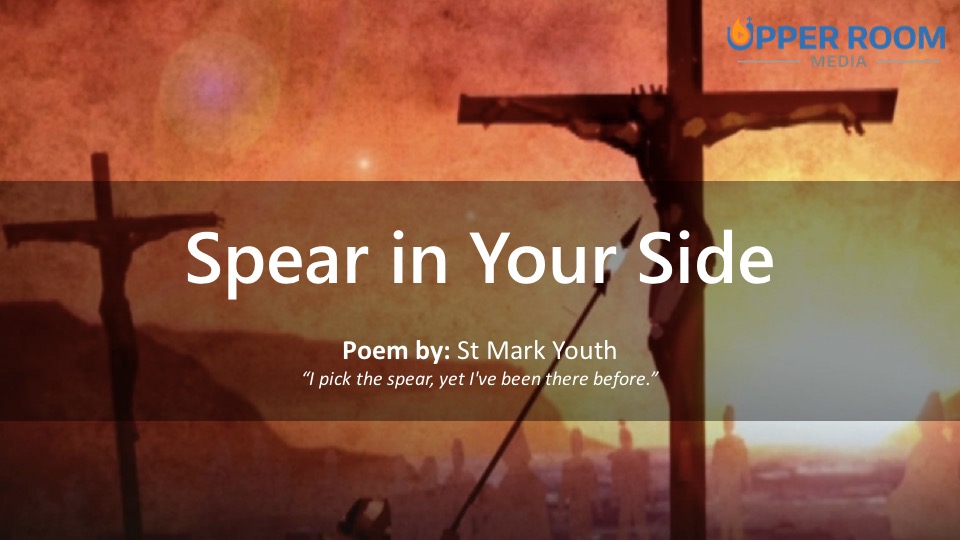
Spear in Your Side

by: St Mark Youth

Every time. Every time…
I tend to ignore your wounds, your sores.
I pick the spear, yet I’ve been there before.

I hide from your face as I run to my shame
Yet the next day your goodness I always proclaim
Bowing down I utter your name
Praying that kindly You’ll forget my blame

You are good
You are merciful
You are kind

Yet as I momentarily forget these gifts
The truth of Your crucifixion I must reminisce
The spear that pierced your innocent side
Is the spear that I push further with my pride

I am Pilate
I am the soldier
I am a sinner

Teach me Lord to put down the spear
Teach me Lord to live in your fear
As I gaze O Lord at thy Passion
Allow me to act in Christian fashion

Put down the spear
Live in His fear
He will hold you dear
And make your conscience clear

3 Things To Do This Lent!

3 Things To Do This Lent

by Meena Awad

Welcome to Lent! Get ready to be smashed spiritually. Get ready to go through dry periods. Get ready to be attacked with division, complacency, judgement, gossip and anything that can go wrong. “But joy comes in the morning” – Psalm 30:5 and “he who endures to the end will be saved” – Matthew 10:22. For “Blessed is the man who endures temptation; for when he has been approved, he will receive the crown of life which the Lord has promised to those who love Him” – James 1:12.

So let’s go over 3 quick things that will not only help us benefit this Lent, but open our eyes to the beauty and sweetness of the Lord.

1 – Annoy your confession father!

We all avoid that one person who comes to us and has the exact same conversation every time. Unfortunately for our confession fathers, they can’t run away. So go be a pest. Every moment this lent you have a chance to confess, take it! Even if you confess more than once in that week. Take this opportunity to develop a strong connection with your father of confession. Have confession more times now than you ever have before. Even if you’re saying the exact same thing every time, even if you don’t have anything to say at all, take the opportunity to sit with him, he will tell you what to do.

2 – Focus!

The world is a noisy and disturbing place. Yet no noise on earth compares to the chaos found in the mind and heart of one who is unfocused.

St John Climacus divides this lack of focus into two things; Tedium and Despondency.
“Tedium reminds those at prayer of some job to be done, and in her brutish way she searches out any plausible excuse to drag us from prayer…” – St John Climacus

It’s a common problem. The constant feeling of having no time to pray or when we do pray, we remember, “Oh, I forgot to message family/friends/boss etc”, “I need to finish prayer quickly so I can work/serve/wake up for the mass tomorrow etc”. Or we just lose concentration during prayer and we think of everything but the prayer.

Despondency is the opposite end of the spectrum. It is when we have all the time and energy in the world, but don’t care enough to dedicate it to God and our spiritual life.

Both are problems of focus. Both have the same solution. St John says the best way to overcome these are by; mourning our past sins and thinking of eternal blessing. So this lent, let us truly mourn and repent of our sins so we can refocus on God. Take time in a quiet place each day. Take note of our short fallings and all that is heavy on our hearts, and mourn over them. Ask, “how can I separate myself from the One I love like that?” Then turn to the Lord and tell him “Forgive me sweet Lord, for I turned from you, I rejected you and caused tears to fall from your pure eyes.”

But repentance is not enough, there needs to be reconciliation. So now we return to God! We now learn that a relationship with a fleeting pleasure can never compare to a relationship with an unconditionally loving and eternal God. Pleasures will pass, no matter how great they may seem, but what God has for us endures forever. For, “Eye has not seen, nor ear heard, nor have entered into the heart of man, the things which God has prepared for those who love Him.” – 1 Corinthians 2:9

And in this way we will neither have Tedium nor Despondency.

3 – Get romantic with God.

It’s incredible what we will do for the things we love; stand up for hours to buy a burger and not complain once, spend thousands to see our idols and have no regrets, talk all night with the boy/girl we love and not get tired. Yet how often do we stand up to eat the Bread of Life and complain, give some money to the poor and have regrets or refuse to stay up and pray because we are tired? It’s time we take the romance in our lives that is aimed toward our passions and turn them toward God. Romance is a natural function inside all humans and it was put inside us by God for God. “All things were created through Him and for Him.” – Colossians 1:16

So this lent, let’s get romantic with God. Take a peaceful nature walk with the Lord. Spend what we can on gifts for His children. Light some candles when we sit with Him and stay up late talking truly and intimately with Him, sharing all our deepest thoughts, feelings, ambitions and dreams. Take Him with us everywhere we go, refusing to let go of His hand. Let our hearts beat as one, in total synergy with God. Let this Lenten period be a honeymoon between us and our most Beloved One.

“Scarcely had I passed by them, when I found the one I love. I held him and would not let him go.” – Song of songs 3:4

Lenten Fasting – Revisited

Lenten Fasting – Revisited

by Shenouda Girgis

Holding the dog hostage and setting the eagle free – Lenten fasting revisited.

Diving into the Lenten season, we find ourselves face to face with an ogre in the room… the infamous no fish, no meat, no milk, no nothing fast. And my first reaction to the impending despair, is to honey the thought with a dose of cognitive behavioural therapy.

Don’t worry, it’s short.

Wait, I can’t lie to myself, its darn long.

Ok, let’s be truthful. It’s not that bad, I always look back and it was like nothing.

At this point I’ll start clenching my fist with a couple of catchy one liners; “what doesn’t kill me, can only make me stronger.”

With our mind fixated on the thought of the seriousness of the situation, we gradually develop our own maxims that push us to fast with more austerity. We become completely focused on eating less to discipline the body and free the soul, tame the dog to guide the eagle. This works – for a time. Then what? After a couple of dodgy fasts, we reminisce on the glory days, where fasting meant so much and felt, like, sort of- liberating. We relabel the focus with the same maxim that we developed a couple of fasts ago, and at it headfirst we go again!

It doesn’t work so we keep trying to uphold this cheap one-line which we can so sternly stare down and focus our glassy eyes on. The one line we set on a pedestal is usually a couple of cheaply put together words that are easy to remember and generally guide the intended thought behind the veil of the words. The more we think, the more the words take on new meaning and the initial thought in all its integrity is lost. What is left is a few flat words that Google thesaurus would dutifully snicker at. With time, we find this one line sink real deep into our mind and sort of take over our whole being, a bit like a mantra. Fasting and non-fasting times, we are just naturally gravitating toward eating less. Fasting loses its meaning; food becomes the obstacle to our goal; if we could just eat less, we would glimpse the shadow of the days of honey and milk. And do you see the monster we’ve developed?

In the beginning we loved food. The joy and complete utter miracle of eating was fresh in our senses. The rich crunch through an apple sent our spirits soaring. We were thankful with a heart overflowing with bliss. We were positive, we were happy. Fasting was a hold on our diet; a tool to violent recollection and inner peace; a stern development of character; it was the perfect balance between the eagle and the dog. Not an assassination of the poor dog. Now we’ve hung the dog at the stake, and the eagle has flown high. We’ve convinced ourselves into thinking we could be free like an angel. But we’re not angels. We’re human, we are body and spirit. The balance between the two and the complete cohesion and fullness of the two is a bliss more glorious than angels. Sort of like the dog attached to the eagle like a kite in an innocent boy’s hands.

Attaining Godly Love

Attaining Godly love

Sermon: Fr Michael Fanous
Blog: Anthony Bebawi

Bible reference- Luke 14: 25-35

“Now great multitudes went with Him. And He turned and said to them, “If anyone comes to Me and does not hate his father and mother, wife and children, brothers and sisters, yes, and his own life also, he cannot be My disciple. And whoever does not bear his cross and come after Me cannot be My disciple. For which of you, intending to build a tower, does not sit down first and count the cost, whether he has enough to finish it—lest, after he has laid the foundation, and is not able to finish, all who see it begin to mock him, saying, ‘This man began to build and was not able to finish’? Or what king, going to make war against another king, does not sit down first and consider whether he is able with ten thousand to meet him who comes against him with twenty thousand? Or else, while the other is still a great way off, he sends a delegation and asks conditions of peace. So likewise, whoever of you does not forsake all that he has cannot be My disciple. “Salt is good; but if the salt has lost its flavor, how shall it be seasoned? It is neither fit for the land nor for the dunghill, but men throw it out. He who has ears to hear, let him hear!”

Continue reading “Attaining Godly Love”

Being Restored by Christ

Being Restored by Christ

By David Ibrahim

Somebody once told me that in the Old Testament there is only one character; and that character is Christ. For the first time however, I read a part of the Old Testament where I found Christ in every verse and in fact He asks us a question in almost every verse. Today’s passage, 2 Kings 4:8-35, is all about our relationship with Christ. With that lens, let’s read this text verse by verse.

 v8: The notable woman from Shenum invited Elisha into her house for food every time he passed by. Like Elisha, Christ is always passing by in my life. The first question is, am I like the woman eagerly inviting Him in or do I just allow Him to pass by me.

v9-11: Now we see the woman’s invitation becoming more eager. Rather than just invite him for food, she has now reserved “an upper room” for every time Elisha passes by Shenum. Actually the upper room of a house was the place where people would go to cool down and even that she sacrificed. The second question is; do I go out of my way to make Christ feel welcome in my heart or again am I relaxed when it comes to welcoming Christ.

v12-17: When asked “Do you want me to speak on your behalf to the king or to the commander of the army?” the woman replied “I dwell among my own people.” What a remarkable response! She is pretty much telling Elisha it’s enough that a holy man is residing in my house.  A lot of times we will serve God and even expect something in return. However this woman portrays to us a quality that is sweeter; seeking God’s holy men just for God. So the third question Christ asks us is do you seek me for who I am or for a reward?

v18-20: Is this fair what happened to the woman? Is it fair that she loses the gift she didn’t even ask for? It said at the beginning of the verse that the child grew. In this context, the Hebrew word implies that he was just learning how to walk. From now on, let us view the child as the gift of spirituality that is a result of our relationship with Christ. If we reflect on our own spirituality, we will find that as it starts to grow, sin enters and it dies out. So the question that is asked to us now is, what do I do if I am spiritually dead?

v21: This is the first response. Here we see the woman laying her dead child on Elisha’s bed. If Elisha is a type of Christ, then the bed is symbolic of the altar. So the first response is that I present myself to Christ’s altar.

v22-25: The woman told her husband to send a donkey and servants so that she can meet Elisha. Immediately, the husband asked why, today is not a holy day? Of course the husband said this because he was grieving over his son but doesn’t Satan try to do this to us as well? Whenever we are trying to resurrect our spiritual life, doesn’t the devil come in asking why? In fact, he often tells us to either delay repentance or he puts thoughts in our minds that we are not worthy of forgiveness. What is my response when I am spiritually dead? Do I seek after holiness in meeting holy men of God (the priest) like the woman or do I listen to Satan’s attempt to prohibit me from meeting Christ?

v26-30: We see here a very strong parallel between the sinner woman of the New Testament and this Shunamite woman. Both were in deep distress, clinged to the feet of a holy man of God and in both instances there was a person that was trying to prohibit them from meeting Christ (Elisha was a type of Christ). The Shunamite woman’s response is remarkable. She says to Elisha in verse 30 As the Lord lives, and as your soul lives, I will not leave you. Is this my attitude in repentance? If Satan tries to stop me, do I give in or do I hold onto Christ for dear life? This is the third response, to stick to Christ like glue.

v31-35: St Augustine has a really nice commentary on this verse. He says Elisha came in person; he was a type of our Lord who had sent His servant ahead of Him with a staff that represents the law… The dead child arose when the living man had fitted himself to him; the Lord accomplished what the staff had failed to do; grace achieved what the Law could not. It’s in these verses that we begin to see Christ’s response to my repentance. The first thing Elisha did was he stretched himself out on the child, mouth on mouth, eye on eye, etc. The fathers say that in the same way that the big man Elisha tried to fit himself on the child’s body, so also Christ the Divine, incarnated and “fit” Himself in the human flesh. The second step was that Elisha rose walked back and forth in the house. Again the fathers say that this was symbolic of Christ walking to the different cities preaching the Gospel. The third step was that Elisha went out again and stretched himself on the child again and of course this alludes to the crucifixion. After all of this, the child who was once dead sneezed seven times and his eyes were opened. Elisha’s actions resulted in the complete rising of the child (seven representing completion). What does this mean for me? When I am truly repentant, the power of Christ’s incarnation, death and resurrection is manifested and I am once again raised from spiritual death. Not only that, but I become a part of Him, “his mouth on his mouth, his eyes on his eyes and his hands on his hands” verse 34. This is the victory Christ gives us when we turn back to Him in repentance.

In our relationship with Christ, we will often encounter moments where we are spiritually dead. Like the child we become immovable and paralysed by our sin. However, when we come to Christ in true repentance, clinging onto Him, an immense Divine power is manifested and we are once again made alive in the body of Christ. May we always return back to the source of life and healing so that we may be eternally united with Him in the Paradise of Joy.

Glory be to God Amen.

Recommended Readings List

Recommended Readings

Spiritual

  • Conferences (John Cassian)
  • The Crucified Jesus (Fr. Manasseh Youhanna)
  • On Marriage and Family life (St. John Chrysostom)
  • On Wealth and Poverty (St. John Chrysostom)
  • The Arena (Bishop Ignatius)
  • The Ladder of divine ascent (John Climacus)
  • The Screwtape Letters (C.S. Lewis)
  • Jesus a dialogue with the Savious (Lev Gillet)
  • Practical Spirituality (Fr. Athanasius Iskander)
  • The Burning Bush (Fr. Lev Gillet)
  • The Way of a Pilgrim
  • Orthodox Prayer Life – the Interior way (Fr. Matthew the Poor)
  • Our Father (Fr. Alexander Schmemann)
  • Practicing the presence of God (Brother Lawrence)
  • Spiritual world (St. Isaac the Syrian)
  • Books by Fr Anthony Corianis
  • Acquisition of the Holy Spirit (St. Seraphim of Sarov)

Biblical

  • Ancient Christian Commentary of Scripture Series (Inter Varsity Press)
  • The Orthodox Bible Study Companion Series (Fr. Lawrence Farley)
  • Bible Character Series (F.B. Meyer)
  • Bible Commentary Series (Fr. Tadros Malaty)
  • Taught by God – Making sense of the difficult sayings of Jesus (Daniel Fanous)
  • Christ in His Saints (Fr. Patrick Reardon)
  • Christ in The Psalms (Fr. Patrick Reardon)
  • Jesus of Nazareth (Pope Benedict)
  • Person of the Christ (Daniel Fanous)
  • Life of Paul (John Pollock)

Christian Faith

  • Mere Christianity (C.S. Lewis)
  • The Case for Christ (Lee Strobel)
  • The Case for Faith (Lee Strobel)

Orthodox Faith

  • The Orthodox Way (Bishop Kalistos Ware)
  • Becoming Orthodox (Peter Gillquist)
  • The Orthodox Church (Timothy Ware)
  • Eastern Orthodox Christianity – a Western Perspective (Daniel Clendenin)

Coptic Church

  • Introduction to the Coptic Orthodox Church (Fr. Tadros Malaty)
  • The Story of the Copts (Iris Habib El Masri)
  • The Coptic Orthodox Church – A Lily Among Thorns (Dr. Raafat Gindi)
  • Journey Back to Eden (Mark Gruber)

Church History

  • Four Witnesses – The Early Church in her own words (Rod Bennett)
  • A short history of the Early Church (Harry Boer)

Saints

  • Father Arseny (Bouteneff)
  • The Holy Fire (Robert Payne)
  • The life of Anthony (St. Athanasius)
  • St. Seraphim of Sarov (Valentine Zander)
  • Mother Teresa – Come be my light (Brian Kolodiejchuk)
  • Lev Gillet – A monk of the Eastern Church (Elisabeth Behr-Sigel)
  • Champion of Truth – the life of St. Athanasius (Michael E. Molloy)
  • A song for Nagasaki (Paul Glynn)

Church & Sacraments

  • The forgotten Medicine – The mystery of Repentance (Fr. Seraphim Aleksiev)
  • Sacramental Life (H.G. Bishop Youanis)
  • Jesus and the Jewish roots of the Eucharist (Brant Pitre)
  • Bread & Water, Wine & Oil (Fr. Meletios Webber)
  • Understanding the Liturgy (Fr. Athanasius Iskander)
  • Christ in the Eucharist (Fr. Tadros Malaty)
  • For the Life of the World (Fr. Alexander Schmemann)
  • Church Cycle Reading with the Fathers (St. Paul brotherhood)

Contemporary Issues

  • The Sacred Gift of Life – Orthodox Christianity and Bioethics (John Breck)
  • The Sword of the Prophet – Islam (Serge Trifkovic)
  • O Death, where is thy sting? (Fr. Alexander Schmemann)
  • Many years with the problems of people (H.H. Pope Shenouda)
  • Four Loves (C.S. Lewis)
  • Problem of Pain (C.S. Lewis)
  • Till we have faces (C.S. Lewis)

Theology

  • On the incarnation (St. Athanasius)
  • Comparative Theology (H.H. Pope Shenouda)

Service

  • The Paradise of Service (H.G. Bishop Youanis)
  • Serve the Lord with Gladness (Fr. Lev Gillet)

The Missing Prayer (Part THREE of THREE)

The Missing Prayer (Pt 3)

By: George Iskander

+ Spiritual sacrifice (Sacrificial worship)

– Hebrews 13:15 “Through Jesus, therefore, let us continually offer to God a sacrifice of praise…”

– In the liturgy we sing a response, “Through the pleadings…the gift of peace, the sacrifice of praise.”

 This is a very interesting concept; praise is considered to be a sacrifice that we offer to our Maker.

St. Cyril of Jerusalem says,

Take courage, toil and strive zealously, for nothing will be lost. Every prayer you make, every Psalm you sing, is recorded; every alm, every fast is recorded 

+ Keeps us PURE!

Imagine you are home alone, bored and lustful temptation enters your heart.  One of the most powerful ways to obliterate the temptation, if running away isn’t an option, is to kneel and praise the Lord.

St. John Saba said:

The passion of adultery is extinguished by the songs of the Psalms, and the beauty of the tunes. By the pouring of the heart before God…

+ Official introduction to serve the Church sacraments

– Prepare us

– Cleanse us

– Educate us

Helps us to raise our minds out of the plaguing thoughts of the world and redirects it to God and Heaven

It also actually teaches us about theology, God’s attributes.

+ Fellowship between the believers (corporate prayer)

With prayer it is very important to have the private secret prayer in your room with the door closed, but it is equally as important to have communal prayer which establishes fellowship between your brothers and sisters in Christ. Praise, such as the Holy Psalmody achieves this.

+ Take the Psalms as our example

David the Psalmist was big on praise, his psalms are all coloured by singing God praises.

O Lord, our Lord, How excellent is Your name in all the earth, Who have set Your glory above the heavens! Ps 8:1

Praise the LORD! For it is good to sing praises to our God; For it is pleasant, and praise is beautiful. Ps 147:1

How can we include praise in our prayers?

A few types of praise:

Personal
Praise of God centred wholly upon God and His eternal characteristics.
For example: His majesty, glory, power, beauty, lavish love, mercy, grace…

This is open to your own personal contemplation

Biblical
Psalms
Those who neglect the prayers of the Psalms with mediation, lose the chance of prayer according to God’s will –  Father Bishoy Kamel.

– David’s Praise to God (1 Chronicles 29:10-13)

– Exodus Ch 15 –  Israelites praise God for dividing the red sea and giving them freedom from the Egyptians

Physical

Prostrations before the lord, C.S Lewis comments in his book: The Screwtape Letters, that “Whatever their bodies do affects their souls” speaking about how if we kneel before the Lord with outstretched arms then our soul will be in the ideal state for prayer.

Signing

The Holy Psalmody & Hymns.

The month of Kiahk, in our Church this month is a very powerful month of revival of our spirits as we raise our hearts in beautiful, selfless praise before our Lord. Weekly Tasbeha is offered at church.

Singing psalms is a medicine for healing the soul (St. Athanasius)

May God teach us to unlock the secret of praise in our prayer life and reap the rewards as it transforms us and gives us a taste of the joy of heaven.

Glory be to God forever, Amen.

The Missing Prayer (Part TWO of THREE)

†
The Missing Prayer

By George Iskander

Why is praise so important?

By God’s grace, after reading this, we can all endeavor to make praise a part of our daily prayer.

 + Praise in the most selfless form of prayer

It has nothing to do with asking, or taking, it’s all about giving and offering. Classed by many of the church fathers as the highest level of prayer.

  1. A. Russel in his book, The Power of Praise, says:

Praise is the form of prayer which recognizes most immediately that God is God. It lauds God for his own sake and gives him glory, quite beyond what he does, but simply because HE IS. It shares in the blessed happiness of the pure of heart who love God in faith before seeing him in glory. By praise, the Spirit is joined to our spirits to bear witness that we are children of God, testifying to the only Son in whom we are adopted and by whom we glorify the Father. Praise embraces the other forms of prayer and carries them toward him who is its source and goal: the “one God, the Father, from whom are all things and for whom we exist (1 Cor 8:6)

 + Praise is a source of blessing, reward and comfort

God loves His creation to praise Him, to acknowledge Him, to appreciate Him…consider this, if you are not a parent, try and picture yourself as one; nothing would make you happier and feel more loved than hearing your child telling you, you are the best dad/mum in in world, and knowing they see you as the strongest person in the world, and that they feel safe that you’re in control of their lives.

Try see the rewards and blessings that come with attending the Holy Psalmody (Tasbeha), which is a strong source of praise.

Praise allows you to have God’s greatest resound in your heart and mind. If you find yourself in a scary, stressful situation, one thing that will calm you down and comfort you is praise.

One time, a friend and I found ourselves caught in a rip and we were 100s of metres from the shoreline but managed to stay together, we tried to swim back, but our efforts were futile and exhausted us. Eventually being so far out and realizing the waters depth, we began to think of the concept of sharks and other sea creatures which made us increasingly more nervous. After exhausting all physical and practical effort, my friend and I turned to God and decided to start praying. We tried thanking God for our situation but it was a bit tough and really hard to mean it due to our rising fears, so we didn’t get much comfort from that. Finally some verses of the Holy psalmody came to me where we sing “Praise the lord the O Seas and Rivers” “Bless the Lord all the winds” “Bless the Lord all things that move in the waters” We lined our boards together and started praising God saying that He was the powerful creator of the universe and everything is under His control, even the weird shadows we saw moving below us. Before we knew it we were both calm and found ourselves back at shore.

 + Praise helps you truly love God and teaches humility

What helps us to love our parents, spouses or friends? Usually when we think of their kindness, selflessness or other great qualities, it reminds us of why we love them

If we keep reminding ourselves of God’s great characteristics as the powerful architect of the universe that sent His Son to save us, it makes us love Him more, and in turn grants us humility by realizing how small we are in comparison.

 + It is the language of heaven

What is heaven but continual praising of God – in fact angels exist in heaven for this very purpose. If we do not enjoy the praise of God on earth, how can we enjoy it in heaven? There is a pure joy that comes with true praise, which gives us a taste of heaven on earth.

St Basil the great says:

The work of praising attracts the service of the Angels because this is a function of their existence. Thus they come closer to those who imitate in their ways.

St. Basil also goes on to say that liturgical music in particular essential because the liturgy is an imitation of heavenly glory and praise.

Next week, we’ll explore praise in a different light!

The Missing Prayer (Part ONE of THREE)

†
The Missing Prayer

By George Iskander

What component of prayer would you say you lacks most in your prayer life?

What surrounds us in all church services, that perhaps doesn’t make its way to the quiet prayer corner of our rooms?

What’s the common theme that resonates through the psalms?

Lets start by identifying the essential building blocks of a structured personal prayer. If we could summarize prayer into 5 components, what would they be? This is not an exhaustive list but rather 5 umbrella categories. Before you read ahead, try and think of what your personal prayers are comprised of.

  1. Thanksgiving
    We are taught from a young age to always give thanks. If you were to ask a child to pray, you will notice that this is how many start their prayers. Thanking God for health, for food, shelter, loved ones, the opportunity to know Him and stand before Him…etc. Thanksgiving is usually what defines the beginning of our prayer and is also illustrated as such in liturgical services and the Agpeya prayer book.
  1. Supplication
    Naturally what follows is our human nature to ask and entreat the Lord the requests of our heart. God please help me in this exam, help me to get this job, help me find a partner…
  1. Repentance
    Repentance is a very important element that we should include daily in our prayer life and is included in the Lord’s prayer; “Our Father…” Asking God to forgive our trespasses is an essential part of a Christian’s daily routine.
  1. Intercession
    Asking for the prayers of the saints, or praying for each other. This is commonly how we are taught to conclude our prayers.

These 4 categories seem to cover it all. Often there is one aspect of prayer that is missing, kind of like the top piece of toast, it’s neglected, a lot of people don’t eat it, but in fact it’s what holds the bread together.

The 5th component is:

  1. Praise
    What is praise? Accurately defined:
    Praise: an expression of approval or admiration, of gratitude and devotion for blessings received.
    Praise of God: Acknowledging of His perfections, works and benefits.
    (M. F. Unger 1988, The New Unger’s Bible Dictionary)

Why is praise so important?

By God’s grace, after reading this, we can all endeavour to make praise a part of our daily prayer.

Tune in for part TWO next week!