The Work of a Witness

The Work of a Witness

By Laura S. Jansson

Originally see at Pheobe Farag Mikhail’s blog Being in Community (April 23, 2020)


I’m a doula, and not everybody knows what that is. When I’m asked what my work involves, it’s tempting to resort to the dry textbook answer: “We provide emotional, physical and informational (not medical) support to people having babies.” But a few examples can help to bring the job description to life for people. When my client is in labor, I’ll say, I might cool down a washcloth to mop her brow, take some news out to the crowd in the hospital waiting room, rub her lower back just so, or speak up with a few words of steadiness when discouragement strikes.

But after fifteen years in this role, I’ve been wondering recently if all the tiny actions a doula undertakes in the course of her work don’t add up to more than the sum of their parts. It seems that, as with many roles, what I offer is encapsulated more in what I am than in what I do. And what I am, largely, is a witness. I am fully present for the woman I serve as she faces with staunch grace some of the hardest moments life has ever dealt her. I watch, marveling, as she dredges up the bravery to drink the cup which no one can take from her. I’m there for her – simply there – as she is called on to shed her preferences, her modesty, and her very blood for the love of another. I bear witness as she looks up from the newborn image of God in her arms, saying, “See what I did there?”

And I do see. Not everyone has the privilege of seeing. Some, like the family members in the waiting room, are not invited; they may be too squeamish, anxious or disinterested to attend. Others are present but do not notice the spiritual significance of what is happening, like the nurse who must be on the lookout for blood loss and meconium staining rather than for sacraments, or the protective husband whose doe-eyes become hawk-eyes under stress. In such a situation, to be the one who has not let meaning go unnoticed feels like an important ministry.

It really does seem to make a difference. To witness to another’s struggle turns out to be healing work, allowing green shoots to come forth from a lifeless stump. A laboring woman who says (as most of us do, at some point), “I can’t do this anymore”, can be revived by the mere words, “you are doing it; I’m here to see you doing it, and you’re doing it very well”. And when a mother is looking back on her baby’s birth the work of witnessing often turns out to have a life-long significance. A nurse who happened to be on shift that one night years ago would be impossible to contact; sometimes even a marriage breaks apart, so that the witness of a shared birth experience shatters with it. To know that there is even just one person who saw her slay the dragon is a powerful weapon against future beasts who might cross her path. Whether their relationship develops into bosom friendship or she never sees her doula again, she knows there will always be someone to share the burden of the memory, to hold the truth of what happened, to keep the flame of her human dignity alive.

The spiritual importance of a witness is exemplified, but not confined, within the birthing room. The powerful act of attesting to one another’s struggles is a great gift each one of us can extend to those in our families, friendships, parishes and communities. Daycare pickup time may bring us an encounter with a sleep-deprived mother who is beginning to doubt her ability to go on, and we can stop to note how much she is already doing, and voice what we see in her that is admirable. Or reading between happy social media smiles, we may suspect a co-worker is in trouble, and set some time aside to check in. Perhaps a knowing smile for the discouraged teenager packing our grocery bags is all it takes for him to feel seen. Or at church, we can refuse to take “fine” for an answer from the elderly man in the next pew who seems so lonely.

It may feel like nothing much, but the work of witnessing has a holiness to it because it partakes in the action of the Holy Trinity: “For there are three that bear witness in heaven: the Father, the Word, and the Holy Spirit” (1 Jn. 5:7). The three divine persons are bound together in a relationship of mutual attestation which confirms their Godhead, in keeping with the ancient principle that (in the words of Christ Himself) “the testimony of two people is true” (Jn. 8:17 – see also Num. 35:30, Deut. 17:6, Deut. 19:15-21, Matt. 18:15-16, 2 Cor. 13:1 and Heb. 10:28). The Father is affirmed as the Father by the Son and the Holy Spirit; the Son is affirmed as the Son by His Father and the Holy Spirit; and likewise the Holy Spirit is affirmed by the Father and the Son. And this witness to the truth is so central to the life of God as to be the reason Christ gives for his coming into the world (Jn. 18:37).

As we are drawn into God, we too become witnesses, affirming and drawing forth this divine love in the reality of one another’s personhood. The ones who have perfected this art and already live fully in its reality are the saints: the “forefathers, fathers, patriarchs, prophets, apostles, preachers, evangelists, martyrs, confessors, ascetics, and every righteous spirit perfected in the faith” spoken of in the Divine Liturgy of St. John Chrysostom. They bear perfect witness not only to God but also for each one of us, even when we are without another witness in the world. They surround us like “so great a cloud,” as the writer of Hebrews says (12:1), wrapping us in their support like incense thick in the air. During the times when we feel completely unseen and alone, these witnesses call us back to a proper remembrance of ourselves in the light of God with Us. “Be strong and take heart,” they tell us, “all you who hope in the Lord” (Ps. 31:24).

The words “witness” and “martyr” mean the same thing, and among the unseen witnesses we think of the women martyrs whose blood spilled on the sandy floors of Roman arenas, giving their lives and deaths for the sake of love. These people, whose names we know, feasts we celebrate and icons we venerate, might be considered our spiritual foremothers; without them the faith would have died out long before it could reach our twenty-first century ears. But equally, those who surround us are our foremothers in the flesh, whose fireside instruction and daily example were what ensured that the true faith was passed to each new generation. Their blood was shed in secret on the sheets of birthing beds, not sand, but like those we more typically consider martyrs, their blood too speaks to us of how new life can come forth when we embrace our human pain and death for the sake of Love.

One mother shared the story of the role of the “great cloud” during the birth of her child. Though this was her seventh baby, it was her first as an Orthodox Christian, and as she says, “I get teary-eyes just remembering how very, very sweet and mystical the whole experience was. It felt so… holy.” She labored in a birth pool in her bedroom, overlooked by the icons of saint whose lives spoke to her. There were Blessed Matushka Olga (a midwife with a life story similar to her own grandmother’s), St. Julianna of Lazarevo (her mother’s patroness), St. Anna and her daughter the Theotokos, and St. Sophia and her three daughters – a community of mothers surrounding, protecting and renewing her strength as she worked to bring her own daughter into the world. Her husband stood by, chanting prayers and anointing her head and belly with holy oil. Her prayer rope stretched several inches longer as she circled round it with the Jesus prayer. As the sun was setting over their home, the baby was born. “I’ve never been so cognizant of the “cloud of witnesses” around me as in those moments,” she says.

Let us strive to be such witnesses for one another.


(c) Phoebe Farag Mikhail (April 23, 2020). Being in Community. The Work of a Witness by Laura S. Jansson. Original post – https://beingincommunity.com/the-work-of-a-witness/


Can’t I Just Pray?

Can’t I Just Pray? Joy and Mental Health

By Phoebe Farag Mikhail

Originally seen at Phoebe Farag Mikhail’s blog Being in Community (October 25, 2019)

I’ve been asked, on more than one occasion, if someone experiencing depression can just read my book about joy and feel better—in other words, just read my book rather than see a therapist or take medication.

My short answer has always been no. Anyone who is suffering from clinical depression or other form of mental illness or mood disorder should always seek the professional help of a trained and licensed therapist, counselor and/or psychiatrist. Spiritual books can help, but they are no replacement for visiting a therapist. When my carpal tunnel syndrome flares up, I rub my wrists with holy oil AND take two ibuprofen. It’s not important which one is the cause of symptom relief – they may, in fact, be working together.

And that’s why my longer answer is still no, but a nuanced no.

Spiritual practices that help us experience joy – the experience of giving and receiving sacrificial love, as described in my book, Putting Joy into Practice – can certainly give us an emotional and even physical boost. Many of these practices have been linked scientifically to positive emotional and physical outcomes. See Robert Emmons’ work on thanksgiving, for example, or the various studies showing how helping others increases oxytocin, the “happiness hormone.” Surely, putting joy into practice in an ongoing and consistent way might be good for our both our spiritual health and our mental health.

Social isolation is a proven contributing factor to many forms of mental and physical illness, and community and connection, the kind we experience when giving and receiving hospitality, for example, are proven antidotes to this. We all know that infants who are hugged and snuggled grow more quickly and thrive more than children who are not, even though they may be fed the same amount and offered the same amount of medical treatment. Studies of resilience in adults often point to consistent belonging and participation in a faith community as a positive factor.

In addition, one of the “joy thieves,” or the “passions,” as I describe in my book, is “acedia,” or despondency, a form of spiritual restlessness or apathy. Its symptoms can mirror some symptoms of clinical depression. The line between them, in fact, might not be a hard one. One unchecked, in fact, might lead to another. And thus, we should not treat one without treating the other. Someone experiencing acedia (or “the noonday devil” as the desert fathers and mothers described it) should certainly visit a father of confession, participate in church and community life, pray, fast, reach out to friends and family. These may suffice, but why not also get an appointment with a therapist?

A therapist might be able to help identify if there are symptoms that are more related to an underlying pathology and need additional care.  Similarly, someone already being treated for clinical depression or other related illnesses stands only to benefit from the spiritual practices that will help heal the spirit and the soul as medicine heals the body.

Because Ecclesiasticus (the Wisdom of Sirach) is a deuterocanonical book in the Bible, many of us are not familiar with its wisdom. Yet perhaps our hesitance to seek help when we need it – both medical and spiritual – would disappear if we took this wisdom seriously:

My son, in thy sickness be not negligent: but pray unto the Lord, and he will make thee whole. Leave off from sin, and order thine hands aright, and cleanse thy heart from all wickedness. Give a sweet savour, and a memorial of fine flour; and make a fat offering, as not being. Then give place to the physician, for the Lord hath created him: let him not go from thee, for thou hast need of him. There is a time when in their hands there is good success. For they shall also pray unto the Lord, that he would prosper that, which they give for ease and remedy to prolong life.

Wisdom of the Son of Sirach 38:9-14

If this applies to doctors who care for our physical health, how much more so to practitioners who care for our mental health? We are integrated human beings. Our thoughts are linked to our emotions, our emotions to our bodies, our bodies to our spirits. When Christ became incarnate, He took on all of those things.

In the twenty-first century we are now starting to recover from over a century of science and medicine that has attempted to divide our bodies from our minds and souls. “Holistic” and “integrated” medicine are becoming part of mainstream health care vocabulary. We are now recognizing how much our mental health is a complex system that is connected to our physical, emotional and spiritual health. There should be no stigma attached to caring for our emotional and mental health—we should celebrate and encourage this.

On the Fountains of Carrots podcast recently, one of the hosts told the story of a married couple who experienced infant loss. Knowing ahead of time that couples who experience infant loss can also experience troubles in their marriage, they lined up couples’ therapy to help them work through their grief even before they actually experienced troubles in their marriage.  They didn’t wait to determine if they would need help or not – they preemptively acted. What a model for us.

In the Coptic Orthodox Litany for the Sick, we pray,

All souls that are distressed or bound, grant them mercy, O Lord; grant them rest, grant them refreshment, grant them grace, grant them help, grant them salvation, grant them the forgiveness of their sins and their iniquities. As for us also, O Lord, the maladies of our souls, heal; and those of our bodies too, do cure. O You, the true Physician of our souls and our bodies, the Bishop of all flesh, visit us with Your salvation.

The healing that God grants is mercy, rest, refreshment, grace, help, salvation and the forgiveness of sins. The absence of these truly affect both our bodies and our souls. And thus we should also never be ashamed to tell our doctors that we are praying and asking our friends and family to pray for us, of asking for a priest to come and anoint us with oil. And when we are suffering from any sort of illness, physical, emotional, mental, we should not deprive ourselves of the help that community can provide.

Let’s erase the stigma of seeking help. The idea that we can live this life alone and conquer all our difficulties—physical, emotional, mental, spiritual—on our own is a dangerous myth. We need each other.


(c) Pheobe Farag Mikhail. Being in Community. Can’t I Just Pray? Joy and Mental Health. Original post – https://beingincommunity.com/cant-i-just-pray-joy-and-mental-health/

Coming to America

Coming to America

By Grace Attawa

Originally found at Phoebe Farag Mikhail’s blog Being in Community (June 18, 2020)

I was born in Kenya, and my names are Grace Wairimu Njoroge. When I got married, I was so quick to drop my two names and add Attwa. You know why?  While in the US the issue is race, in Kenya itis all about tribes.  Anyone can tell what tribe you are from and judge you based on your last name.  

Today when I introduce myself to new people in Kenya, if I don’t speak my mother tongue, they are usually left wondering where I am from.  I saw what tribalism did to my family and a lot of innocent people back home and I hated it.  It always got worse during election time when neighbors became enemies, and families broke and divided! When I changed my name to Attwa, I loved being incognito. I loved when I met people and related with them as Grace, a Kenyan not tied to a tribe, because tribe is an issue that continues to divide people.

I became Orthodox when I was 12 years old. What attracted me to the Coptic Orthodox Church was LOVE.  I felt accepted, loved and cared for. I had no tribe or social status in the church, we had the liturgy in English and we were all united in Christ.  The church was predominantly Kenyan, because those were the majority except for the few Egyptian missionaries that lived in the compound.  I was a church member loved so much by Abouna (Father) Moses who is Egyptian. He did not see us as any different than him, we were all lovable and he saw us with the love of Christ.  We thrived in this love.  That is all what we knew even when it was tough love!  We all have stories about the tough love, but the love outweighed them and when we look back, all we remember is we are where we are  today because he allowed Christ to use him to LOVE us and show us how to LOVE.

During my time in the church in Kenya, I met a lot of missionaries (a lot young people and some older folks who came during summer or winter breaks to serve God in Kenya) and they taught me the meaning of love. I could not comprehend the fact that they traveled so far to come and share their love.  During their visits, they were dressing like us, eating with us, singing with us, praying with us and more importantly just sharing the love of Christ with us!  I imagined the churches in America to be one big loving community because the worldview I had of the Coptic Church abroad had been shaped by my interactions with these missionaries. 

But today, after being in the US for four years I wonder. Where is the love? Where are the Copts who were so amazed that there was a church full of black people and they were all Coptic? Where is the love of the parents who sent them to extend the love and compassion? Where is the compassion and care for the African American communities that look like me? No one has targeted me specifically with hateful words, and I have always personally felt loved within the Coptic Orthodox community.

But sadly, I see some of them young or old, busy hating and writing a lot of hate spewing messages against fellow brothers these days. When I get upset, some tell me I should not be upset, because I am Kenyan, not African American.

Sorry, you are wrong. I am them, I am them. My kids are them. You should be them too, especially because we all come from an oppressed background as Coptic Christians and we therefore ought to be more compassionate. 

My heart aches for the silence. My heart aches for the lack of empathy. Many of you would never know what it means to have a real fear for your growing son.  I have to teach my son about hate when I’ve always shielded him with love… his innocent mind has to be corrupted with warnings about the difference between an African Americans, and others in this country.  It pains my heart when he looks at me and doesn’t get it. He shouldn’t get it! He should only know love and acceptance.  I have to warn him about police brutality and how as a young African American his mistakes will not be looked at the same as that of other Caucasians or immigrants with a color privilege.

I have been praying and hurting but more so, for the ignorance I see from many people.  For my friends who do not get it. And they may never get it. I am worried about the future of our children in the church. 

As I educate my son on matters of racism, I pray that every household in the Coptic community does the same with their children because I would hate for the cycle to continue. But remember the best book for the child to read is our behavior.

We need to pray for our brothers, we need to empathize and take a moment and try fit in their shoes or at least tie our shoes and walk beside them.

What is happening in America today is sad. I have never read so many hateful comments on social media by Christians. We have forgotten who we are and whom we represent.

We are Christians. When we write hateful comments on social media we are falsely representing Christ to others. When we think hateful comments in our hearts we are harboring hatred towards our own brothers and sisters.

My eyes are foggy as I strive to find that love, and light amid so much hate and darkness: a people so divided that they are not letting their heart feel, feel for a grown man groaning and crying for his mama.  

Yet on these same days I also found hope in these words from the Pauline Epistle on the Feast of the Pentecost:  “For as the body is one and has many members, but all the members of that one body, being many, are one body, so also is Christ. For by one Spirit we were all baptized into one body–whether Jews or Greeks, whether slaves or free–and have all been made to drink into one Spirit. For in fact the body is not one member but many. If the foot should say, “Because I am not a hand, I am not of the body,” is it therefore not of the body?

… But now indeed there are many members, yet one body. And the eye cannot say to the hand, “I have no need of you”; nor again the head to the feet, “I have no need of you.” No, much rather, those members of the body which seem to be weaker are necessary. And those members of the body which we think to be less honorable, on these we bestow greater honor; and our unpresentable parts have greater modesty, but our presentable parts have no need. But God composed the body, having given greater honor to that part which lacks it, that there should be no schism in the body, but that the members should have the same care for one another. And if one member suffers, all the members suffer with it; or if one member is honored, all the members rejoice with it” (I Corinthians 12:12-26).

I am suffering. So are you.


(c) Phoebe Farag Mikhail. Being in Community. Coming to America by Grace Attawa (June 18, 2020). Original post – https://beingincommunity.com/coming-to-america/

The Silent Spiritual Killer

The Silent Spiritual Killer

Adapted from a sermon by Dr Adel Magdy

Passage Luke 7:28-35

In our lives, there are some sins that are very obvious. You fall into sin, and the manifestation is there immediately; murder, adultery, theft – the consequences are visible and immediate. We know instantly that we have sinned.

There are other sins in our lives that aren’t as obvious. They subtly creep into our lives, and eventually destroy us. These are the sins that are particularly dangerous because there are no warning signs.

In the field of medicine, there are some diseases that are known as, “silent killers,” for this very reason. They do not display symptoms until it is too late and the disease has completely ravaged the body.

The same applies to silent spiritual killers. They creep in slowly until its too late, because there are no pre-symptoms. The silent spiritual killer that we will focus on is the sin of judging others negatively and finding faults of others. This eventually consumes all our thoughts and feelings until we are drowning in sin.

The Lord highlights an upsetting passage and describes the Pharisees as such. They constantly degrade and judge those around them. Christ says,

‘We played the flute for you, And you did not dance; We mourned to you, And you did not weep. For John the Baptist came neither eating bread nor drinking wine, and you say, ‘He has a demon.’ The Son of Man has come eating and drinking, and you say, ‘Look, a glutton and a winebibber, a friend of tax collectors and sinners!’

Luke 7:32-34

No matter the circumstance, the Pharisees found a way to be judgemental. In the happy times, they were not happy. In sad times, they were not sad. When they saw someone fasting, praying, living a righteous life, instead of thinking thoughts of praise, they criticised and accused John the Baptist of being demon-possessed. When the Lord wanted to show them that He was One of us, immediately they criticised Him for being a Friend of drunkards and sinners.

This is a problem in all our lives, to some degree. Having a negative attitude, even silently in our hearts, can lead to our destruction.

I can typically tell when it is time for me to confess when I find myself critical toward others, or I look toward a situation and judge. Instantly, this is a reminder to confess and start fresh. The Lord lifts the scales from my eyes and I am renewed to an attitude that can make excuses for others.

If you consider someone in your life that is always negative and critical, it is exhausting to be around them. You can never please them. On a nice sunny day, they will complain of the heat. The next day is cold, and they complain that it’s too cold to even go outside. In the process of being critical, they destroy themselves spiritually.

The Lord is calling us to start fresh, and to look to others in a new light. To stop being critical and start trying to look through the eyes of the Lord. Today we can all promise the Lord to give the benefit of the doubt to those around us. When someone does something that I perceive as wrong, I make excuses for them. I stop judging them in my heart. Instead of being like the critical Pharisees, today I’ll start fresh. I’ll stop judging them.

When we look through the eyes of the Lord and we take away the hardness of our heart, we can no longer be critical of others. When we see people in the gentleness of the Lord, we grow in compassion for those around us.

How many times in the gospel did the Lord see a sinner? How many times did He condemn a sinner? Almost never. How many times did the Lord see the sinner and make an excuse, and not only that, but praise the goodness within them? He would take the one good thing and make them feel like they were the most special person on earth.

This is the message that we can take. That it is not our place to be critical of others, to be critical of the hierarchy, to be critical of my brothers and sisters. It is my place to be like Christ. To look at people with the same gentle and compassionate eyes of the Lord. To remember that when the Lord looks at my sins He doesn’t criticise me, so when I look at others I shouldn’t criticise them.

In Luke 5 we read the miracles of the leper who fell on his face before the Lord and implored Him saying, “Lord, if You are willing, You can make me clean.” This is a beautiful expression, that shows a multitude of virtues in the leper. He comes to the Lord and complete humility and acknowledgement of His power. There is something more subtle that we see, and that is, the Lord makes a point of touching the leper.

There are so many instances that the Lord heals with His words alone. There was no reason why the Lord needed to touch to heal. To understand the significance of the touch, we need to understand what it meant to be a leper. Leprosy, in those times, meant death. As the leprosy rotted the body, the smell became tremendous and meant that their social network was taken away. A leper was deemed unclean and could no associate with their own family. They had to live your life away from people, they had to wear a bell so people knew they were coming and could move out of their way. More still, they had to yell, “unclean” so people would run in the opposite direction.

In the midst of this, he cries out to the Lord, if You are willing, You can make me clean. The Lord would be expected to run away from the leprous man. For the very first, someone has taken a step toward him, instead of away from him. Instead of people throwing things in his direction, someone has drawn near to touch him, despite his leprosy.

This was a touch of, “I do not judge you, I do not criticise you, I love you.”

Instead of looking at people and seeing them as bad people, people that you’d rather run in the opposite direction of, I can make excuses from them. For the one that gives me a hard time, I promise that I will pray for them, instead of attempting revenge. I will show them love when I see them, even if it hurts. And I do this, for the sake of the Lord, because it is what I know He would do.

Abomination of Desolation

Adapted from a sermon by Fr Daniel Fanous


Passage: Matthew 24:3-35

The gospel this week is quite similar to the gospel from last week. That’s because the church takes a number of weeks for preparation. The church recognises that it takes a while for messages to enter into hearts. So in these weeks leading up to the feast of the New Year in the Orthodox Church on September 12, the Church reminds us that the Year is coming to an end, our lives will come to an end, and that the world will also eventually come to its end. 

And because this is something we don’t want to hear, the Church repeats it to us several times. We don’t want to hear that our lives will come to an end. We know that family members suddenly become sick or pass away, that accidents happen, every day, every minute every second. So the church reminds us of this. 

It’s also fortuitous that on this day also, it is Father’s Day. This is also a reminder for us fathers – both biological and priestly – of the words that Christ speaks to us. The gospel today says:

“Now as He sat on the Mount of Olives, the disciples came to Him privately, saying, “Tell us, when will these things be? And what will be the sign of Your coming, and of the end of the age?” 

Christ then gives us a catalogue of signs and indications of the end of times. That’s what we’ve just heard in this long gospel: hearing about things that will happen on the earth, wars, rumours, persecution. And one of the warnings or the signs that he gives to us is quite striking, he says, “Therefore when you see the abomination of desolation, spoken of by Daniel the prophet, standing in the holy place,” Matthew adds his own commentary in parentheses: “(whoever reads, let him understand)” then continues, “then let those who are in Judea flee to the mountains. Let him who is on the housetop not go down to take anything out of his house.”

Be radical, because things are upon you. And these words are really strange. This abomination of desolation. It comes from Daniel 9:27 in the Old Testament where he speaks about an abomination of desolation.

And most likely, he’s speaking about a very concrete historical event. There was a figure by the name of Antiochus IV Epiphanes. His last name means the “manifestation of God” because this is who he thought he was. He was the head of the Seleucids, and they came and overtook Israel in about 70 BC. When he overtook the place, he realised that the Jews held the temple of God as the most sacred space, and as the core of their being.

He then took an altar of Zeus, one of the Greek gods, and put that in the Holy of Holies, where only God was supposed to be.

It was so horrific that that event was burnt into the times, the people, the history, that this was the symbol of how things have totally been desecrated. That the place of God has now become the place of a Greek god.

So after that, you get Christ speaking about it in this passage, most likely talking about an event that would happen with the Romans, only a few decades later, which is why Matthew wrote, “whoever reads, let him understand”. He tells us to pay attention, we know what he’s talking about. And that’s because one of the Roman emperors, Caligula, proposed to set up his own image in the temple in about 40 AD. 

St Paul in Thessalonians talks again about this abomination of desolation. When something takes the rightful place of God, when the Holiest of Holies has been desecrated, when instead of being the centre, the core of where God’s presence is manifested, there is something else that takes place. But we shouldn’t think that this will help us determine when the abomination is. Christ isn’t trying to give us a timeline.

And it’s quite strange that when you actually read from the fathers, what you find when they talk about these passages, they’re very disinterested in trying to put a time on it, trying to do calculations and figure out when the end of the world will be. Instead, they understand that to be about themselves – that they themselves need to be watchful.

St. Gregory the Great says this:

“And let us keep in mind that these present afflictions are as far below the last tribulations, as is the person of the herald below the majesty of the judge he precedes.” 

He is saying that what is happening to us right now is nothing compared to what will be at the end. But then he says: “Reflect with all your mind upon this day”. As in now. Not the end of times, now. “My dearest Brethren.  Remedy what is now defective in your present life.  Amend your ways.  Conquer evil temptations by standing firm against them. Repent with tears of the sins you have committed.  For the more you make ready against the severity of His justice by serving Him in fear, the more serenely shall you behold the Coming of that Eternal Judge.” 

So what he’s saying is, don’t worry about the time course. Don’t worry about when this will be. Worry about you yourself being watchful and ready.

And so when Christ then says to us, “when you see the abomination of desolation,” and especially on Father’s Day, both biological and priestly, we must consider where the abomination of desolation could be. It can be in the altar of the church and can be in the altar of my heart. That’s where the abomination of desolation is. The early church fathers are very clear in the way they interpret scripture. As St. Paul said, “these things happened to them as types and were written for our admonition”. These things were written for me. 

And so then when Christ says, “When you see the abomination of desolation”, He’s saying, look in your hearts and see – the place is called to be the Holiest of Holies, what do you find? What do you see? 

St. Paul tells the Corinthians, “Do you not know that your body is the temple of the Holy Spirit who is in you, whom you have from God, and you are not your own?” (1 Corinthians 6:19) That is a very misunderstood passage because people believe it to mean that he’s talking about individuals, and that you shouldn’t harm your body by doing something like smoking, for example. 

But he actually says it in the plural. The word “you” there is in the plural in Greek. He says, “Do you not know that you are the temple of God?”

And then Origen, looking at that, says,

“but each of us is a stone of that temple.”

So each of us individuals is a temple. But at the same time, each of us is a stone of the greater Temple of the body of Christ.

And that means, as Christ says to us, when you see the abomination of desolation, flee. Be radical in your action. Don’t tolerate it. We are a temple. We were fashioned by God so that we could be indwelt by him. That we could become a sanctuary of his presence. That on the altar of our hearts, we can offer gifts to him.

And so, if we look at the altar of our hearts, and here I speak more to the Father than anyone else: what is in the altar of your heart? What is in the Holiest of Holies? Look deep within – is there anything there besides Christ?

Any lust, money, pride, ambition, desire, whatever it is – what stands in the altar of your heart?

Christ tells us to take radical action. “Therefore when you see the abomination of desolation, spoken of by Daniel the prophet, standing in the holy place”(whoever reads, let him understand), “then let those who are in Judea flee to the mountains. Let him who is on the housetop not go down to take anything out of his house.” Flee. Take radical action. Don’t tolerate having the abomination of desolation in your heart, the rightful place of Christ.

And there’s no action more radical than turning to Christ. In Romans 7, St. Paul says:  “I find then a law, that evil is present with me, the one who wills to do good. For I delight in the law of God according to the inward man. But I see another law in my members, warring against the law of my mind, and bringing me into captivity to the law of sin which is in my members.” He says, When I look at my own heart, that which I don’t want to do, I do. That which I want to do, I can’t do. And therefore I see that there is something in me, I’m being indwelt. He says,  “O wretched man that I am! Who will deliver me from this body of death?  I thank God—through Jesus Christ our Lord!”

St. Paul feels as we should all feel: that we are made to be a temple. We are made to be indwelt, but just as we can be indwelt by Christ, we can be indwelt by many other things.

So then, let us look at our hearts, and I speak to myself first – do we not know that we are the temple of God? So how then do we tolerate something to be in the rightful place of Christ in our hearts? How do we tolerate there’s an abomination of desolation, which is anything which takes the place of Christ in the Holiest of Holies? Let us then beg our Lord Jesus Christ, that He is ever present on the altar of our hearts. And as we read in the Matins gospel, and I say to you again, let us be forever watchful that nothing and no one takes the place of Christ in our hearts. And if anything does, we are radical, we flee, we take action. Glory be to God forevermore.

🌏 Full sermon 🌏

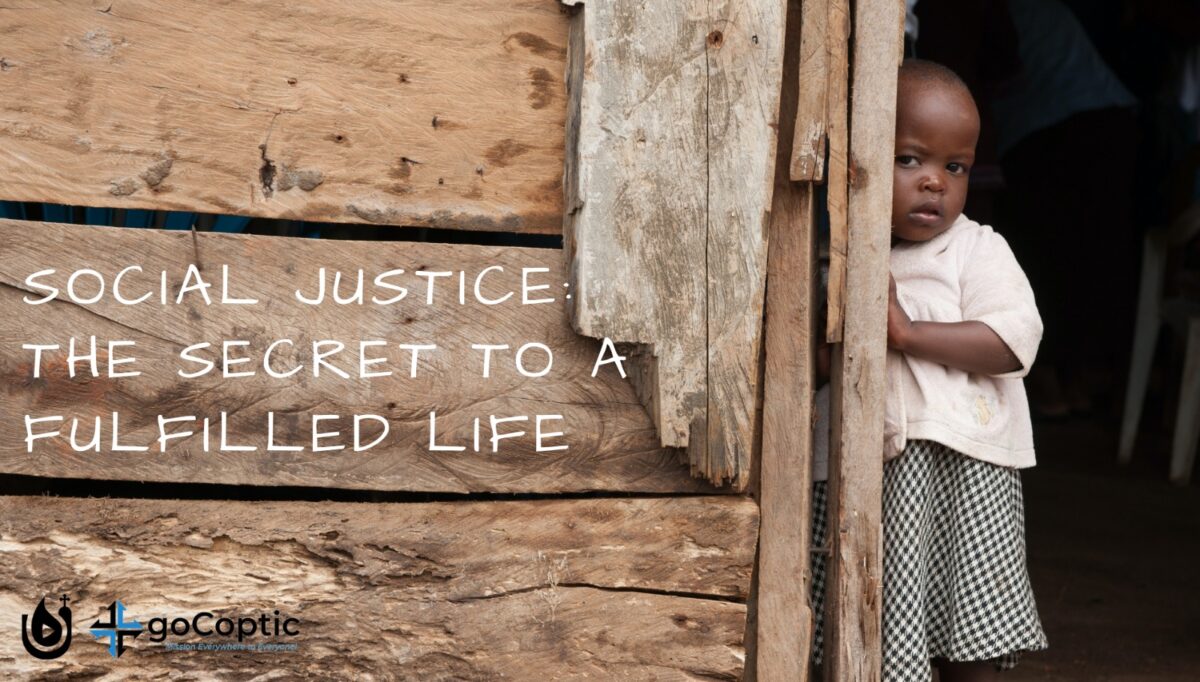
Social Justice: The Secret To A Fulfilled Life

Social Justice: The Secret To A Fulfilled Life

By Dalia Fam

Original post by goCoptic blog site (July 3, 2020)


I have discovered a secret. Throughout our 13 years living in Zambia, we have experienced many short-term mission trips from all over the world. We have witnessed many lives transformed from mission trips. But, when they go back home they lose the same passion they had in Africa. Why? Can you only have zeal for mission in Africa? NO!

Missionaries lose their zeal because, unlike their mission trip, they stop practicing social justice daily.

Social justice is a way of life. It is found in every aspect of our life – from the way we spend, to the way we teach our children, and to the way we prepare our food.

Social Justice includes if we “clothed the naked, given your bread to the hungry, door open to every stranger, been a parent to the orphan, [and] made the suffering of every helpless person your own.” – St. Basil the Great, On Social Justice

Social justice is a mission that every Christian and Church must do, not only in Africa. This blog post will discuss the biblical, patristic and modern-day examples of social justice in our Faith. We pray this inspires you to do social justice as a way of life!

Biblical Understanding of Social Justice

Justice in the Old Testament is a common theme and it forms the basis of God’s holiness. Therefore, when we participate in social justice, we partake of this holiness. The Old Testament also includes many examples, such as Elijah, of faithful men and women who defend the poor and powerless.

The ultimate example of social justice was Jesus Christ. He starts His mission proclaiming His desire to bring justice to those in need and to the oppressed (Isaiah 61:1-2). He helped the destitute, poor, and marginalized. He went out of His way to the outcast woman at the well. He sat with sinners. He taught justice in that whatever we do for the sick, imprisoned, and stranger, we do it for Him.

Even in His death, the cross of Christ reconciled all and was the essence of His declaration of justice. The apostles continued to live out Christ’s mission of social justice through healing the sick, caring for the widows, and sharing their possessions to anyone in need.

St. John taught “How does God’s love abide in anyone who has the world’s goods and sees a brother or sister in need and yet refuses help?”  – 1 John 3:17

We should follow these holy examples that lived before us to spur us into social justice action!

Patristic Understanding of Social Justice

The Early Church Fathers knew the importance of the daily spiritual practice of social justice. The closer the Fathers drew to God, the more they loved man and wanted to help those most in need. They knew social justice was not optional but a spiritual practice like praying and fasting. They knew it was the necessary path to true communion with God.  

St. Gregory of Nazianzus, wrote, “As long as there is time, let us visit Christ, serve Christ, feed Christ, clothe Christ, offer hospitality to Christ, honor Christ.”

These teachings guide us to practice social justice daily and should be a way of life.

Examples of Practicing Social Justice

Our Orthodox Church has many modern-day saints and missionaries who set an example for us by practicing social justice. In the fourth century, St. Verena, out of a cave in Switzerland, cared for the lepers. Even under Islamic oppression, Coptic Churches practiced social justice through caring for the orphans, widows, the poor, elderly, and the sick. Eastern Orthodox missionaries such as St. Stephen of Perm, defended Alaskan natives against traders and others that treated them harshly. Bishop Abraam, known as the “Friend of the Poor,” offered shelter, food, clothing and more to the poor. A Greek Orthodox archbishop defied culture and took a risk to stand with Martin Luther King Jr., during the civil rights era.     

Conclusion

The opportunities for social justice are all around us. Not only in Africa. We have to intentionally look for these opportunities. We can care for the forgotten, the outcast, the poor, the elderly, the homeless. Anyone who has no voice. You can be their voice!

For us to be in ultimate communion with God, we need to practice social justice daily! It is the secret of a fulfilled life!

Mission Assignment: Pray and find opportunities around you for practicing social justice as a way of life.

(c) Fr Abraham and Dalia Fam. goCoptic. Original blog found at-https://gocoptic.org/social-justice-the-secret-to-a-fulfilled-life/

Unspeakable Beauty

Unspeakable Beauty

By John

Original post by Becoming Fully Alive blog site (June 25, 2015)


Someone once asked St. Pachomius to tell them of a vision he saw so that they could learn from it.

He replied:

“If you see a humble man with a pure heart, that would be greater than all the visions; because through that vision, you would see the invisible God. Do not ask for a better vision.”

If seeing just one godly man can have such a profound impact on a person, then how glorious would it be to see three godly men living in unbroken communion and mutually offering their lives to Him?

Reading through 1 Samuel, I was awed to read about three such men reflecting the beauty of the Holy Trinity. They are only mentioned in two verses, and to my knowledge they are not mentioned again in the Bible:

“…three men going up to God at Bethel will meet you, one carrying three young goats, another carrying three loaves of bread, and another carrying a skin of wine. And they will greet you and give you two loaves of bread, which you shall receive from their hands.” 1 Samuel 10:3-4

Who Are They?

The first thing that is said about these men is that they are “going up to God at Bethel.”

What a beautiful verse!

How great would it be to be described by nothing else but how focused you were on pursing God? These men were not described by their relationships, their occupation, or even where they came from (which was very traditional in those times) but they were simply described by their pursuit of God.

Bethel, which means house of God, is significant because it was one of the first places where God met with His chosen people. This is actually the same place Jacob dreamed of a ladder reaching to heaven, having angels ascending and descending on it and having the Lord standing above it. (Genesis 28:12-13)

It almost sounds like these three men are on their way to climb this ladder to ‘go up to’ God.

Living in Communion

I can imagine that these men held one another accountable and encouraged each other in Him as they made this journey up to God together. They were not wise in their own eyes and knew the power of having a companion so as not to travel alone (Ecclesiastes 4:12).

Truly did the Psalmist speak of men such as these:

Behold, how good and how pleasant it is or brothers to dwell together in unity! Psalm 133:1

It also seems as though these men of faith had all things in common. Surely there was one goat and one loaf of bread for each of them rather than one man having three goats and another having three loaves of bread to himself. Each brought what they had and made up for what the other lacked.

Furthermore, they had one spirit as they did anything together; it was never one of them doing an action individually. The following phrase makes this clear: “they will greet you and give you two loaves of bread.” They didn’t live in communion with just themselves, but from their abundance they were able to provide for the for needs of those they came into contact with. They only kept for themselves what they needed.

Thinking about how these men might have greeted those in their path I can only think they were genuine, warm, and heartfelt. They were the type of people to ask you how you were and would actually care to hear your response. They were the type of men that didn’t just say “God bless you” to people without actually being a source of blessing to them (as witnessed by their free gift of bread).

Worshiping in Spirit and Truth

These men were worshiping God the way He intended them to worship Him.

It’s likely that the goats they were taking with them were intended to be sacrificed – one for each of them – as a sin offering:

“or if his sin which he has committed comes to his knowledge, he shall bring as his offering a kid of the goats, a male without blemish. And he shall lay his hand on the head of the goat, and kill it at the place where they kill the burnt offering before the Lord. It is a sin offering.” (Leviticus 4:23-24)

They were not only worshipping God in their relationship with one another, with their giving of themselves physically and emotionally to others, but they were also giving God glory by living a life of repentance.

These men remind me of Melchizedek in that they also prophetically brought bread and wine to offer to God as a prefigurement of the Eucharist. They also seem to be “without father, without mother, without genealogy, having neither beginning of days nor end of life” (Hebrews 7:3) but worship God continually.

What beautiful men!

We are all called to be like our Lord, God, Saviour, and King, Jesus Christ.

Along with that though, we are called to live in harmony and communion with one another and to be an icon of the Holy Trinity. It was the unity that these men had that made them special. Their relationship with one another was a reflection of God Himself.

These three men of faith are a beautiful example of perichoresis, which is a term used to describe how the three Persons of the Trinity are One God. Perichoresis is the divine dance of Love where there is a complete and mutual giving and receiving. It involves Persons in harmony having perfect consideration for each other.

Lord, give us to reflect Your unspeakable beauty!

(c) Becoming Fully Alive (2016) Original post – https://becomingfullyalive.com/unspeakable-beauty/

When Will It End?

When Will It End?

Adapted from a sermon by Andrew Bishara


Passage Matthew 24:3-35

The disciples were sitting on the Mount with Christ when they questioned Him… “Lord, tell us, how is the world going to end? I see now that You know all things, You know how the world works. I want You to tell me how the world is going to end. How is it going to end? What are the signals that will happen before the world ends?”

The disciples question Jesus, because like many of us, they do not want to live with uncertainty. Christ responds, “do not be troubled, have peace, but there will be tribulation, much bigger than you can imagine.”

In all of this, have peace. Despite hearing this, it would be very difficult for the disciples to hold their peace. Expect the worst is coming, but have peace. Whilst the gospel seems gloomy, it is quite applicable to many of us.

During my final year of school, I hated more than anything, the uncertainty that was coming. What mark am I going to get? What course am I going to get into? The answer is still the same, “do your best, endure and leave the rest to Me.”

What would have happened if Christ had told the disciples all that was to come? They would’ve done whatever they wanted and fixed their lives at the last moments. This sounds like a great plan for many. We wouldn’t need to worry our entire lives. I can set an alarm for an hour before, and I’ll be fine.

But imagine what would be lost along the way! If I live as if I have all the time in the world, I will surely live to regret the time I wasted.

If Christ gave the disciples that time and they wasted their entire lives up until the last hour, then would they have gained enough virtue, enough wisdom, enough understanding to then enter the kingdom of Heaven?

Many more would be lost if we all knew when the world is ending. Moreover, if I am constantly seeking anxiously when the end will come, I will be unable to sustain virtue along the way.

Christ is telling us to do our best and endure and leave the rest to Him. This applies to every aspect of our lives. It is not uncertainty. He does not present the signs so that we can go out looking for them. These are more or less, natural events that should not matter to us, for as long as we do our due diligence.

All that matters is that I endure, I need to stay close to Christ. I know that I will get the promise at the end of the gospel.

Do not be troubled, no matter where you are in life compared to where you think you should be, it is all part of the plan.

He will send His angels with a great sound of a trumpet, and they will gather together His elect from the four winds, from one end of heaven to the other

Matthew 24:31.

If I endure, if I do my best, the angels are coming with the sound of trumpet to deliver me from all my troubles.

We need to keep pushing until we hear the joyous sound of the trumpet.

Full sermon

Fight the Good Fight

Prayer

“The Holy Spirit still speaks in each one of us! The Spirit teaches you how to conduct yourself, how to shake off burdens of your past, how to battle against giants, how to lift up your arms like Moses to defect the enemy; and God will straightway fight for you. I have hope in Jesus Christ that He will render these words useful to you that we might together be able to cross the great chasm that separates the life according to the flesh from the life according to the spirit. I pray that we might pass form authority and pull off the fleshly desires to submit to the tug of the Holy Spirit. And I pray that we might be filled with power and grace and all the gifts that are given us by Christ. Grant us, O Lord, to be victorious by You and to live for You. Amen”

– Extract from “Words For Our Time – The spiritual words of Matthew the Poor”